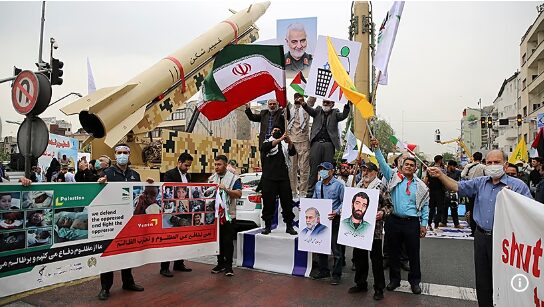
Cheap, precise and deadly: Iran’s best missiles pose a challenge to the US military.
Kheibar Shekan ballistic missiles use a combination of trajectories, manoeuvres and speeds to confuse air defences and reach their targets.
The missiles can be kept ready and launched rapidly from vehicles. This increases the possibility of evading American and Israeli fighter aircraft, writes the Wall Street Journal.
Iran uses Kheibar Shekan missiles in attacks on American bases in the region. Although most of the missiles are shot down in the air, some penetrate the defensive lines and cause problems.
Last week, two American soldiers were killed at a military base in Jordan when three missiles succeeded in getting past American air defences.
In some variants of the missile, the nose section – which carries the explosive warhead and separates during the final phase of flight – is equipped with a small motor that enables it to adjust its direction as it approaches the target at a speed of 6,000 miles per hour, according to analysts and officials.
That corresponds to a speed of around 9,600 km/h. The missiles have a range of 1,450 kilometres.
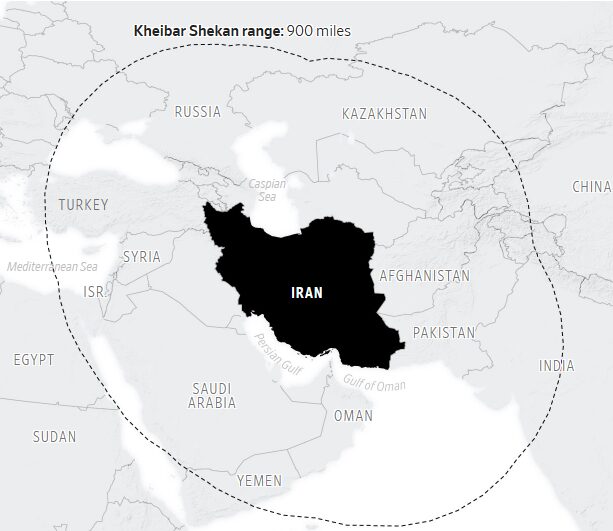
The Kheibar Shekan can vary its trajectory more than any other ballistic missile. This makes it more difficult to detect and destroy.
Iran also launches high-speed attack drones and less sophisticated missiles at the same targets, thereby adapting its tactics, according to American officials.
Iran has repeatedly attacked bases where American soldiers are stationed throughout the Middle East. Iran is also targeting the radars that form the basis of air defence across the region. Weakened air defences expose American soldiers to greater danger.
Although these missiles are causing certain problems for the American forces of US Central Command (CENTCOM), the United States still has almost complete control of the airspace, even directly over Iranian territory.
“I think what this tells us is that Iran is paying close attention, that they are learning and that they are looking for ways in which they can attack us,” said retired Army General Joseph Votel, former commander of CENTCOM.
“This is a military force that has a well-developed drone capability and that has long had both a missile programme and a rocket programme. They possess considerable expertise in this field.”
Before the war broke out, the Pentagon and the Israel Defense Forces assumed that Iran possessed 2,500 Kheibar Shekan missiles and other medium-range missiles.
“The Iranians realised, in a sense, during the war that the Kheibar Shekan missiles are excellent, because they are relatively cheap to produce, provide flexibility in terms of launch systems and are quite effective,” said Nicole Grajewski, an expert on Iranian strategy at Sciences Po in Paris.
Today, Breitbart News reports that US President Donald Trump is refraining from a planned major escalation against Iran after the Pentagon warned that air-defence stockpiles in the Middle East had been depleted.
The decision was taken following a meeting at the White House on Friday, at which Trump and his senior national-security advisers considered whether to escalate operations against Iran significantly after almost two weeks of sustained American attacks.