

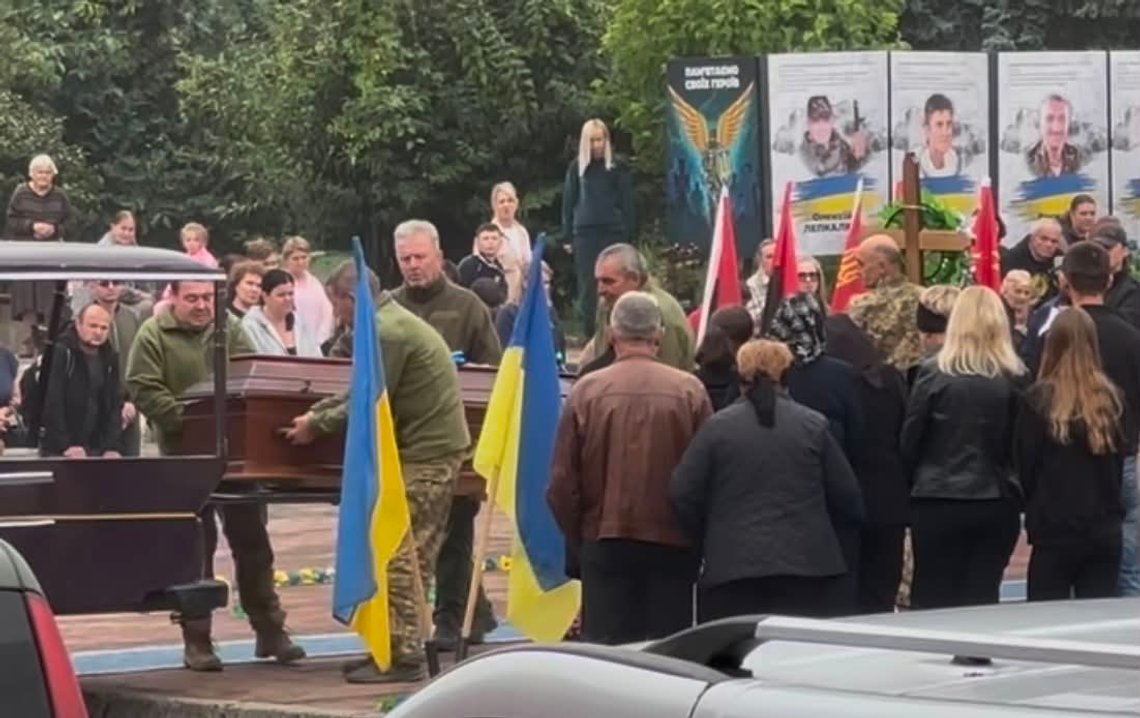


The struggle to recruit soldiers in Ukraine is turning violent. This is reported by the BBC.
Vasyl Krupych knows what it means to fight for Ukraine.
He describes frightening scenes from the fighting in the eastern Donbas region, where he – sometimes praying, at other times crying – somehow survived the assault by Russian troops while serving as a machine-gunner.
But in December last year, while serving behind the lines, Krupych was attacked by his own compatriots while searching for conscripts evading service.
He says that two men ignored the demand to produce their documents and ran away. When his patrol pursued them, Krupych was severely beaten with a crowbar. He subsequently spent six weeks in hospital.
‘He broke one of my ribs, and I lay there unable to breathe,’ the veteran said in a recent interview. ‘What did we fight for, if soldiers can now be beaten up?’
Ukraine’s military ombudswoman says that such attacks are now ‘common’ and ‘a major problem’, as the country struggles to mobilise men to fight in the fifth, exhausting year of Russia’s invasion.
It is not a subject people here care to discuss much, for fear of fuelling Russian propaganda.
But the latest report from the national police shows that more than 600 assaults on recruitment officers have so far been recorded, and warns that the aggression has become ‘increasingly threatening’.
The first major alarm came in April, when several recruiters were stabbed, one of whom died. Earlier this month, in Lviv, around 200 protesters surrounded officers attempting to detain a suspected conscript, and smashed and overturned their car.
The unrest made the front pages after President Volodymyr Zelenskyy condemned violence against serving soldiers.
His controversial decision since then to dismiss Defence Minister Mykhailo Fedorov – because of differences in personality and vision with Ukraine’s commander-in-chief – means that efforts to resolve the conscription crisis will stall.
But the anger that has just erupted in Lviv suggests that the need is urgent.
The reasons appear to range from sheer fear of serving on the front line – by now everyone knows someone who has been injured or killed – to a reluctance to enlist in a war to which no imminent end is in sight.
The only wave of enthusiasm since the initial rush to the front came in late 2023, when Ukraine launched a counter-offensive to retake territory in the south-east. It did not last long.
That was when the phase of ‘brutal mobilisation’ began, according to opposition MP Oleksandr Honcharenko.
He blames the backlash on this.
‘These officers hunt people in the streets and sometimes use quite violent methods,’ the MP says.
‘Violence breeds violence. It is a huge problem, and it is going to get worse.’
Military analyst Ivan Stupak agrees.
‘We began to suffer from shortages of personnel on the battlefield, constant losses,’ he recalls. ‘Ukraine’s high command had to replace those losses, so they launched busification’, the term Ukrainians use for mobile patrols that end with men being rounded up in buses and sent away to serve.
‘When they need an additional 5,000 personnel, they start bringing them in – and if people refuse, it ends in fights in the street.’
Thus, for every story of a conscription officer being attacked, there are accounts of violence committed by the recruiters themselves.
Ukraine’s human rights commissioner recorded more than 6,000 such complaints last year – twice as many as in 2024. These include allegations of abuse and unlawful deprivation of liberty, as well as poor conditions at recruitment centres.
Kyrylo Ogdansky still becomes upset when he speaks about what happened to him in Dnipro in November last year.
The university professor, who is exempt from conscription, was stopped in the street by a man in civilian clothes who wanted to check his mobilisation status.
There are rules governing such patrols, including that police officers must be present, so Ogdansky protested.
He was then assaulted.
‘One of them knocked the phone out of my hand, and two pushed me into the bus from behind. When I asked what was going to happen, one of them began hitting me in the head. He struck me several times on the nose,’ Ogdansky says.
He remembers the threat that he would be sent straight to the front line. ‘He said: “I can call the commander, and then you’ll be sent to Pokrovsk.”’
Instead, the professor spent two weeks in hospital with a suspected neck injury and large purple-black bruises beneath his eyes.
It is clear that Vasyl Krupych experienced horrors in the war.
He volunteered from the very beginning and has survived some of the most brutal battles.
Krupych is proud of his service – a tattoo on his neck reads ‘Glory to the Armed Forces of Ukraine’. But he is plagued by nightmares.
When his vehicle was struck by an FPV drone, he was seriously injured, but managed to drag a friend to safety. He saw two others burn to death.
‘We are doing our duty. We fought, we defended our people – and now they are attacking us.’
What does he think could motivate people to serve, rather than force them? He mentions higher pay. But then he shrugs.
‘It cannot be done differently, it is not possible. Our boys must be replaced. But no one volunteers,’ he tells the BBC. ‘Everyone is afraid of dying.’
During his six months as defence minister, Mykhailo Fedorov began introducing reforms to address the growing crisis.
He started with measures intended to make military service more attractive, in the form of fixed-term contracts for new recruits, with the possibility of deferring further service, and better pay, especially for the most dangerous tasks.
But it was still preliminary work in progress, and a comprehensive reform of conscription remained on his to-do list when he was removed.
The proposals have included transferring conscription patrols to the police, who are less personally invested in the task. There is also discussion of proper training for officers, as well as psychological screening.
Ukraine openly acknowledges that the country has a problem, which is new.
The country now has only an acting defence minister, but still no solution.
It should be mentioned that, after more than four years of war, a certain war-weariness can also be detected in Russia.
Russians are returning to cash, as disruptions to mobile internet interfere with card payments, while more businesses are attempting to avoid tax amid growing economic pressure more than four years into the war with Ukraine.
Russia has put 1.56 trillion roubles ($20 billion) in cash into circulation since the turn of the year – the largest increase for the equivalent period of any year outside the Covid-19 period, according to central bank figures analysed by the BBC.
The increase comes amid a wave of Ukrainian drone attacks that have repeatedly prompted the Kremlin to shut down mobile networks across large parts of the country, leaving many people unable to pay by card. The government says that the purpose of the disruptions is to counter the drone attacks.
‘Having cash available gives you a certain sense of control and security,’ a woman in Moscow told the BBC on condition of anonymity. ‘If an emergency arises in the city, I know that I will still be able to buy the essentials, even if the mobile network goes down.’


