

Day 2: Lviv
1. August. On the overnight coach to Lviv was Veronika, a medical student who, by virtue of her studies, already holds the rank of Junior Lieutenant in the Ukrainian Armed Forces. She is twenty-two years old and grew up camping; she enjoys pitching a tent alone in the wilderness for days at a time. Now she is returning to her home town in central Ukraine.
Her father was conscripted into the army a month ago, and she is, naturally, deeply concerned for him. She knows only that he is stationed somewhere in the south-east of the country. He is permitted to telephone her for only a few minutes once a week. By coincidence, he calls at the very moment she mentions him. Their conversation is brief: he asks whether she is well; she reassures him that she is, then asks the same of him.
She quickly regains her composure and explains that every call follows the same pattern. Only after he has completed his weekly round of calls to the rest of the family do they compare notes and piece together whatever fragments of new information each has managed to glean.
Veronika suggests taking the tram into the centre of Lviv, to the Town Hall, where a ceremony is to be held in memory of eight soldiers from the city who have fallen in the war. Similar ceremonies take place across Ukraine, each with its own local traditions and variations.
Rynok Square
We take our seats outside the Grand Café Leopolis, overlooking the historic buildings that line Rynok Square, home to both the Town Hall and the church where the memorial ceremony is already under way. Outside, soldiers rehearse their marching drill.
A convoy of police cars pulls up outside, followed by ambulances carrying the coffins of the eight fallen soldiers onwards to their funerals. Bringing up the rear are coaches carrying the bereaved families.
Outside the Town Hall, the municipal staff have assembled in neat rows to pay tribute to the fallen heroes. In Ukraine, the word “hero” is reserved for soldiers who have fallen in defence of their country.
Then, from high in the Town Hall’s clock tower, a lone trumpet suddenly sounds a mournful solo. Every pedestrian comes to a halt, remaining motionless until the final note fades away.
For almost every Ukrainian family, the moment is deeply personal. Nearly everyone knows someone serving at the front, and someone who has been killed. As the coffins pass by, several people in the crowd sink to one knee, while many others are openly weeping.
Veronika is among them. Once she has composed herself, our conversation turns to Russia and the way it has expanded throughout history by absorbing the territories of its neighbours. She believes that many Russians still think in imperial terms—of spheres of influence and national prestige—and that, whether their government acts rightly or wrongly, “Mother Russia” always comes first, much as nationalism once did in the Ottoman Empire or Nazi Germany.
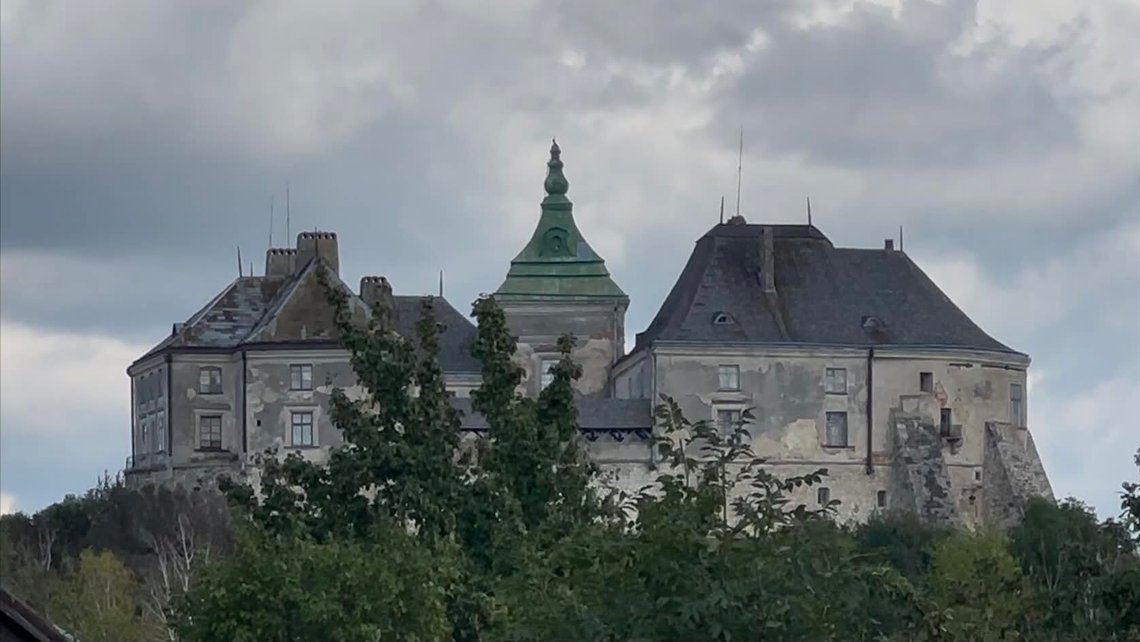
Olesko Castle
Veronika leaves for the railway station. I set off for Olesko, an hour’s drive to the east, the legendary setting of the Norwegian 1930s crime bestseller The Ride from Olesko, written by Max Mauser—the pseudonym of the altogether more sinister Jonas Lie.
Jonas Lie was the grandson of his namesake, one of the “Four Greats” of Norwegian literary realism. The younger Lie, however, became the feared Chief of Police under the Nazi occupation of Norway.
By far the most famous resident of Olesko Castle was Jan III Sobieski, the Polish king celebrated for his victory at the 1683 Battle of Vienna.
Kryivka
Lviv is renowned for its nightlife, cuisine and rich history. All three come together at Kryivka, a themed restaurant modelled on the clandestine bunkers (kryivky) used by the Ukrainian nationalist guerrilla movement that fought first against Nazi German and Soviet forces during the Second World War, before waging a prolonged insurgency against Soviet rule until the early 1950s. Isolated holdouts continued the armed struggle until 1960. Some families lost every male member, despite the precaution of keeping the youngest brother from joining the partisans.
To gain entry to Kryivka, visitors are challenged by a uniformed “partisan”, who demands the response “Heroiam slava!” (“Glory to the heroes!”) before ushering them into an extensive recreation of the concealed forest bunkers, complete with weapons, uniforms, wartime memorabilia—both from the wartime insurgency and today’s conflict—and even a small shooting range. The most popular target is—you guessed it!
Up Next:
Tomorrow, Ukrainian Railways leaves for Kyiv. The capital has been hit hard in recent days, yet the weekend promises glorious weather and temperatures above 35°C. Shelter is likely to be sought more often from the sun than from Russian missiles.


