

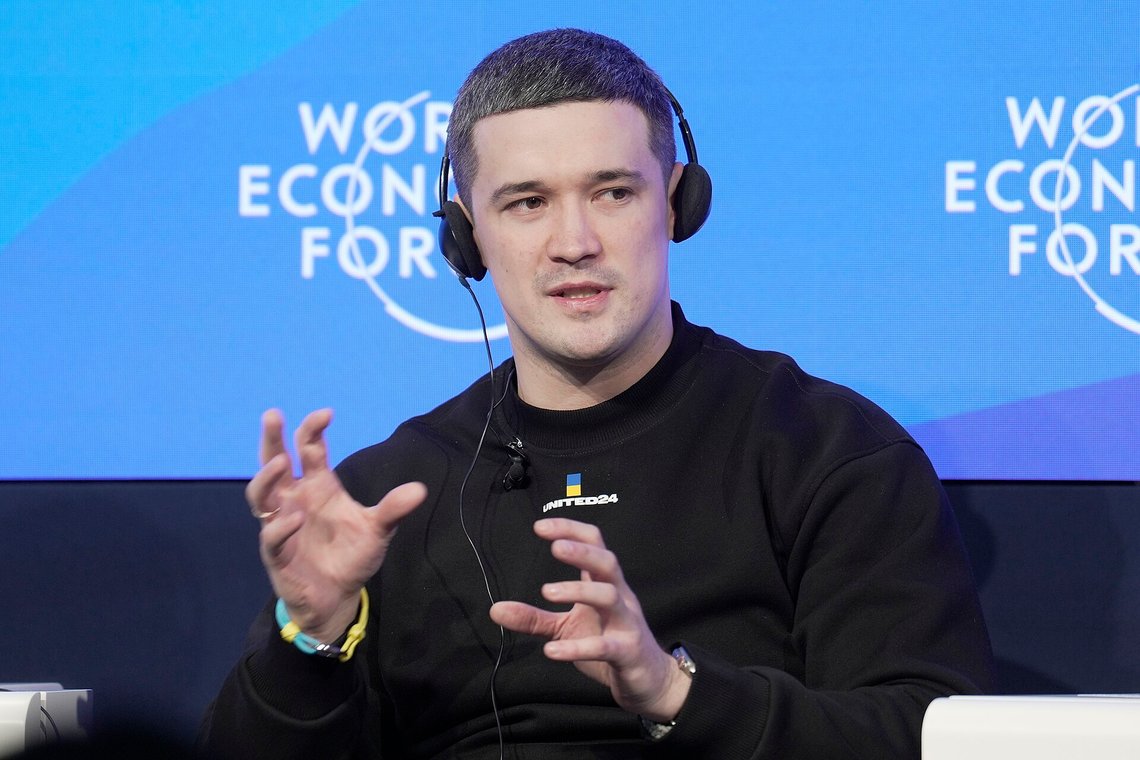
The Ukrainian Defence Minister Mykhailo Fedorov (35) has revolutionised drone warfare. He allows the drones themselves to decide whom they will kill. The goal is to reach the Russians’ pain threshold. If enough are killed, Russia will throw in the towel. Fedorov is cooperating with Alex Karp, head of the American security company Palantir. Together they have revolutionised warfare, but military professionals are sceptical.
Fedorov’s expertise was digital advertising. Tech people are technologising warfare, and this is leading to a brutalisation. Military professionals have reservations that tech experts do not. What is new is that Fedorov and Karp are allowing the drones to become fully autonomous. They themselves choose whom they will kill. It is a new step in drone warfare, in warfare as such. That was the boundary people previously warned against.
Another group that is sceptical is human-rights experts: If the drones themselves can decide whom they kill, we are speaking of an entirely new type of war. Here we are slipping directly into the kind of war that was previously held up as a nightmare scenario.
The New York Times is pro-Ukraine, but apprehensive:
Who is Mykhailo Fedorov? He is the man President Volodymyr Zelensky appointed four months ago to lead the Defence Ministry, in order to help implement a strategy that essentially consists of killing so many Russian soldiers that Moscow cannot recruit enough to continue fighting. (The aim is to increase Russian casualty figures from 35,000 killed and wounded per month to more than 50,000.)
To achieve this goal, Fedorov is pushing for the introduction of autonomous drones capable of independently deciding to use lethal force.
A good quote: “Autonomous weapons are the new nuclear weapons. Countries that possess them will be protected.”
Who likes the sound of this? Technology companies connected to the defence industry.
Fedorov, who comes from a background in digital advertising, has become Ukraine’s point of contact with Silicon Valley, promoting the war as a testing ground for defence technologies. He is collaborating with Alex Karp, chief executive officer of the defence-oriented data analytics company Palantir, in order to integrate artificial intelligence into Ukraine’s military. Fedorov has also met Eric Schmidt, a former chief executive officer of Google who founded a venture fund, D3, focused on weapons development in Ukraine.
Fedorov is also leading an initiative to monetise or trade Ukrainian military data, including a library of more than five million annotated battlefield videos filmed by surveillance and attack drones. These include footage showing how people behave when killer drones approach, such as running or hiding. Last month Ukraine opened the datasets to companies from allied nations: If they share their AI models with Ukraine, they can gain access to Ukraine’s data.
 FILE – In this Wednesday, May 15, 2019, file photo, Palantir CEO Alex Karp arrives for the Tech for Good summit in Paris. (AP Photo/Thibault Camus, File)
This image is from the period when Alex Karp cultivated a mad-scientist look. Today he is more business-like. Clever tech boys are often nerdy and possess tunnel vision. But war provides opportunities for them. What is new here is the use of metadata, the enormous database containing everything the drones have filmed during attacks. With the help of AI, the drones can be developed to become even more lethal. If they themselves are to determine the targets, we are moving towards a limitless war. It was previously considered inhuman for robots to wage war. Now we are there.
The Fedorov/Karp duo is successful. Recently Ukraine has proven far more effective in attacks inside Russia. Western leaders do not wish to lose the war. They have invested so much prestige in “beating” the Russians and are willing to go far in order to achieve it.
Andrew Kramer in the NYT has written the profile of Fedorov and calls it:
Enter the Killer Robots: The Ukrainian Forging the Future of Warfare
His interest in technology began with the video games he played as a teenager in the steel city of Zaporizhzhia. He turned his hobby into a technology career, founding a digital advertising company before he had finished his studies, and became a partner with Facebook in the sale of targeted advertisements on the platform.
Military professionals are educated in warfare. They learn something about the consequences of military choices throughout history. Tech-savvy people think differently. They see drones roughly as the introduction of Uber.
In the same way that apps have revolutionised taxi services and food delivery, Fedorov believes warfare is ripe for disruption. This entails, he says, leaving combat as far as possible to machines — including, one day, those capable of making lethal decisions on their own.
“The world needs security, and only autonomous weapons can ensure it,” Fedorov said in an interview in his office at the Defence Ministry. “Autonomous weapons are the new nuclear weapons. Countries that possess them will be protected.”
The combination of AI and the absence of human morality opens the door to a new reality. Words such as security acquire a new meaning. We do not ask about the price of this security.
Tech nerds have a different relationship to their surroundings.
Zelensky hired Fedorov to run social-media advertising for his presidential campaign in 2019, and then appointed him, at the age of 28, to lead the ministry responsible for the digitalisation of public services.
When Fedorov, who has never served in the military, moved to the Defence Ministry in January this year, he brought with him a team of advisers and data analysts. Most of them are young men and women, and they stand out by coming to work in tracksuit bottoms. Fedorov installed a table-tennis table in one of the corridors.
With a media corps on their side, there are no objections, no debate. The character of war is changing without people understanding anything about it.
The same media that have criticised Israel’s conduct of war to pieces have no scruples whatsoever when it comes to Ukraine. There everything is permitted.
Ukraine has changed the European elite.
On Politisk kvarter (Norway’s flagship daily political debate program on NRK radio), Raymond Johansen (ex-Labour Governing Mayor of Oslo) from the NGO Norwegian People’s Aid warned against Norway agreeing to the French initiative concerning the deployment of French aircraft armed with nuclear weapons. It would dramatically escalate our risk in a crisis situation. France wishes to spread the risk. It is harder for the Russians to strike back if the threat is spread across a large geographical area. Norway would thereby shoot upwards on the scale of selected targets due to our proximity to Russia, Johansen warned.
But Ine Eriksen Søreide, leader of the Conservative Party, expressed sympathy for Macron’s initiative. In a situation where America is withdrawing, someone must fill the vacuum.
Once again, a tactical manoeuvre intended to fill a strategic vacuum is being presented as inevitable.
Another step on the road towards great war.


