

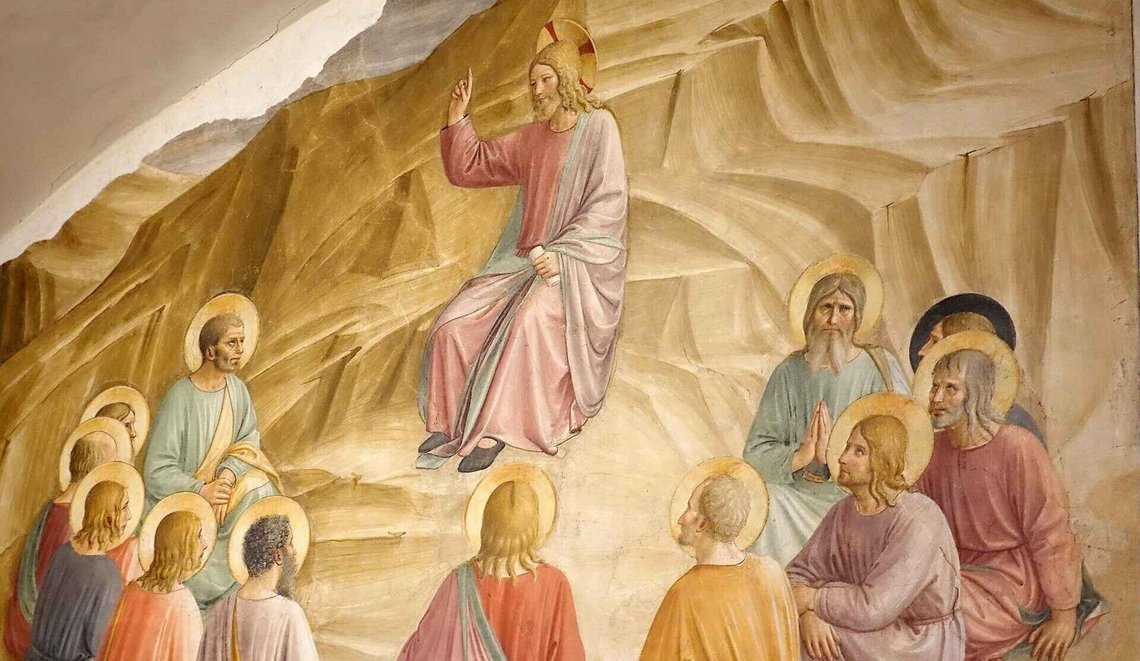


38 «You have heard that it was said, ‘Eye for eye, and tooth for tooth.’ 39 But I tell you, do not resist an evil person. If anyone strikes you on the right cheek, turn to him the other also. 40 And if anyone wants to sue you and take your shirt, let him have your cloak as well. 41 If anyone forces you to go one mile, go with him two miles. 42 Give to the one who asks you, and do not turn away from the one who wants to borrow from you.
43 You have heard that it was said, ‘Love your neighbour and hate your enemy.’ 44 But I tell you: Love your enemies, ⸆ and pray for those who ⸆ persecute you. 45 In this way you may be children of your Father in heaven. For he causes his sun to rise on the evil and the good and sends rain on the righteous and the unrighteous. 46 If you love those who love you, what reward is there for you? Do not even the tax collectors do the same? 47 And if you greet only your own people warmly, what is extraordinary about that? Do not the nations do the same? 48 Be perfect, therefore, as your heavenly Father is perfect.»
Matthew 5:38–48
This summer, like many others, I have seen the film «The Odyssey», but I have also had the opportunity to read the book «The Egyptian» by the Finnish author Mika Waltari.
Waltari takes us to roughly the same period as «The Odyssey», but something jarred when I watched the film (which I nevertheless recommend). I encountered a different moral reality in the book «The Egyptian» from the one I encountered in the film. And although Waltari’s book is a novel, it is highly credible.
Those who read Waltari encounter people who lived in a world where morality, power, violence, sexuality, religion and human life function within a pre-Christian horizon, and it struck me how much power, revenge, deception, sexual abuse and violence can be part of our normal existence without people necessarily experiencing it as a fundamental moral problem.
That does not mean that people in antiquity lacked a conscience. They could experience strong feelings of guilt, loyalty, shame, honour and religious fear. But the moral frame of reference itself was different from the one Jesus Christ introduced. Jesus gives morality a new centre, a new point of departure. He showed us that human dignity requires a spiritual revelation.
Christopher Nolan’s «The Odyssey» has been criticised for modernising the Homeric universe. He gives Odysseus a conscience that is far less characteristic of the Homeric universe.
The film tones down much of the brutality found in Homer’s time and in antiquity generally: torture, sacrifice, mutilation, revenge and the almost self-evident satisfaction of taking revenge.
Homer does not tell us of a world in which evil is absent. Quite the contrary. But it is a different moral order from the one with which Nolan and modern man are familiar. In antiquity, honour, loyalty and retribution carried far greater weight than universal love for the other. It is an order we recognise in certain honour cultures, but we do not like to talk about it openly.
Odysseus can, for example, plunder a city, kill the men and take the women as spoils of war. This is not necessarily presented as an existential moral collapse on his part. It is part of the logic of war.
For me, «The Odyssey» confirmed how difficult it is for us to imagine a moral world that is not already permeated by Christian categories. It is as though we believe we can disregard Jesus Christ and still retain the fruits of his sacrifice.
Tom Holland, author of «Dominion» (2019), is concerned with Christianity’s significance for our understanding of morality. He believes that modern man thinks our moral ideals are universal and self-evident. But he says that many of them are, historically speaking, highly distinctive, and that they have been shaped by Christianity.
Holland says quite explicitly that what makes us modern – including our conception of human dignity, care for the weak, equality and the moral condemnation of abuses of power – is largely a result of the Christian revolution.
What is interesting is that Holland arrived at this view while working on antiquity. He then discovered that the values of the ancient Greeks and Romans gradually began to seem alien and disturbing to him. Among other things, he reacted to crucifixion, a method of execution designed to inflict the greatest possible suffering on the condemned person. And he reacted particularly to antiquity’s lack of an understanding that the weak and the poor possessed intrinsic worth.
It is as though Jesus is commenting on this understanding when he says, «If you love those who love you, what reward is there for you?»
Most people do that, after all, but Jesus introduces an entirely different standard, namely that our love should not depend on the recipient’s merit.
If love is given only to those who deserve it, it is really only reciprocity.
It is only when love is also given to someone who does not deserve it that it begins to resemble God’s love. And then Jesus concludes with a demand that may seem impossible when he says: «Be perfect, therefore, as your heavenly Father is perfect.»
We may wonder how Jesus can demand such a thing. But here we are actually closer to Christianity than many realise, for as C.S. Lewis writes in the book «Mere Christianity»: Jesus has nothing else to offer but perfection, perfect love, and Jesus has one goal: to make us all perfect, a process that begins in the encounter with him himself.
It was precisely this love that once gave the world a new direction. Our morality is not the result of a linear ethical evolution. Belief in that is a myth. Rather, it is historically and religiously conditioned.
Modern man still lives on a moral inheritance that he no longer always recognises as Christian, and therefore we are also in danger of losing it.


