

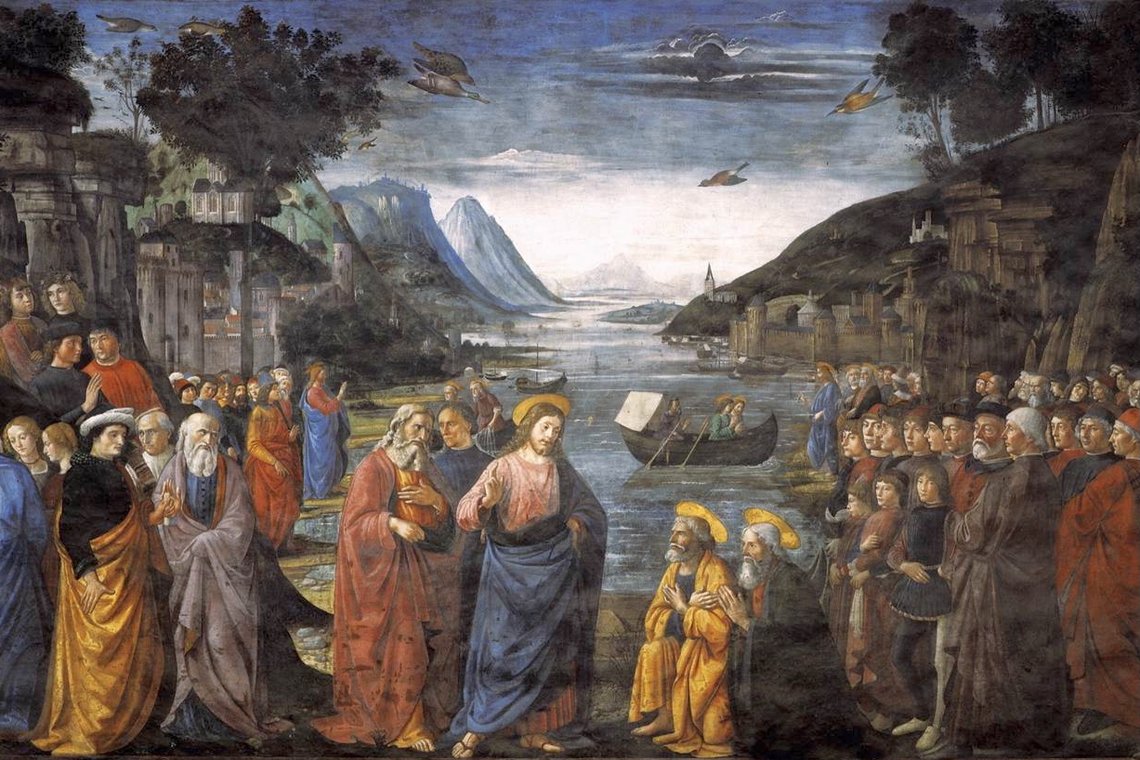


16 Then the eleven disciples went to Galilee, to the mountain where Jesus had told them he would meet them. 17 And when they saw him, they worshipped him; but some doubted. 18 Then Jesus came to them and said, “All authority in heaven and on earth has been given to me. 19 Therefore go and make disciples of all nations, baptising them in the name of the Father and of the Son and of the Holy Spirit, 20 and teaching them to obey everything I have commanded you. And surely I am with you always, to the very end of the age.”
Matthew 28:16–20
It never takes long before someone in Norway problematises Christianity’s positive significance for our culture and the freedom that characterises the Christian cultural sphere.
The latest is Egon Holstad, editor and commentator at the newspaper iTromsø, who in a commentary in VG is given the opportunity to beat the drum in earnest. In his text, he attacks the Christian Democratic Party (KrF) and the leader of the Christian Democratic Youth Party (KrFU), Ingrid Olina Hovland, for their claims regarding the positive effect of the Christian faith on society’s culture and morality.
Egon Holstad maintains that religion is a private matter, and that the individual’s choice should be respected by others. He believes that religion then becomes entirely unproblematic for all involved and uninvolved parties.
There is not room for a full review of our history over the past thousand years in a Sunday reflection such as this, but today’s biblical text gives us an opportunity to reflect somewhat on the claims made by the editor from the north. It is particularly the claim that religion is a private matter that should give us pause. For this view is shared by an increasing number of people, including leading politicians. Such as Prime Minister Jonas Gahr Støre, who some years ago claimed that it is a strength of our democracy that we have washed religion out of politics.
This desire for politics without religion is, however, problematic. It is easy to hear the difference between those who argue from faith in the God of Christianity and those who argue from the atheism of naturalism when, for example, abortion is the topic. Yet their point of departure is in principle the same, namely a belief. They all bring a belief with them, and belief creates opinions.
But let us return to today’s text, the Great Commission (misjonsbefalingen): Notice that Jesus instructs his disciples to teach all who come to faith to observe what he has commanded them. And the foundation of this message is unequivocal: God’s love for humanity.
In the New Testament, Jesus himself repeatedly points to the commandment of love as the greatest and most fundamental commandment. In the Gospel according to Matthew it is written:
“Love the Lord your God with all your heart … and your neighbour as yourself.”
Jesus says that “all the Law and the Prophets hang on these two commandments”.
At the same time, Jesus gives the disciples a “new commandment” in the Gospel of John:
“Love one another. As I have loved you, so you must love one another.”
What is revolutionary is not merely that one should love, but that love itself should take Christ as its measure – that is, a self-sacrificial love.
But if one looks at the Great Commission itself, it is also clear that Jesus meant something more than a general ethic. The disciples were to:
make people disciples,
baptise them,
teach them to observe Jesus’ words,
proclaim the Gospel of the Kingdom of God,
and bear witness to him as Lord.
Jesus’ proclamation that “So in everything, do to others what you would have them do to you” gave our encounters with other people a new ethic and new purposes.
In light of Jesus’ farewell words, there is every reason to challenge the claim that religion is a private matter. For religion concerns far more than what can be defined as a private matter. A religion that proclaims a commandment of love such as that conveyed by Jesus, and which moreover places equal value on women and men, will produce different legislation from a religion that does not. To say that a religion should not influence public arrangements is therefore dangerously naïve. Religions shape everyone’s understanding of good law, just as ideological convictions do.
Faith influences the lawgiver, and law shapes society, and we rarely see this more clearly than as we now enter the month of June.
The month of June has become Pride Month, during which schools and other organisations hold various events to demonstrate that they welcome diversity and inclusion. It is a secular version of the Great Commission that we are witnessing. The liberals of the West have agreed that all nations should bow before queer ideology and become its disciples. In schools, pupils are taught what it means to observe what this ideology commands, namely that truth is an enemy of our freedom.
The queer revolution rests just as much upon faith as a priest’s sermon in church. To believe that we can all determine our own sex, that men can have vaginas and give birth to children, requires a conviction that must draw its nourishment from the spiritual realm. But unlike the Christian faith, the new religion also requires us to combat reason, and it must therefore criminalise its opponents. The queer theory of postmodernism has become our state-bearing faith and the normative foundation of society, but unlike Christianity it cannot tolerate opposition.
We all believe in something. As Christians, we believe in the God of truth, and that it is there that freedom is to be found. A demand to exclude Christianity from political life in reality entails the abolition of democracy and the introduction of absolutism. That is not God’s will for our lives.


