

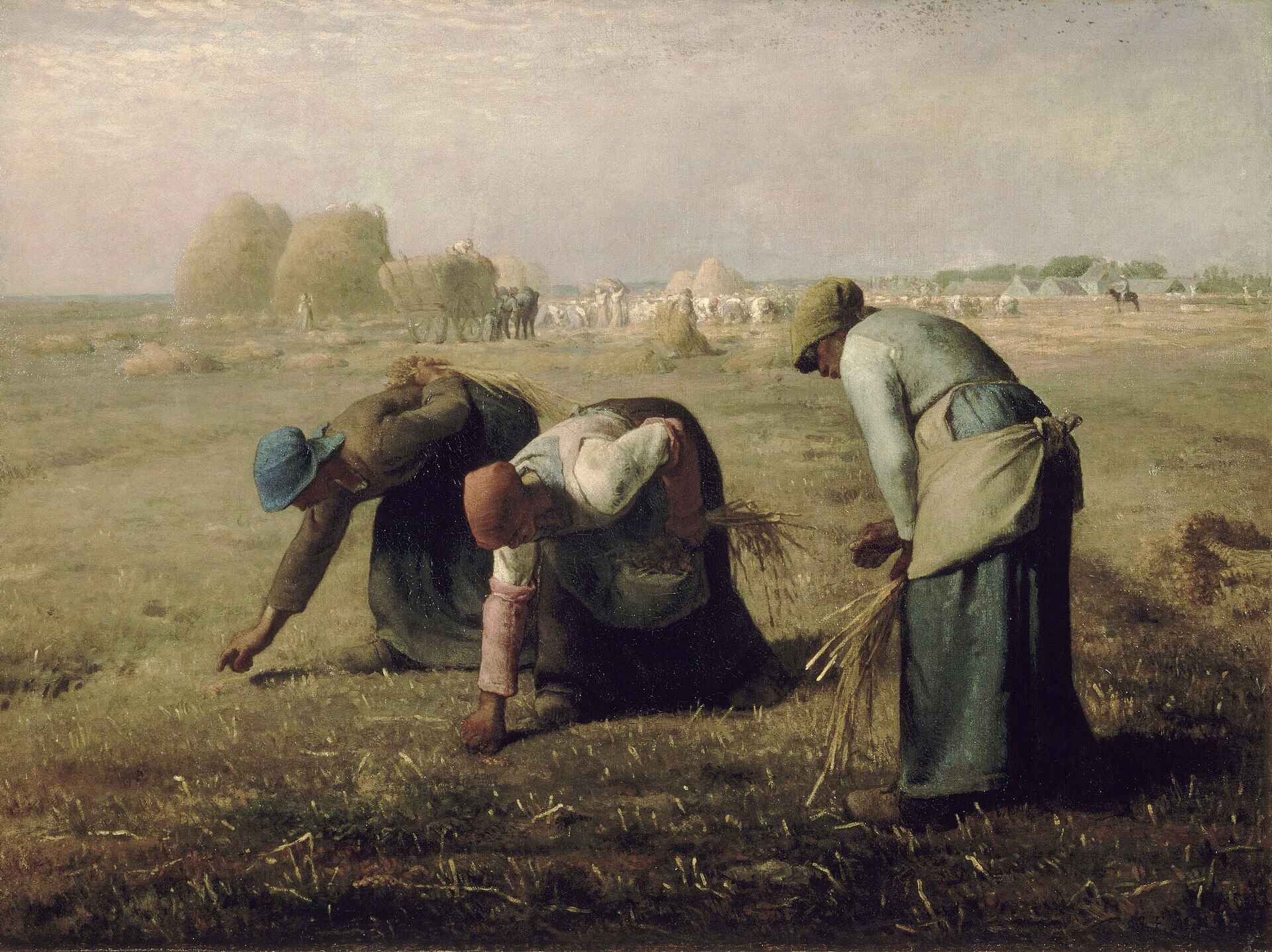
 Jean-François Millet (1814–1875), “The Gleaners”, Musée d’Orsay, Paris.
16 And we have come to know the love that God has for us, and we have believed in it. God is love, and the one who abides in love abides in God, and God in him.
17 In this, love has been made perfect among us: that we may have boldness on the day of judgement. For as Christ is, so are we in this world. 18 In love there is no fear: perfect love casts out fear. For fear bears punishment within it, and the one who fears has not been made perfect in love. 19 We love because he loved us first. 20 The one who says, “I love God”, yet hates his brother, is a liar. For the one who does not love his brother whom he has seen cannot love God whom he has not seen. 21 And this is the commandment we have from him: the one who loves God must also love his brother.
The First Epistle of John 4:16–21
Although we have now reached 3 May, I choose to dwell on one of the texts that was selected as the reading for 1 May. For what would the worker have been without God and His care for mankind?
The ideologues of the labour movement, such as Karl Marx, were highly critical of the Christian faith. They believed that faith made workers lethargic and indulgent, incapable of fighting for what they considered to be the rights of workers.
The question that never received a proper answer was how atheism could provide a moral foundation for the idea of justice. The idea of injustice and equality are, namely, spiritual questions that are difficult to resolve within the cold mathematics of materialism.
For if the origin of man is the result of a cosmic coincidence, it is not easy to argue for fair wages and social rights. In such a world, power prevails, and that was indeed the norm in pre-Christian times. At that time, it was only the Jews who knew the law of God.
When we know what was the norm in ancient cultures, it is extraordinarily interesting to read the texts of the Bible with regard to what rights working people were to have, and how these rights were defended.
The Books of Moses, for example, contain several concrete laws on how workers, servants, foreign workers and day labourers are to be treated. This concerns in particular fair wages, rest, dignity and protection against exploitation.
In Leviticus 19:13 we may read the following:
You shall not keep back the wages of a hired worker overnight until morning.
The employer was thus not to delay payment or exploit the worker’s dependency.
In Deuteronomy 24:14–15, the matter concerns oppression:
You shall not oppress a poor and needy hired worker … on the same day you shall give him his wages before the sun sets.
But one of the most striking matters concerns the day of rest, that is, the right to rest, also for workers.
In Exodus 20:10, the day of rest is mentioned in one of the Ten Commandments:
… On it you shall not do any work, neither you, nor your son or your daughter, your male servant or female servant, nor your livestock, nor the foreigner residing in your towns.
In all ancient societies apart from the Jewish, workers were subordinate to the needs of the ruler. Slaves and servants were productive forces. That a law states that servants, foreigners and draught animals are also to have weekly rest is remarkable.
Here we encounter a law that requires even rulers to submit to God’s care for mankind. But this does not apply only to the day of rest. In Judaism, this care also applies to the right to wages and the absence of oppression.
Rest was therefore not a luxury for the upper classes, but a divine commandment that included everyone, including slaves.
But it is not only in the Books of Moses that we find texts that imply a concern for workers. The prophet Jeremiah writes (22:13) a warning about him who does not pay the worker wages:
Woe to him who makes his neighbour work for nothing and does not give him his wages.
And the prophet Malachi 3:5 follows up with the following clear warning:
God will judge those who oppress day labourers.
The New Testament continues where the Old Testament left off, and James writes the following (5:4) in his epistle:
The wages you withheld from the workers who harvested your fields are crying out.
Paul is also clear that we all have the same Lord in heaven (Ephesians 6:9), and that employers are to cease threatening and remember that He shows no partiality.
Taken together, Judaism and Christianity present several principles for the treatment of working people:
- Pay wages fairly and on time
- Do not exploit vulnerable workers
- Provide rest and human dignity
- Treat foreigners justly
- Power entails responsibility, not the right to oppress
What must be noted is the background and motive for this approach, namely that we are all created in the image of God, and therefore possess the same human dignity. Or as it states in today’s text: God is love, and the one who abides in love abides in God and God in him.
The well-known American sociologist of religion Rodney Stark shows that it was Christianity, with its defence of the individual, property rights and equality before God, that laid the foundation for capitalism, and that it was capitalism, with its competition for labour, that improved the conditions of workers, not class struggle.
Socialism can therefore never provide workers with the benefits that Christianity and capitalism provide. The socialists’ claims of injustice become empty in a godless universe, for they have no standard against which to measure justice. But the words of socialism are not only empty; they also become dangerous. For where the dream of revolution and a classless society has prevailed, the result has always been the opposite, namely slavery, exploitation and misery.
The idea of human dignity and justice presupposes a spiritual revelation that we find only in Judaism and Christianity. There is therefore every reason to fear the consequences of increasing secularisation and reduced faith among our population and political leadership.


