
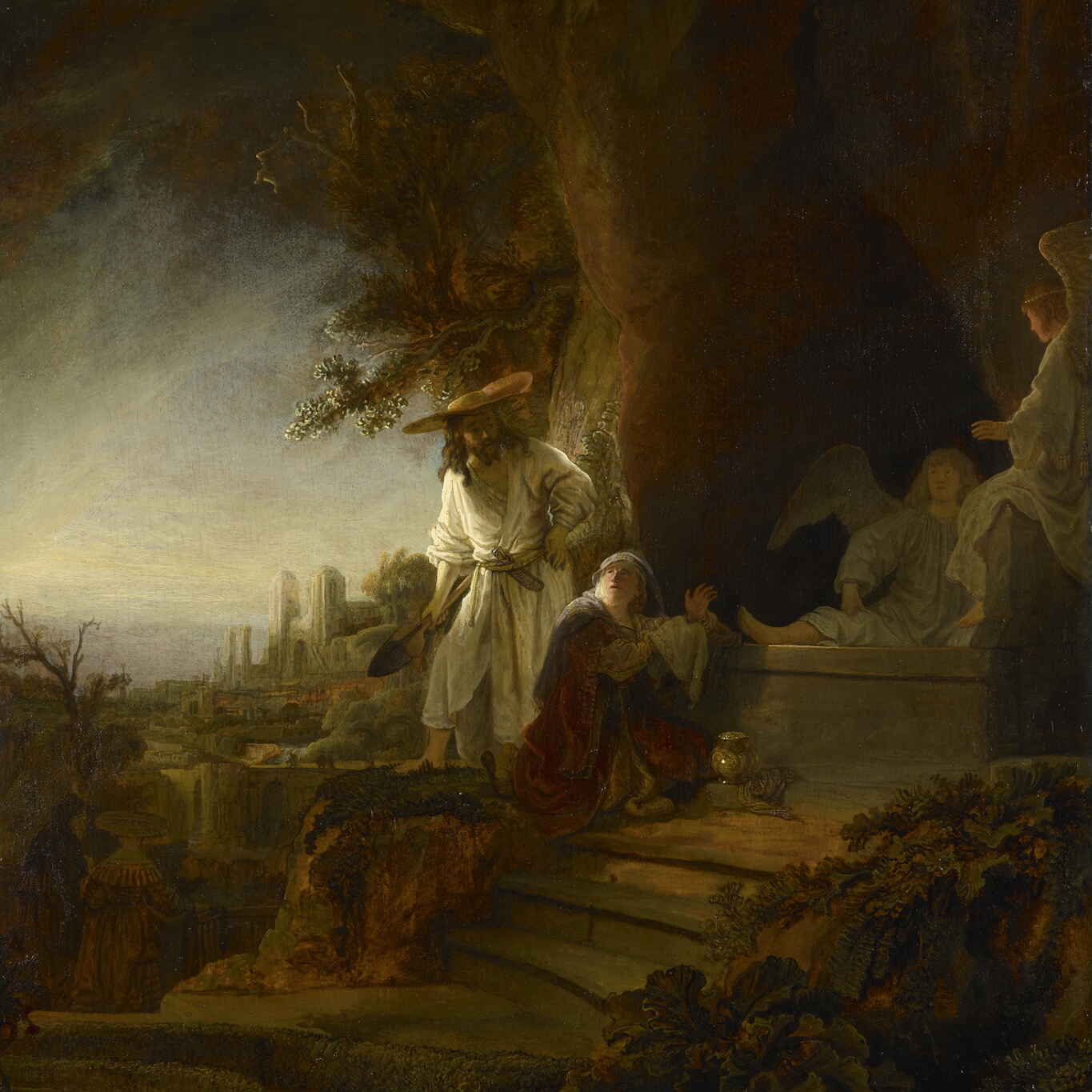
Rembrandt (1606–1669), “Christ and Mary Magdalene at the Tomb”, Royal Collection, Buckingham Palace, London.
1 Early in the morning on the first day of the week, while it is still dark, Mary Magdalene comes to the tomb. Then she sees that the stone in front of the tomb has been taken away. 2 She runs off and comes to Simon Peter and the other disciple, the one whom Jesus loved, and she says: “They have taken the Lord out of the tomb, and we do not know where they have laid him.” 3 Then Peter and the other disciple set out and came to the tomb. 4 They ran together, but the other disciple ran faster than Peter and arrived first. 5 He bent down and saw the linen cloths lying there, but did not go into the tomb. 6 Simon Peter then came after him, and he went in. He saw the linen cloths lying there, 7 and the cloth that Jesus had had over his head. It was not lying together with the linen cloths, but rolled up in a place by itself. 8 Then the other disciple also went in, the one who had come first to the tomb. He saw and believed. 9 For until then they had not understood what the Scriptures say, that he must rise from the dead. 10 Then the disciples went home.
11 But Mary stood just outside the tomb and wept. As she wept, she bent down and looked into the tomb. 12 Then she saw two angels in white sitting where Jesus’ body had lain, one at the head and one at the feet. 13 “Why are you weeping, woman?” they asked. She answered: “They have taken away my Lord, and I do not know where they have laid him.” 14 At that moment she turned around and saw Jesus standing there, but she did not understand that it was him. 15 “Why are you weeping, woman?” Jesus asks. “Whom are you seeking?” She thought that it was the gardener, and said to him: “Sir, if you have taken him away, tell me where you have laid him, and I will take him with me.” 16 “Mary,” said Jesus. Then she turned and said to him in Hebrew: “Rabbuni” – which means Teacher. 17 Jesus says to her: “Do not touch me, for I have not yet ascended to the Father. But go to my brothers and say to them that I am ascending to him who is my Father and your Father, my God and your God.” 18 Then Mary Magdalene went and said to the disciples: “I have seen the Lord!” And she told what he had said to her.
19 It was evening on that same day, the first day of the week. For fear of the Jews’ leaders, the disciples had locked the doors where they were gathered. Then Jesus came; he stood among them and said: “Peace be with you!” 20 And when he had said this, he showed them his hands and his side. The disciples rejoiced when they saw the Lord. 21 Again [Jesus] said to them: “Peace be with you! As the Father has sent me, I send you.” 22 Then he breathed on them and said: “Receive the Holy Spirit. 23 If you forgive anyone their sins, they are forgiven. If you retain the sins of any, they are retained.”
John 20:1–23
On the first day of Easter nearly two thousand years ago, Jesus Christ looks upon Mary Magdalene, the woman he had raised up from a difficult life. She stands outside the empty tomb and weeps when Jesus looks at her and says: “Why are you weeping, woman? Whom are you seeking?” Mary thought it was the gardener, and said to him: “Sir, if you have taken him away, tell me where you have laid him, and I will take him with me.” “Mary,” said Jesus. Then she turned and said to him in Hebrew: “Rabbuni”, which means Teacher. Jesus then says to her: “Do not touch me, for I have not yet ascended to the Father. But go to my brothers and say to them that I am ascending to him who is my Father and your Father, my God and your God”.
How many people, cultures, and nations have not been radically transformed after an encounter with the Son of God, he who says “peace be with you”, who refers to us as his siblings and who has loved us since the dawn of time?
The Creator of the earth knew what he was doing when in love he gave us free will. He understood that we would misuse the trust he gave us, but he so desired to love us that he was willing to do everything so that eternity might be filled with people who live in fellowship with him.
But it is as though we have forgotten what God was willing to undergo.
On Good Friday, when he was crucified, Jesus cited the opening of Psalm 22: “My God, my God, why have you forsaken me”. Many have wondered why. But somewhat later in this psalm, in verse 7, the one prophesied is referred to as a worm. But here the translator has forgotten the original meaning, for in the Hebrew original text this worm is described as tôlā‘at (often referred to as the kermes scale insect).
The scale insect associated with the Hebrew word tôlā‘ (often identified as the kermes scale insect) has a rather particular life cycle – and after Jesus’ death the meaning was truly understood.
For when the female is ready to lay eggs, she attaches herself permanently to a tree or a branch, where she forms a hard shell over herself and the eggs. The eggs develop inside her body, and when they hatch, she dies, and the small larvae emerge. She thus gives her life for her offspring. And they extract a scarlet-red dye.
In the light of this knowledge, Jesus’ words on the cross become even more meaningful. He was executed, in perhaps the worst conceivable manner, for all, also for those who crucified him, and he asked God to forgive them. But he had to die so that we might live.
But this incredible love from the Creator of the world is what we are now in the process of casting aside. It is as though we believe we have become too proficient in relating to God. It is perceived as naïve and almost something childish, something we ought to leave behind as adults. Our own love is sufficient. The message is experienced almost unanimously from our political leadership. They do not need Jesus, and they point to development. They are willing to include everyone, also those who reject the invitation from Jesus Christ. It is as though they are saying that Easter was in fact unnecessary. They have themselves become the point of departure of morality.
But if Easter was not necessary, if the reckoning with death is not real and Jesus’ victory was a mere performance, we must also prepare ourselves for what awaits us, whether it is truly worth it. For the world that turns away from Jesus Christ also says no to all the blessings that a life with him entails. As a society we lose a moral compass and the foundation for an ethical standard that makes it reasonable to strive for the good. Indeed, we will lose the understanding of what the good is.
We will no longer have a God who washed the disciples’ feet, and who became an example to be followed by all leaders. Servant leadership is affirmed only in Jesus Christ, and without the resurrection it is without significance.
For Jesus’ death and resurrection are not merely a historical event that took place nearly 2000 years ago. It is just as relevant today, and reminds us that in our encounter with death and with evil we are to proceed onward to something better. Jesus’ words that he is the way, the truth, and the life become meaningful with the resurrection.
Without a risen Jesus Christ, we thus lose not only an understanding of truth and human dignity. We also lose hope for eternity.
If we say no to Jesus Christ, we say no to the greatest message ever proclaimed. For there is nothing greater than a creator who looks upon us in love and says: It was for you that I suffered and died.
Happy Easter!