


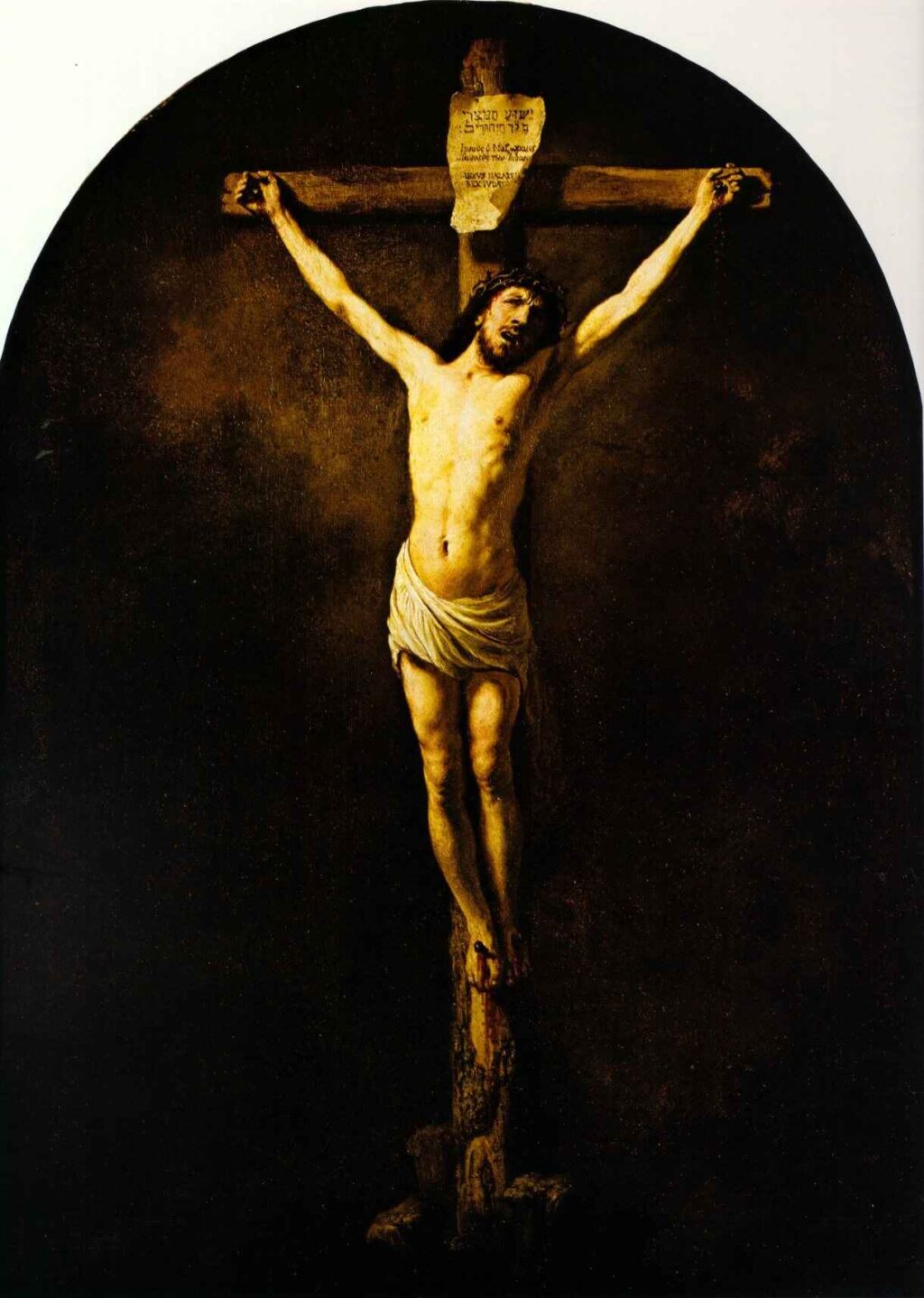
If you do not choose the Kingdom of God,
in the end it matters little what you have chosen instead.
William Law (1686–1761)
In the Christian philosophy of history, from Augustine to Bossuet, God’s intervention in human history is the central event. Through the life, death and resurrection of Christ, sacred and profane history meet. For Augustine, the substance of history is the conflict between the sacred and the profane, between Civitas Dei and Civitas Terrena, between veritas and vanitas. After Christ, as the midpoint of history, the profane and the sacred histories are separated and run in parallel. The profane or worldly history has no direction, meaning or goal. And historical progress exists only in one sense: the movement towards an ever greater distinction between faith and unbelief, between Christ and Antichrist. The only intelligible rhythm of history is a pendular movement between creative periods of faith and spiritual longing and destructive periods of apostasy and flight from the sacred. In contrast to profane history, sacred history has a clear linear direction and progression: towards Christ’s return and the Judgement, which is both the end (finis) and the goal (telos). The victory of the Cross is the final fulfilment of Christ’s work of salvation at the end of history.
Profane history
Jacques-Bénigne Bossuet (1627–1704) maintained in his work Discourse on Universal History that if history appears meaningless and without any discernible pattern, it is because our perspective is too limited. The world appears to be without justice, where no distinction is made between the faithful and the blasphemous, and where evil seems to be rewarded. Profane history is nothing but abuses and injustices, fatal mistakes, shattered dreams, hopes that fail, ambitions, pride, greed and betrayal – an endless repetition of evil and suffering. History ends again and again in catastrophe.
But the meaningless reveals a hidden meaning, according to Bossuet. The just order has not yet been established – not until the Day of Judgement, when all will be revealed. Until then, we must live in a perpetual struggle against the forces of this world. But God’s plan stands firm; it cannot be shaken by anything that happens here on earth. All events will nevertheless prove to have a meaning when viewed from a higher perspective, from the standpoint of eternity. For Bossuet, it is precisely the absence of visible signs of meaning and justice in history that justifies faith in the invisible (2 Cor 4:18). This is, in that case, the implication of what Bossuet says: if matter and sensible things are all that exist, no meaning can be found except in the transcendent, in the world of the spiritual; for meaning can never be deduced from the purely material.
The historical process itself reveals no evidence of meaning or direction. Nor can God’s will be derived from profane history, and the course of history cannot explain the mystery of the Incarnation. But God’s intervention in history through Christ has broken the natural flow of history. Through one historical event, God has revealed His will: through Jesus Christ, through the Word made flesh.
Even if the events of profane history in themselves have no meaning, history is nevertheless justified by being a journey towards the eschaton – the last times, the fulfilment of history and the Day of Judgement. And behind the meaninglessness of profane history there lies another history. In it, the world is a stage upon which the struggle between evil and good, between the disciples of light and of darkness, is played out, and where salvation or damnation is what the entire drama concerns.
Sacred history
History is the narrative of salvation. Man used the freedom he had received from the Creator to rebel, and thereby condemned himself to exclusion from God’s presence. But God intervened to save estranged humanity from damnation and to lead it onto the path of reconciliation. The historical process, as sacred history, thus begins when God revealed Himself to mankind in the form of the Son, who sacrificed Himself on the Cross for the purpose of reconciling humanity with the Creator. Salvation and eternal life are the fruits of reconciliation.
The theological principle for the understanding of the historical process as the history of salvation is the Fall. Man’s sin and God’s saving purpose both require and justify historical time. History becomes a trial, a test of the individual’s will, in which a distinction is made between the “children of light” and the “children of darkness”, as Augustine expresses it, and in which the individual’s choice – which ultimately concerns the invocation of God and the individual’s response to the call, whether one accepts or rejects Christ – determines the question of the soul’s salvation and eternal life. This Christian interpretation of history therefore stands or falls on the acceptance of Christ’s salvific work and the Incarnation as doctrine.
Jesus Christ is Alpha and Omega, the beginning and the end; what lies between the beginning and the end is irrelevant. History is the intermediate period, the time between the revelation of the holy plan and its fulfilment in the future. Christ is the only meaning in a world of meaninglessness. He is the Lord of history, Kyrios Christos, Lord of the Kingdom of God, but also of secular history; for behind the events of history and the visible appearance of things, mysterious forces operate in secret. The earthly powers are already defeated, yet they are still active. With the work of salvation, history has taken a new course, but it is not visible. The Kingdom of God is already here, and yet, as eschaton, lies in the future. The work of salvation has already occurred, but is not yet confirmed.
In this radical tension between what is and what is to come, between the near and the infinitely distant, faith and hope are the mode of life of the Christian. What atheists will call the irrational belief in the Resurrection as the decisive event of history is, for the believer, the rational foundation for the hope of the coming Kingdom of God – a kingdom already experienced as existing in the world, albeit hidden and small in comparison with what is to come.
To live eschatologically
A “Christian world” would be a contradictory concept; for a Christian understanding of human history can only be based on the fundamental antagonism that will always persist between the Kingdom of God and the kingdom of man. The Christian lives in the world, but is not of the world. This is one of Christianity’s paradoxes that has no solution in historical time. Christianity exists in a compromise with the world, and is therefore part of history; but it is equally true that the Christian, as a spiritual being, lives in constant conflict with the “natural man”, the man who has not received grace. As the spiritual descendants of Abel, Christians are devoted to living in the city of Cain, where sin always reigns. An essential part of what may be called “living eschatologically” in the world is to struggle against evil and desire – not only in others, but in ourselves. We all have something of Cain within us.
History is a tribunal in which the individual’s spiritual development and lived life are assessed, regardless of the time into which one happens to be born. For human beings, it is entirely a question of accepting or denying Christ and salvation. The lives of individuals in historical time take the form of a peregrinatio, a pilgrimage, towards salvation and eternal life. We are all pilgrims, peregrinantes, upon this earth and – if we have accepted Christ – on the way towards the same goal. Life is a journey concerned with spiritual development, and history is the process of continually regaining the ascetic disposition implicit in Christianity, and of overcoming the material and natural forces that draw man away from God. To live eschatologically also means to live morally, with self-imposed limits, inner discipline and self-sacrifice.
The lives of believers are like a secret history within profane history, unknown and invisible to those who do not see from a higher perspective with the eyes of faith. For Christians, history has always been a history of salvation arising from the belief in an ultimate meaning, where the past is merely a preparation for the fulfilment of the future – an eschatological future which, however, exists for us only in a dimension of hope and expectation. It is not possible for us to know anything about the future except what God wishes to reveal to us, in glimpses and fragments, through the visions of holy women and men. To live eschatologically is therefore to live in hope, but also with uncertainty; it is to accept that existence is a mystery, yet in unconditional trust in God’s love.
The Kingdom of God
Hope for better times in the future is an illusory hope; for history has shown itself to be a battlefield for destructive forces. The Preacher says: “What has been will be again, what has been done will be done again; there is nothing new under the sun” (Eccl 1:9). Everything is vanity and a chasing after the wind. And yet one cannot live without hope; for without hope there is only resignation and despair, which often end in destructive nihilism. But the only hope that is not an illusion is the hope that is a fruit of faith. We are saved by hope, says Paul (Rom 8:24). Faith and hope are justified by interpreting the events of history and human suffering in the light of all that the death of Jesus on the Cross has promised, namely the final victory of the Cross at the end of history. History becomes “universal” in that it is given unity and meaning, and is directed towards a final goal. The Kingdom of God, realised at the end of history, is the fixed point that gives history direction and progression.
The Kingdom of God begins with the life, death and resurrection of Christ. But in the world, evil and death are still a reality. The Kingdom of God is not visible – not yet. Christians live in hope between the present and the future, between what is and what has not yet been realised. The Church is only the provisional manifestation of the Kingdom of God, and the “communion of saints” is a precursor of the future community of souls. But the Kingdom of God will come, and the victory of the Cross will become universal truth. The Kingdom of God means that God has set all things in order in a new reality, and that our prayer has been fulfilled: Thy kingdom come, thy will be done.
Jesus explains that the Kingdom of God is comparable to the mustard seed. At first it is small, insignificant and scarcely visible. But this single seed grows into a great tree. Or take the parable of the leaven. A small amount of yeast works from within in secret and ultimately transforms the whole (Matt 13:31–34). In other words: God works in secret before He works openly. The transformation occurs from within first. The Kingdom of God is thus present, the victory has already been won, but not all can or will see it. When Jesus speaks in parables, this too is a form of judgement. It reveals the truth to the receptive, but is incomprehensible to those with closed souls. A judgement is passed on the individual’s personal response. The Kingdom of God must be received voluntarily, by those who desire it and seek it.
At the end of history
The Christian understanding of world history must be based on the suffering and resurrection of Christ, and the Cross is the central symbol of the hope that Christians bear. Christ’s death on the Cross was not a defeat; for with the Resurrection, everything was turned into a victory over death and into the reconciliation of humanity with God. By Christ’s atonement for our sins in our place, the relationship with God was restored. The Cross is the key to salvation – the door stands before us, and we open it by accepting Christ and receiving His sacrifice. In this way, a new life becomes possible for us, as forgiven and saved from sin, with eternal life in prospect.
The course of history becomes meaningful, comprehensible and “progressive” only through the expectation of the fulfilment of the eschaton, with the final victory over sin and the resurrection to eternal life, when time itself dissolves into eternity. The victory has been won through Jesus Christ, even if it is not yet fully realised. But at the end of history, the victory of the Cross will be finally confirmed, visible to all. The Judgement is the ultimate consequence of the Cross. The Judgement is the revelation of those who have accepted and those who have rejected Christ. The powers of evil are broken, justice is restored, and humanity is judged, creation renewed – “a new heaven and a new earth.” The victory of the Cross is the victory of truth over falsehood, of love over indifference, of light over darkness, of eternal life over death. It is more than a cosmic event.
Christians must hold fast to the Cross as the symbol of the beginning and of the fulfilment of God’s plan. It is paradoxical that the Cross, an instrument of torture and death, should become a symbol of victory over death, of eternal life, of the spiritual kingdom that overcomes the material kingdom of power. The Cross does not symbolise death, but meaning and eternal life. It symbolises all the hopes and longings of the faithful and at Easter assumes the significance of the most powerful of all symbols (and the most hated by the enemies of the faith).
In a conversation with the Caliph Mahdi of Baghdad, in the year 781, Timothy I, head of the Church of the East, defended the Christian faith and explained the meaning of the Cross. In response to a question from the Caliph, Timothy answered:
“As you say, O King, the Cross leads to death, but death leads to resurrection, and resurrection leads to life and immortality, and this is why, as a symbol of life and immortality, we worship the one and invisible God through it. It is through the Cross that God opened for us the source of life and immortality.”


