

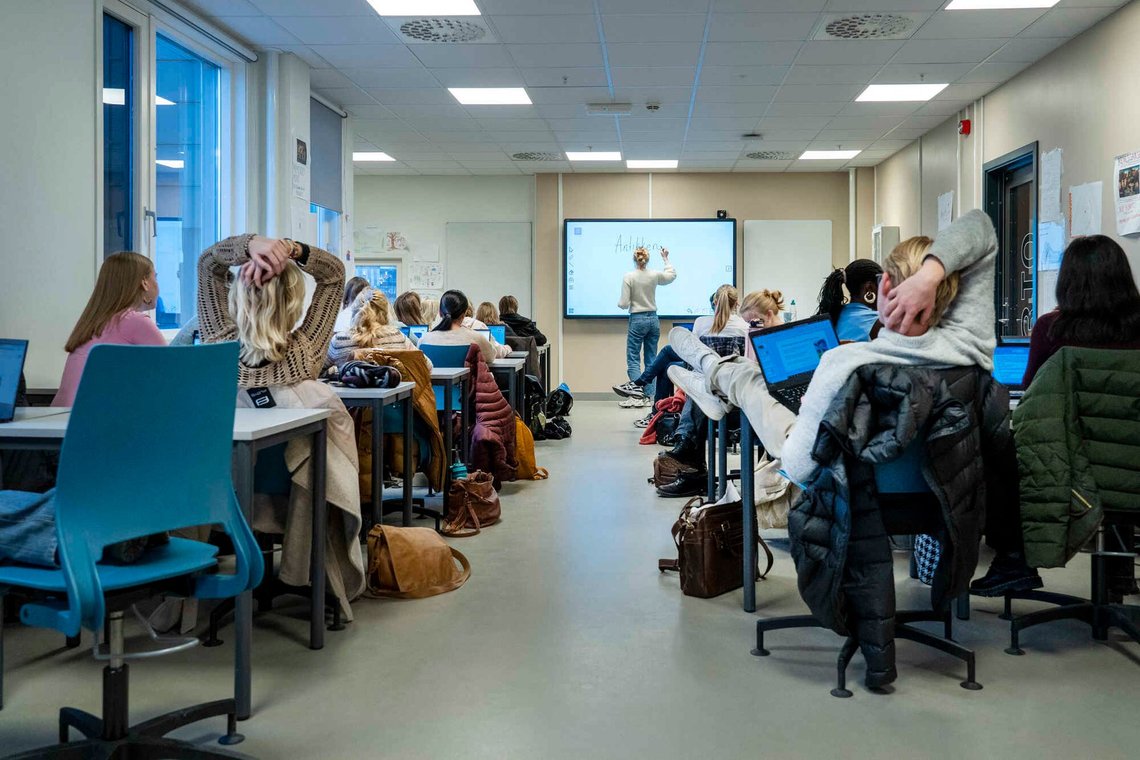


Only 56 per cent of immigrant boys complete upper secondary education within six years. Among pupils in Norway overall, the figure is 82 per cent.
This is shown by a new report from the Directorate of Integration and Diversity, IMDi, which will be presented on Thursday.
In 2015, 49 per cent of immigrant boys completed upper secondary education within five or six years of starting school, according to IMDi’s indicator report for 2025. By 2024, the proportion had risen to 58 per cent, according to the same report.
According to NRK’s coverage of the new IMDi report, which will be presented on Thursday, the trend has now reversed: NRK states that 60 per cent completed in 2024, and that the proportion fell to 56 per cent in 2025 — in other words, two consecutive years of increased dropout following a decade-long period of improvement. It is worth noting that NRK’s figure for 2024 (60 per cent) does not entirely correspond with the figure in IMDi’s own 2025 report (58 per cent).
This article uses NRK’s figures for 2024 and 2025, since the new report is not yet publicly available.
By comparison, boys in the rest of the population have gone from 72 per cent in 2015 to around 82–83 per cent today. The gap between the groups has therefore not narrowed, even during the years when immigrant boys performed better.
Immigrant girls complete upper secondary education far more often than boys, at 74–75 per cent. Norwegian-born girls with immigrant parents perform best of all groups, with a completion rate of around 89 per cent.
Vocational programmes hardest hit
The picture is not the same for all educational pathways. Among immigrants who choose vocational programmes, around 56 per cent complete them, compared with 75 per cent in the rest of the population. In programmes preparing pupils for higher education, the difference is smaller: around 81 per cent compared with 93 per cent.
A majority of immigrants apply for vocational programmes, while Norwegian-born pupils with immigrant parents more often choose programmes preparing them for higher education. Immigrants who have lived in Norway for a short period have lower completion rates than those who have lived here for a long time. Pupils who had lived in Norway for three to five years when they started upper secondary education had a completion rate of 57 per cent. Among those who had lived in Norway for ten years or more, the proportion was 77 per cent.
Dropout is also linked to results from lower secondary school. Immigrants have, on average, almost five fewer lower secondary school points than the rest of the population, a difference of just over half a grade. The difference is greatest among boys who have immigrated from countries in Africa, Asia, Latin America and Europe outside the EU/EEA.
High risk of exclusion
Dropping out of upper secondary education is regarded as a key risk factor for long-term exclusion. According to the OECD, young people who do not complete upper secondary education are seven times as likely to end up outside both employment and education as their peers who complete it.
IMDi director Libe Rieber-Mohn points to several reasons why immigrant boys drop out more often than other groups.
– A short period of residence in Norway and poor language skills will have an impact. So too will whether you have managed to complete lower secondary school, and whether you have parents who can provide good support, Rieber-Mohn tells NRK.
She also highlights a gender difference in how the young people live.
– Immigrant girls in some groups experience less freedom than boys, and that may provide an opportunity to do more schoolwork, she tells NRK.
Wants earlier follow-up
Rieber-Mohn believes the solution lies in identifying pupils early, long before they drop out.
– The most important thing of all is early intervention. Dropping out of school does not happen overnight, but begins long before. Schools must ensure that everyone experiences a sense of achievement, that they are seen, accepted and included, she tells NRK.
Minister of Education Kari Nessa Nordtun (Labour) tells NRK that the government has made clear to municipalities and county authorities that pupils who are absent must be followed up from the first day.
– It is serious when young people do not complete upper secondary education. To counteract this, schools must identify challenges before they have time to develop, Nordtun tells NRK.
Part of a broader picture
School dropout is one of several findings in the new IMDi report. At the same time, the figures show that Norwegian-born people with immigrant parents perform better than their parents in both education and working life, and that employment among immigrants has increased over the past decade, particularly among women.
At the same time, the report points out that immigrants remain overrepresented in the low-income statistics, have an unemployment rate around four times that of the rest of the population, and are overrepresented both as perpetrators and as victims in crime statistics.


