Once again, Norwegian politicians are allowing themselves to be shocked by dismal PISA results. But the decline in the level of knowledge among the young is not affecting Norway alone.
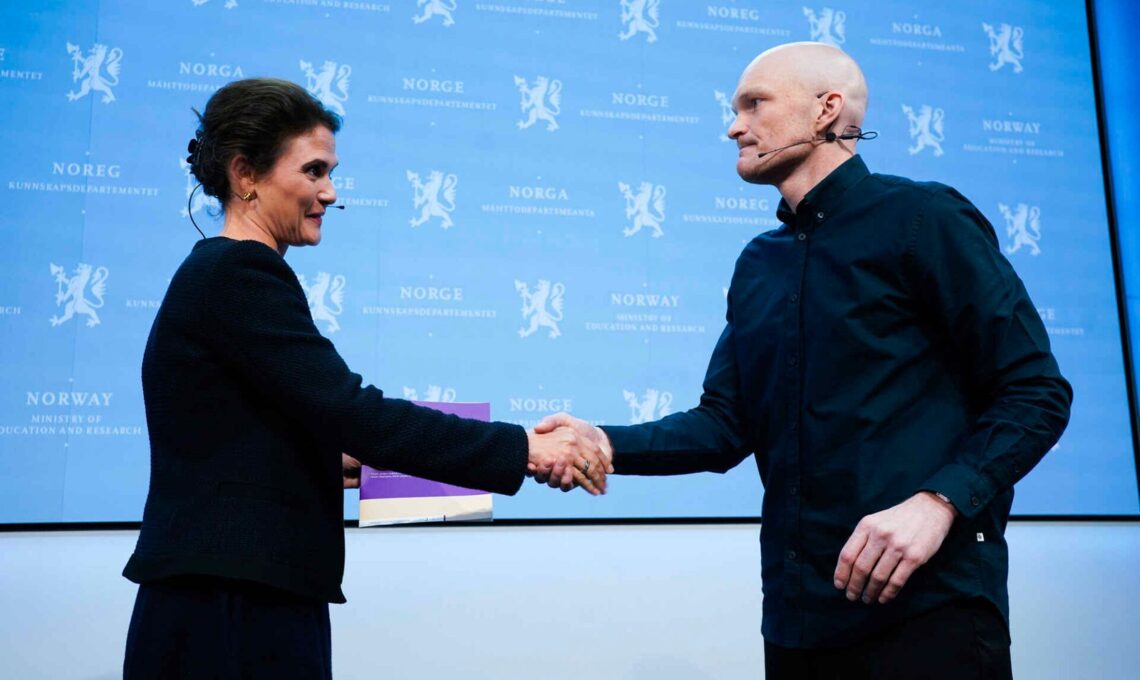
The results of the PISA survey were presented at a press conference on Tuesday morning. The arrows have been pointing downwards since 2015. An increasing number of pupils are leaving compulsory school without mastering reading or basic mathematics.
Researcher Fredrik Jensen at the University of Oslo, who presented the survey, takes a gloomy view of the development.
– We are seeing a decline in the average results in reading and mathematics since 2022. And we are seeing a significant decline in the average results in all three subject areas – science, reading and mathematics – over the past decade, Jensen said of the period from 2015 to 2025.
)
A normally endowed child can easily learn to read at the age of four, and with a little interest and help from the parents, it is entirely possible to master mathematics at fourth-grade level by the age of six. But after nine years in Norwegian compulsory school, the end product is young people aged 15 to 16, a large proportion of whom know virtually nothing.
– The results are extremely serious and confirm a development we have seen over a long period. Not enough has been done to reverse the negative trend in Norwegian pupils’ learning outcomes over the past ten years. It is my responsibility to facilitate a reversal of this trend through more forceful measures going forward. I accept that responsibility, says Minister of Education Kari Nessa Nordtun (Labour).
As Minister of Education, Nordtun naturally bears symbolic responsibility for the dismal results, but she cannot bear the responsibility alone. The decline has been going on for many years and appears impossible to reverse.
This is not so strange, since some of the main reasons why Norwegian pupils are becoming increasingly ignorant are due to political decisions that do not appear to be up for discussion.
The poor results are also depressing standards in upper secondary schools, since politicians have decided that everyone should complete twelve years of schooling.
Consequently, a number of pupils begin upper secondary school who can be described as virtually educationally retarded, since they can barely read or do arithmetic.
Teaching is adapted to the weakest, in classic social-democratic fashion, but the idea of raising the weakest does not work. Many of them lack both the ability and the will.
As a result, the pupils who initially have both the ability and the will to perform well are also affected. The pupils who could have performed are brought down to the level of the weakest, to whom all teaching is adapted.
This decline is carried forward into colleges and universities. Norwegian academia has become a complete parody, and here two of several causes may be mentioned:
- The requirements for entering higher education are falling, and consequently the standard of students is falling, which leads to a weakening of teaching.
- Increasing numbers choose outright bullshit subjects that should never have been financed with public funds, subjects such as gender studies, women’s studies and critical race theory.
The catastrophic development that has characterised teaching at all levels for several decades is the result of political decisions made by politicians who are themselves characterised by profound ignorance, and the trend has been visible throughout this entire period. Without proper teaching, there is little to inspire hope of improvement.
Former Minister of Education Tonje Brenna seemed almost proud of being so poorly educated.
Germany
German politicians had a faint hope that PISA 2025 would produce a slight turnaround, or at least a stabilisation without any further decline in school performance. But this hope has not been fulfilled – on the contrary: the latest PISA survey marks a new negative record. Never before have the results been worse, writes Die Welt.
Standards are falling significantly in scientific knowledge, mathematics and reading proficiency alike. The country report for Germany states:
‘Viewed over a longer period, the 2025 results in all three areas of assessment are the lowest ever recorded in Germany as part of PISA, reinforcing a negative trend that has persisted throughout the preceding decade.’
Is it ignorance that has led Europe’s former economic powerhouse now to struggle against deindustrialisation and recession, following the Energiewende, open borders and climate hysteria?
)
Sweden
We see the same trend in our neighbouring country, Sweden. Swedish pupils have never performed so poorly in mathematics, reading comprehension and science, writes Aftonbladet.
Sweden’s 15-year-olds are performing worse in every area, but the largest decline is in reading comprehension, where the result has fallen by 21 points compared with the previous assessment, in 2022.
– This is extremely serious, as reading and numeracy are fundamental skills at school, in everyday life and for being able to participate actively in society, says Anna Castberg, Head of Analysis at the Swedish National Agency for Education (Skolverket), in a press release.
Acting Director-General of the Swedish National Agency for Education, Christina Månberg, is also concerned.
– Sweden, the Nordic countries and many other countries have now reached record-low results in reading comprehension and mathematics.
The Swedes can nevertheless console themselves with the fact that the results are even worse in Norway.
United Kingdom
The British PISA results are interesting. English pupils achieve far better results than pupils in Wales, Scotland and Northern Ireland. This might seem strange, since England has been by far the hardest hit by mass immigration, which is one of the explanations for the decline of schools (more on this below).
According to PISA 2025, children in Wales are almost two years behind their English peers in science, mathematics and reading. Pupils in Scotland and Northern Ireland also perform poorly.
But overall, British pupils have climbed sharply in the rankings of the 91 countries participating in the survey, and now rank 8th in science, 10th in reading and 10th in mathematics – the country’s best rankings since the assessments began in 2006, according to The Telegraph.
The success is largely due to the strong results achieved by 15-year-olds from England, who performed significantly better than their peers from Northern Ireland, Scotland and Wales in all three subjects.
Sir Nick Gibb, a former Conservative education minister, argues that the reason is that both the Welsh Labour government and the authorities in Scotland and Northern Ireland have introduced a skills-based curriculum – in contrast to England’s knowledge-based curriculum.
‘Wales did not follow the reforms introduced in England, but actually went in a different direction. That is why the gap has widened. They need to move to a knowledge-based curriculum.’
The opposite is happening. Lucy Powell, the Labour government’s Education Secretary, appears to prefer the methods that lead to decline. Powell has signalled plans for significant changes to England’s curriculum, with greater emphasis on skills and technical subjects at the expense of knowledge.
‘I hope that Lucy Powell will learn from these results and not go in the same direction as Wales, which in the long term would deprive young people of opportunities,’ Sir Nick said.
In Norway, large sums were allocated in 2024 to create a more ‘practical school’. The Labour government, with Nordtun, was behind the decision.
There are, however, signs of change: In August, the Labour government presented plans to reduce the use of screens and artificial intelligence, and instead ensure that pupils are capable of acquiring knowledge themselves, including by ensuring that they learn to read from physical books. The only question is whether this can be implemented, and whether the focus will become knowledge-based, the method that appears to work.
Mass immigration
There is little doubt that immigration has affected standards in schools in Western Europe. At several schools in Oslo, an overwhelming majority of pupils do not master the Norwegian language. Consequently, it also becomes difficult to acquire knowledge in the other subject areas.
One of the reasons is that many of the immigrants received poor schooling in their countries of origin, particularly those who come from Muslim and/or African countries. The parents are also often poorly educated, and consequently help from home is absent.
Disruption in classrooms, violence in the schoolyard and such disturbances result in poorer teaching. Thus, even though immigrant pupils are to a large extent excluded from the PISA results, which in reality are therefore even weaker than the figures indicate, standards among the other pupils are also weakened.
There is also much to suggest that the ability to acquire knowledge varies between different countries. This is, of course, a forbidden subject, and one is quickly accused of racism if one points to the variation that IQ tests show between countries.
But there is no need to bring IQ into the discussion. One example: Pupils of Indian background perform far better than pupils of Pakistani background. These are people who grew up in the same country, in the same environment, and who should therefore, genetically speaking, have had the same starting point.
Ancient India was a gigantic continent, and the variations between the different regions were (and are) considerable. Moreover, it tends to be well-educated and affluent Indians who arrive in the West. This also applies to the first wave of Pakistani immigrants, but this was subsequently followed by family reunification.
So culture probably has at least as much significance as IQ. It is difficult to produce outstanding women in a country such as Afghanistan, where girls are denied education from a relatively young age, and where women cannot appear in public without a chaperone and without being fully covered.
Inbreeding is another problem. The clan mentality leads to marriages between cousins. This practice creates major problems in the United Kingdom, where many children of immigrant background are born with mental disorders because their parents are too closely related.
A few years ago, the present writer wrote in an online newspaper that has since closed:
In Bradford, 75 per cent of married Pakistanis are married to a cousin. In the United Kingdom as a whole, the figure is at least 50 per cent.
Consanguineous marriage occurs today among all population groups in Norway, but is most widespread among Norwegian residents who come from Pakistan, Turkey or other countries in the Middle East and North Africa.
Among immigrants from Pakistan, it is estimated that around 41 per cent of all parental couples are cousins or closely related, and a further 11 per cent are related in some other way. The corresponding figure for ethnic Norwegians is 0.1 per cent (SNL).
There are several alarming aspects associated with the PISA survey. Much suggests that the Norwegian results are actually even worse than the survey indicates.
Norway is one of only four countries marked with an asterisk in the PISA report because we exclude so many pupils from the survey. Nevertheless, ‘the world’s richest country’ ends up all the way down in 32nd place.
)
Europe is in the process of rejecting the valuing of knowledge and the ability to create something. This is being replaced by societies that increasingly reward those who are willing to commit crime, particularly violent crime and sexual offences. In such a society, Europeans, who have been taught dialogue and respect for everyone, will lose in the long run.
Neither schools nor the justice system have adapted to the new reality, and the politicians in power appear to ignore these issues completely. This is now evident in the praise for King Harald’s speech about how anyone can be Norwegian:
Norwegians have also immigrated from Afghanistan, Pakistan and Poland, Sweden, Somalia and Syria.
Norwegians are girls who love girls, boys who love boys, and girls and boys who love each other.
Norwegians believe in God, Allah, the Universe and Nothing.
But it was largely ethnic Norwegians who turned up outside the Royal Palace to lay flowers for ‘the grandfather of all Norway’. Strangely enough, neither the media nor politicians on the left have been particularly concerned with the sacred ‘diversity’ in that context.