

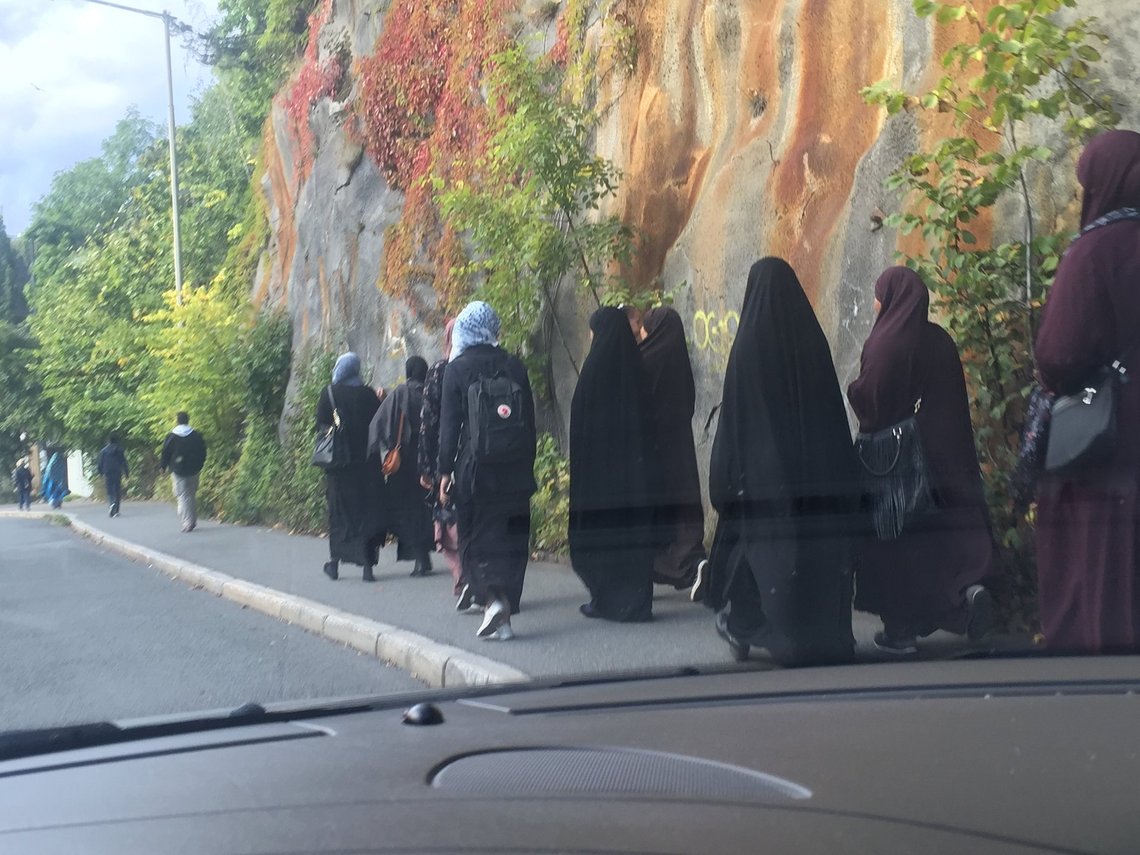


In a new report, the research foundation FAFO concludes that the term “parallel society” is inappropriate, can lead to stigmatisation and recommends that the authorities avoid using it. They believe that there is no basis for determining the prevalence of parallel societies in Scandinavia.
While “parallel society” is a well-established term in everyday speech, and there is largely a common understanding of the term in the population, the researchers at the FAFO Research Foundation believe that it is not possible to use the term because there are nuanced differences in the use of the term and that it can therefore lead to stigmatisation.
This is revealed in a research report of more than 80 pages that was commissioned by the Directorate of Integration and Diversity (IMDi). The assignment was to create a knowledge status on parallel societies in Scandinavia, with a focus on characteristics, prevalence and measures.
The vast majority of people perceive a parallel society as a completely or partially closed society that exists alongside the majority society. It is characterised by a high proportion of foreign-cultural immigrants, usually from Islamic countries, unsuccessful integration, low labour market participation, many on social security, social control through religion and/or clan culture, organised crime and a low threshold for the use of violence.
But the researchers at the FAFO Research Foundation disagree with this, writing that “Research is consistently critical of the use of this term for Scandinavian conditions, and we find few researchers who have empirically investigated whether parallel societies exist in Scandinavia”.
Document has only read the abstract. We can state that there has been no shortage of personnel involved in the process. Four researchers, including three from FAFO, have done the work.
FAFO researcher Rebecca Nybru Gleditsch. Photo: FAFO
FAFO researcher Ida Kjeøy. Photo: FAFO
FAFO researcher Rebekka Ravn Lysvik. Photo: FAFO
University Librarian Marianne Inez Lien. Photo: UiO
The clients in IMDi who have defined the mandate and are therefore formally the buyers of this assignment are represented by Katrine Bakke Lossius and Karen Sofie Pettersen.
IMDi contact Katrine Bakke Lossius. Photo: Facebook

IMDi contact Karen-Sofie Pettersen. Photo: Facebook
Special thanks to Erika Braanen Sterri for project management during the project’s inception, Beret Bråten for review and quality assurance, and Sofie Steensnær for fine layout.
Project manager Erika Braanen Sterri. Photo: FAFO
Proofreader and quality controller Beret Bråten. Photo: FATO
Sofie Steensnæs Engedal. Photo: FAFO.
In addition, there have been dozens of other people involved in the process.
It is not stated what the project has cost in terms of salaries and other expenses, or when the assignment was given. However, the introduction refers to the fact that there was a debate in the Norwegian media about parallel societies in 2015 in which Paris and Molenbeek in Brussels were mentioned. So the topic may have been maturing for a while. The word “terror” appears once in connection with Molenbeek, which is linked to the terrorist attack in Paris in 2015 by the Islamic State (IS). Islam is not a topic in the report, and the word “Islam” is not mentioned.
Words such as immigration or immigrant appear more than 70 times throughout the report, while words such as integration appear around 50 times. But these researchers have produced a quality-assured and proofread report that concludes that parallel societies do not really exist in Scandinavia, because no one has defined what a parallel society really is.</p
Risks stigmatisation
The researchers simply believe that the research has no basis for saying anything about the prevalence of parallel societies, either in Norway, Sweden or Denmark. This is because there is no agreed understanding of the term “parallel society”, which makes it impossible to derive relevant measures or measure the phenomenon precisely. The researchers base this on the fact that in Denmark the authorities define what constitutes “vulnerable areas”, while in Sweden this is done by the police. The researchers therefore believe that in the Swedish case, crime will be more emphasised in the conceptual understanding than in the Danish case.
The researchers believe that if the definition of the term is not completely agreed and equally applied, “there is a risk that measures to combat crime or reduce school dropout rates will be implemented in the areas where most immigrants live rather than in the areas where crime or dropout rates are highest”.
The researchers have not investigated whether the aforementioned conditions such as school dropout, crime and a high proportion of foreign-cultural immigrants coincide. It therefore claims that “Research also shows that politically defining an area as disadvantaged can contribute to increasing the stigmatisation of the area and those who live there, further exacerbating the problems that exist there”
.
Wants to avoid the term
The researchers have found that since there are different practices in the use of the term parallel society and different social institutions in Denmark and Sweden are responsible for defining disadvantaged areas, and different characteristics of disadvantaged areas can thus be emphasised differently, the researchers conclude that it is safest not to use the term.
They conclude that the term “parallel society” is not very suitable for research. This is because the term is rarely used in academic literature, and when it is used, the definition is very varied and unclear. At the same time, however, they write that “Danish authorities have a definition of parallel societies that differs from those found in research”. This makes it unclear to the reader which research the researchers are referring to.
The team of researchers therefore recommends that governments should avoid using the term parallel society because it is unclear, potentially stigmatising and can lead to imprecise or counterproductive measures.
With the proviso that Document has not read the entire report, but only the summary, an understanding of the report may be that a problem only arises when you talk about it, or that a problem will disappear if you do not talk about it, such as parallel societies, and that the topic should be left to researchers who can discuss the topic. Because in the preface it says: «We would like to thank the Directorate for a demanding but very interesting assignment, and for good discussions during the work».


