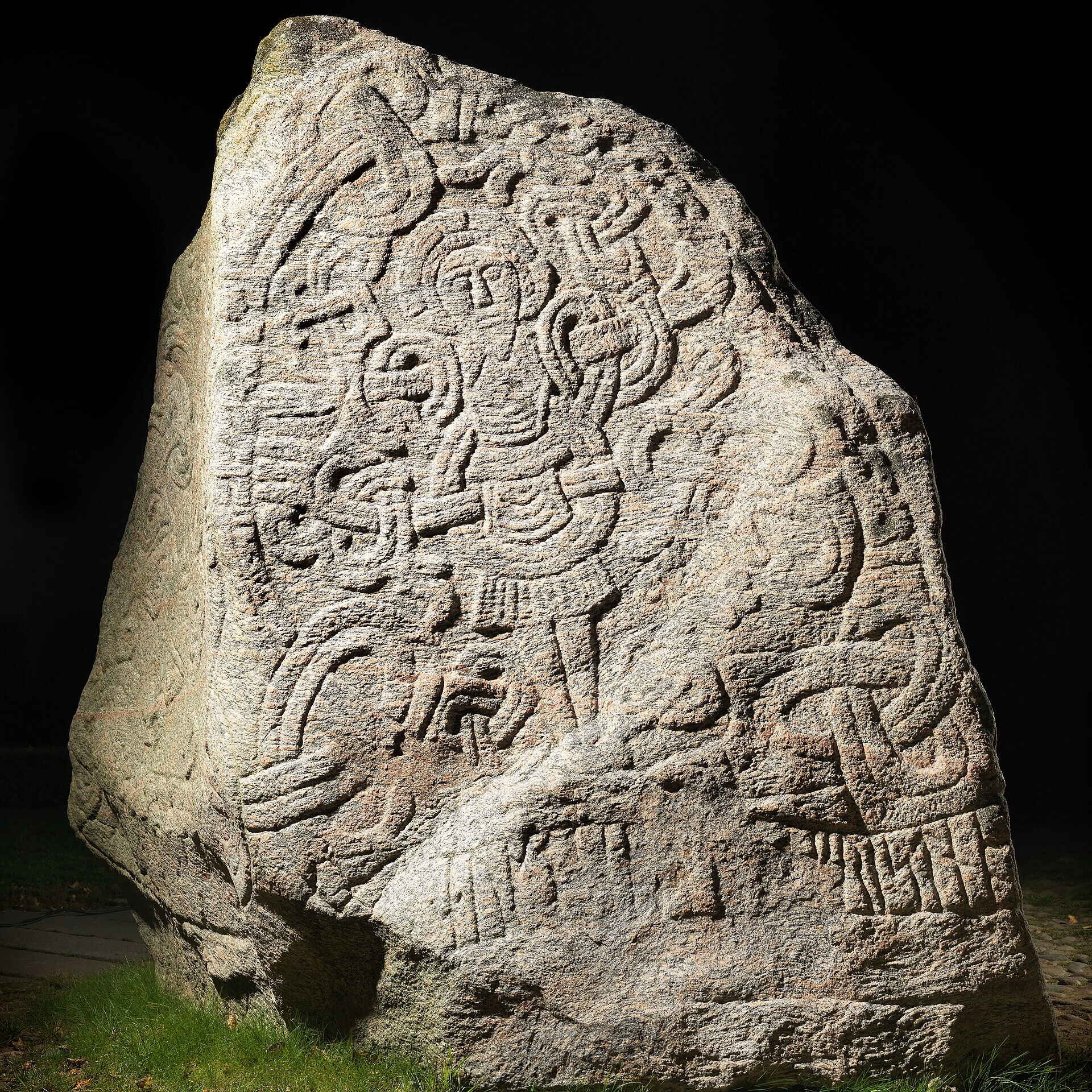
The Jelling Stone. Photo: Roberto Fortuna / National Museum of Denmark / Wikimedia Commons (CC BY-SA 3.0).
I recently watched a foreign programme about which Scandinavian language is easiest for a foreigner to learn. It was pointed out that Norwegian, Danish and Swedish are basically so similar to one another that if you learn one, you can also easily gain access to the others.
Together with Icelandic and Faroese, they all derive, of course, from a common Old Norse language that was spoken throughout the Nordic region a thousand years ago and was known as ‘the Danish tongue’. It could just as easily have been called the Norwegian or Swedish tongue.
After the Scandinavian languages diverged from one another over the centuries, we now have languages which, although they bear the imprint of their common origin, sound very different. Danish in particular sounds very different from the other two.
As a daily user of the Danish language, I must admit that Danish presents considerable difficulties for those trying to learn it – far greater than Norwegian and Swedish.
The other day I met a German couple outside the local bakery. They had a sweet dog, which I petted. Dansk er en svær sprok, the German tourist remarked. I had to agree with him, and observed that many Danes do not speak it either.
It reminds me of my former Norwegian boss at the Nordic Council of Ministers. When he travelled by bus in Copenhagen, he noticed that spoken Danish was so incomprehensible that even the natives repeatedly had to ask: Hva sir du?
Spoken Danish is rapidly diverging from written Danish, which, unlike Norwegian, is conservative and adheres to its Latin heritage. Hence ‘nation’ in Danish and ‘nasjon’ in Norwegian. The latter probably has something to do with the Norwegian need to distance itself from the ‘four-hundred-year night’ of 1380–1814, when the country was under Danish rule. It was therefore natural to change ‘tio’ to ‘sj’.
But the Norwegians are probably wise to distance themselves from Danish, as the spoken language is diverging from written Danish at a galloping pace – and to such an extent that one cannot learn Danish by reading texts.
How are the following words pronounced in modern Danish: købmand, blive, aldrig (how many pronounce the g?), sommerfugl (why is it not called ‘sommerful’?), ska, meaning ‘skal’ and ‘skulle’, som becoming sgu.
What use is Danish to anyone?