

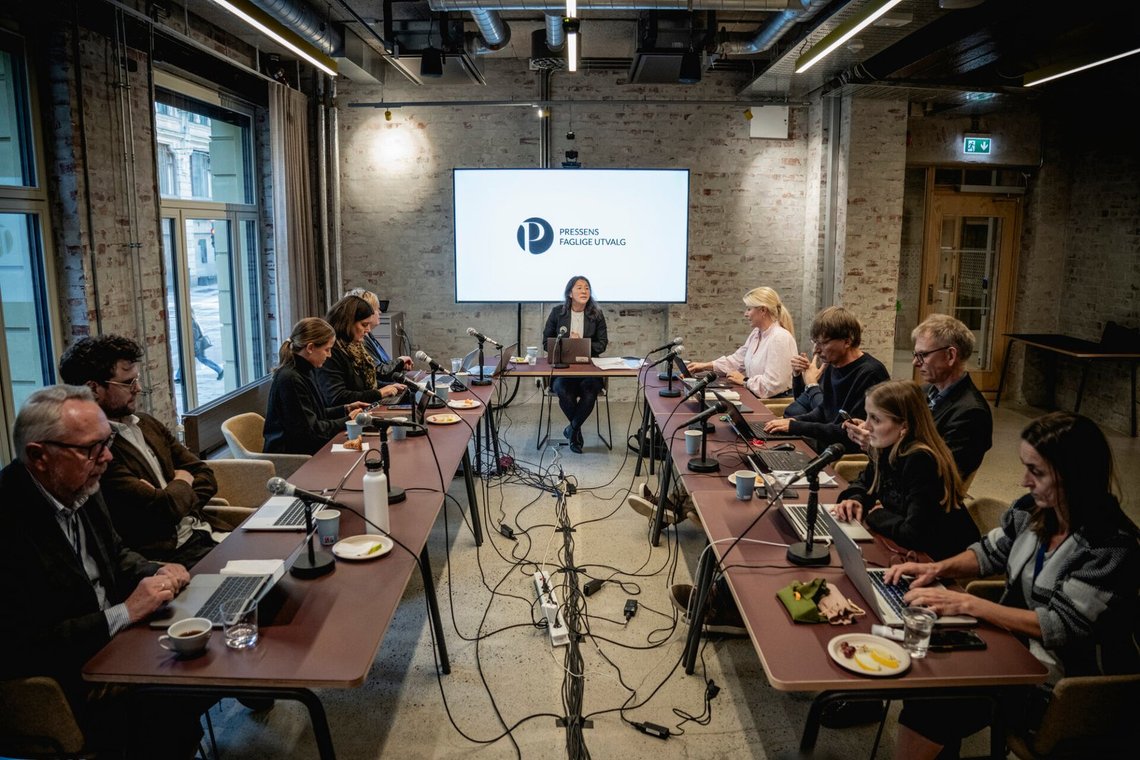
Rulings from the Norwegian Press Complaints Commission (PFU) are pouring in. At the same time, a newspaper has been found in breach for publishing a text by Anne Kalvig about sex and trans issues, and during the proceedings parallels were drawn with how Jews were spoken about before the Second World War. It is time to ask: What has happened to common sense?
It has been an intense few days for Document. On Wednesday, two new adverse rulings came from the Norwegian Press Complaints Commission (Pressens Faglige Utvalg, PFU). We of course publish the rulings and let readers form their own opinion. But we must also be able to question what is now happening.
In one of the cases, it concerns a Norwegian who was arrested following a serious incident in Huddersfield in the United Kingdom. We did not identify him by name. We linked to British media where the name had already been published.
Later, the mother herself appeared in the Daily Mail by name and with a photograph, together with her son. We were therefore certain that the PFU could at least not find us in breach for identification. But it did. The internet knows no Norwegian national borders. Nevertheless, we seem to be moving towards a system in which information can be openly available from major foreign media, while Norwegian media risk being found in breach for showing readers where they can find it.
We are almost back to the time before the internet. Where is the common sense?
Anne Kalvig and the boundaries of what is permitted
Then, on Wednesday evening, I sat down and read the text by Anne Kalvig that RA Stavanger published and removed again after a couple of hours. I had to read it once more. For what exactly was so egregious about it?
This was a text about sex, trans issues and women’s rights. One can agree or disagree with Kalvig, but these are questions that obviously must be open to discussion in a free press. Nevertheless, the newspaper was found in breach. Even more remarkable was the discussion in the PFU, where a parallel was drawn between the way trans people are spoken about and the way Jews were spoken about in the interwar period. That is when the warning lights should begin to flash. For what exactly is being said?
That certain views about biological sex are not merely wrong, but so morally reprehensible that they can be compared with the language that preceded Europe’s greatest catastrophe? Anne Kalvig is a very courageous and strong woman. She deserves support for daring to stand her ground in this.
It is also interesting that her text was subsequently published in Denmark. Once again, we encounter the same paradox: What becomes problematic in Norway can be read in our closest neighbouring countries. What, then, is the purpose of trying to establish Norwegian information boundaries?
Press ethics require judgement
The Code of Ethics of the Norwegian Press (Vær Varsom-plakaten) is important. Press ethics are important. But rules work only if they are applied with judgement and common sense. That also applies to the use of anonymous sources.
Anonymous sources have always been a necessary part of journalism. People possess information that the public ought to know, but may risk their job, position or other serious consequences if they come forward. If the threshold for using such sources becomes so high that editorial offices do not dare to use them, it is not only Document that has a problem.
Then journalism has a problem.
The paradoxical thing about the Kalvig case is that the editor of RA Stavanger actually removed the text after only a couple of hours. It did not help. He was found in breach anyway. It is then legitimate to ask what kind of press-ethical regime we are moving towards.
Who determines the established truths?
This is about something bigger than the PFU. It is about which views are allowed to establish themselves as truths in the Norwegian public sphere, and how increasingly difficult it becomes to challenge them.
We see it in questions about sex. We see it in the immigration debate. And we see it in foreign policy.
Palestine and Ukraine are two of the great moral questions of our time, and strong political narratives have developed around both conflicts. But reality cannot always be forced into the same political alliances. Cracks appear. That is why it is interesting when people and groups who stand together on one issue suddenly find themselves on opposite sides of another.
It tells us something about how artificial some of the political alliances really are.
Brennpunkt and the circle around Rød-Larsen
Then I watched the first part of NRK’s Brennpunkt about Terje Rød-Larsen and Mona Juul. It is interesting television. But it also leaves one major question: Where is the rest of the circle? Terje Rød-Larsen and Mona Juul did not emerge from nowhere. They were part of a Norwegian political and diplomatic milieu with connections into the Ministry of Foreign Affairs, the Labour Party, the UN system and international networks. These were people who knew one another, worked together, helped one another advance and had access to some of the most important arenas of power Norway had.
Everyone understands that there is a power network here that has exchanged knowledge, services and contacts. It is therefore not enough simply to study the individuals. Who opened the doors? Who knew what? How did the connections between the Ministry of Foreign Affairs, the Labour Party, the organisations and the international institutions function? And why is it so difficult for the Norwegian media to investigate the milieu itself?
That is where the truly interesting story lies.
Terje Rød-Larsen and Mona Juul are products of a milieu that had power and approval. If one investigates only the individuals, but not the system that elevated them, one risks missing the most important part of the story.
From popular movement to elite
Øystein Steiro has written several important articles about the concentration of power in Norway and developments within the Labour Party. For this is also about how Norway has changed. The Labour Party was once an enormous popular movement. The party, the trade union movement and the local organisations bound people together and gave ordinary people political influence.
The same was true, in a different way, of the Christian popular movements. These structures have been weakened. Instead, we have acquired a society in which ever more power is concentrated in smaller circles – politically, culturally, administratively and in the media. That creates an entirely different dynamic.
In the 1970s, the radicals stood outside the institutions. They built their own newspapers and organisations and challenged power. Today, the heirs of this movement are largely inside the institutions. They are in the media, academia, organisations and parts of the state apparatus.
That also makes the reaction to media such as Document interesting. For what happens when people who regard themselves as opposition figures have suddenly become the establishment? They continue to think as though they are fighting power.
But now they themselves are the power.
History cannot be controlled
We see this in Germany as well. Alternative für Deutschland has grown while the party has faced massive political and media opposition. The thinking seems to be that if one merely describes a political phenomenon negatively enough and often enough, it will disappear. But history does not work that way. The media believe they can consign a phenomenon to oblivion by blackening its name. It can have the opposite effect.
If millions of people feel that their own reality does not correspond with the picture presented by politicians and the media, words gradually lose their power. People look around them. They compare what they hear with what they themselves experience. And if the gap becomes too great, they begin to trust their own eyes more than the media.
Then it does not help how many times one repeats the same characterisations. They become empty blows in the air.
Norway is a small country
The same perspective is often lacking when Norwegian and Danish media discuss Donald Trump and the United States. One may think whatever one likes about Trump. But the United States is a great power, and Norway is a small country. That is a fact we sometimes seem to forget. Norway and Denmark are like two kitchen gardens in the great geopolitical world. Yet one can get the impression that Scandinavian commentators believe Washington is sitting and waiting for their assessment of the American president.
Of course it is not.
This becomes far more serious when attitudes in the media also influence the political establishment. For Norway is dependent on the United States for its security. The question should therefore be what serves Norwegian interests, not what Norwegian commentators think about the person occupying the White House.
Trump has an enormous work rate and operates with a force that stands in stark contrast to the picture many Norwegian media present of him.
The same applies to relations with China. We constantly hear analyses in which Xi Jinping is portrayed as the long-term and strong strategist, while Trump is portrayed as unpredictable and chaotic. But great-power politics is not determined by which characterisations European commentators prefer.
It is determined by power, economics, military capacity, energy, trade and the ability to play the cards one actually holds.
A game for the great powers
Norway must understand the world in which we live. Geopolitics is a game for the great powers, not for the small ones. Small countries must be all the wiser. We cannot afford to make ourselves smaller than we need to be because our own political and media circles are so certain of their moral superiority that they forget how power actually works.
That applies to the press as well. A press that ceases to be curious and instead begins to guard the boundaries of which opinions are acceptable will sooner or later lose something absolutely crucial: Trust.
That is perhaps the common thread running through all of this – from the PFU and Anne Kalvig to Brennpunkt, Norway’s centres of power, Germany and the United States.
Who decides which questions may be asked? Who decides which views are respectable? And who scrutinises those who themselves possess the power to define the boundaries?
That is precisely why a free press needs more than rules. It needs courage. And it needs common sense.
God’s peace.
This is an edited text based on a transcription of Skogpod dated 24 September 2026, and as such is typical of its style and pattern of thought.
Buy ‘The Prince’ by Machiavelli from Document here!


