

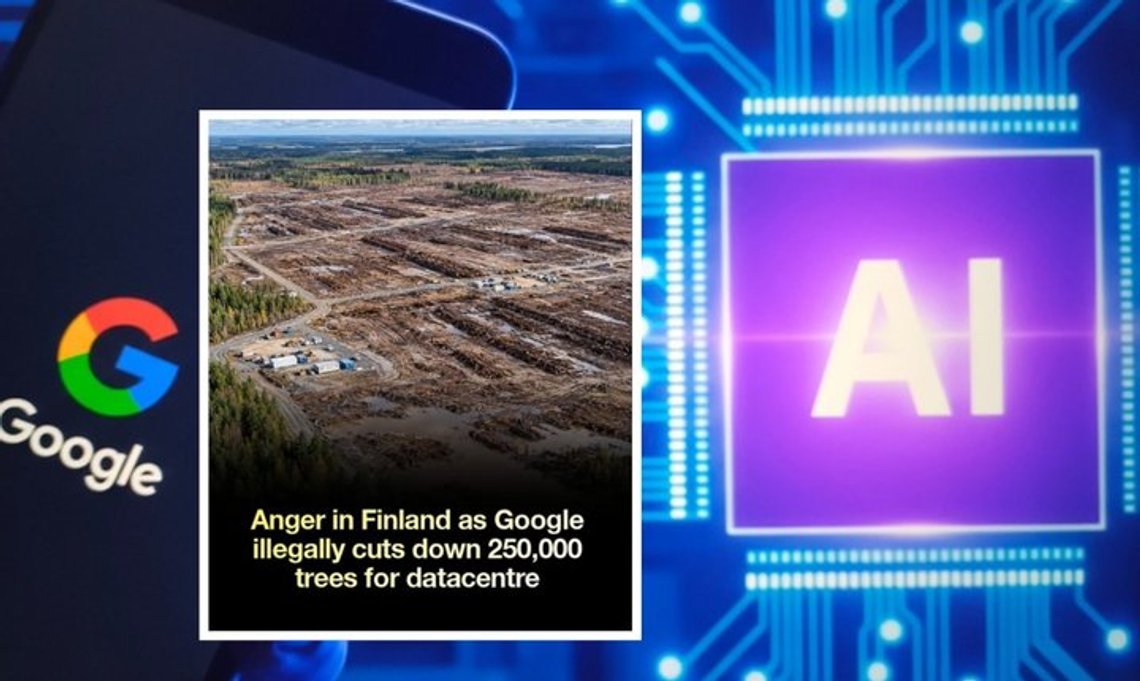


Google is accused of felling around 250,000 trees in Finland before the company had obtained the necessary permits to build data centres. Watch a video of the destruction further down the page.
The woodland areas were transformed into a muddy wasteland, and wolves moved into a nearby village in search of food after the wildlife disappeared from the forest.
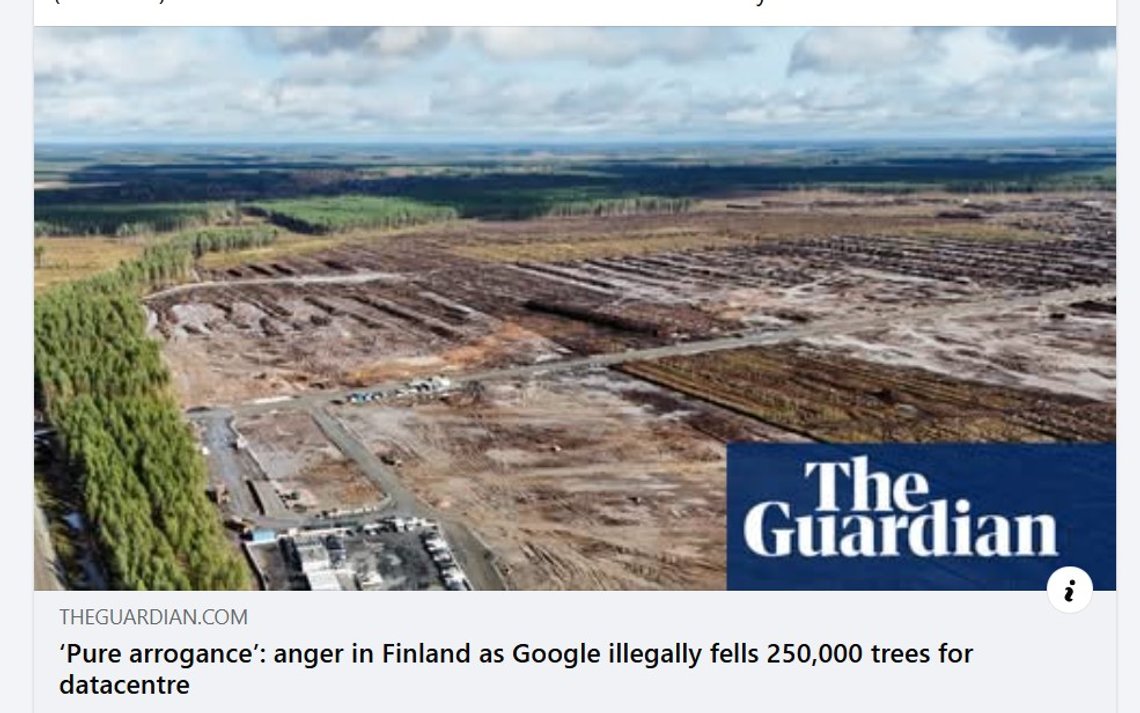
Screenshot: The Guardian.
The Finnish authorities have now halted preparations for two of Google’s data centre projects in order to assess the environmental impact, reports the New York Post.
The tech giant cleared around 330 hectares of forest in northern Finland as part of its extensive investment in artificial intelligence (AI), The Guardian reported on Thursday.
According to the newspaper, Google is accused of having started the clearing before the company had obtained all the necessary approvals. Finnish law requires large-scale projects to undergo a mandatory impact assessment before work commences.
Halted by the Finnish authorities
The felling took place near Muhos, south-east of Oulu, Finland’s fifth-largest city. Pictures from the area show a vast, devastated landscape with tyre tracks, muddy puddles and piles of earth where there used to be forest.
According to local residents, wolves have moved closer to built-up areas since the animals in the forest disappeared.
Anni Ranta told The Guardian that wolves had entered the village of Otanmäki, around eight mil from the construction site.
She also expressed concern about noise from the data centres. The area consists of hard bedrock, which may make the noise particularly noticeable.
The Finnish Licensing and Supervisory Authority gave Google’s project company, Tuike Finland Oy, until 23 October to halt all preparatory work on the projects in Muhos and Kajaani.
The head of the Environment Department, Tommi Muilu, pointed out that extensive work had already been carried out, including tree felling, the removal of topsoil, the construction of site access roads and storage areas, as well as alterations to ditches and culverts.
The tree felling also caused nearby water sources to turn brown and led to the pollution of streams flowing into the River Oulujoki.
– It is sheer arrogance
Local residents have criticised Google for proceeding without taking sufficient account of the natural environment and the local community. They have also asked the company to postpone the development and help compensate for previous environmental damage in the area.
– It’s been done the wrong way. The American way. It makes no sense. Absolutely no sense at all,” Muhos resident Antti Jakonen told The Guardian.
He urged Google to help restore the local salmon population, which was destroyed by hydroelectric development many years ago.
Hanna Halmeenpää, head of the Finnish nature conservation organisation SLL, also criticised the company’s approach.
– They bought that huge tract of land and just started felling the trees, without further ado. “It’s pure arrogance, and it’s unbelievable,” she told the newspaper.
Google’s Finnish managing director, Antti Järvinen, claimed that the company believed it had the necessary permits to begin the extensive tree felling.
Järvinen has since apologised for the damage. Google has also stated that the company will work to protect water sources and plant new trees across an area of around 130 hectares.
Conservationist Vesa Hyyryläinen questioned the extent to which environmental damage should be accepted in order to expand AI infrastructure.
“I wonder why we have to sacrifice so much of our natural environment. They’re giving it all away far too easily,” he told The Guardian.
Fears of Russian aggression
Opposition to the data centres is not just about environmental destruction. Ranta also fears that the facilities could become targets for Russian aggression in an already tense security situation in Europe.
– I don’t want them in Finland at all. I don’t like the whole idea of AI and the world changing, and the way it’s changing. It’s happening too fast, too soon,” she said.
Opponents believe Google has tried to get the development underway quickly, before Finnish legislation has had time to adapt to the rapid developments in artificial intelligence.
Google’s planned facilities near Muhos and Kajaani are situated around 145 kilometres apart. They form part of the company’s $15 billion investment in AI infrastructure in Finland, which was announced in September.
The issue has received little attention in the Norwegian media, despite the fact that Google is also building data centres in Norway, including one in Skien. NRK published a brief three-sentence NTB report that provided hardly any information on the matter.
Nettavisen quotes a comment from Google’s Head of Communications for Finland and Norway, Sondre Ronander.
– “We understand the concern that the situation has caused. In this instance, we did not meet the high standards we have set for ourselves,” says Ronander.
Sarpsborg Data Centre – Residents’ Interest Group
In Norway, too, Google’s data centre expansion is facing local opposition. In the Facebook group ‘Datacenter Sarpsborg – Residents’ Interest Group’, members have shared videos of the development in Skien.
In one of the videos, we hear Skien’s then mayor speaking enthusiastically about the planning process. The video also provides a clear picture of the extensive environmental impact on the forest area.
– Take a look at what the forest looks like where Google is building a data centre in Skien! It could end up looking much the same in Hasle if we don’t stand up and speak out! writes Pål Øyvind Tellmann Nordengen in the group.
Opposition to data centres is not limited to Norway either. A Gallup survey published on 13 May 2026 showed that 71 per cent of Americans are opposed to the construction of data centres for artificial intelligence in their local area.


