



We wrote a short while ago about the many elephants that were strutting through the streets of Arendal during Arendalsuka, Norway’s annual political gathering, which no one wanted to talk about. The biggest elephant of all, however, lies on the seabed out in the North Sea. In addition, many smaller Russian elephants sail along the Norwegian coast every single day.
The Norwegian authorities scarcely dare talk about it. The world’s largest subsea gas and oil network in the North Sea, and the many Russian LNG ships along the Norwegian coast. The French, Belgian and Spanish authorities naturally do not say a word either. And no one really wants to find out who blew up Nord Stream I and II.
We sense an infinite irresponsibility and an unpalatable double standard in Oslo as well as in Stockholm, Copenhagen, Berlin, Brussels, Paris and Madrid. And we understand that our government is incapable of safeguarding Norwegian interests.
The reality is that while the proxy war between Russia and the Western European NATO countries rages unabated in Ukraine, gas and oil exports from Russia to Europe continue. Most of the Russian gas comes with the Russian shadow fleet down along the Norwegian coast. And most of it goes precisely to Belgium, France and Spain.
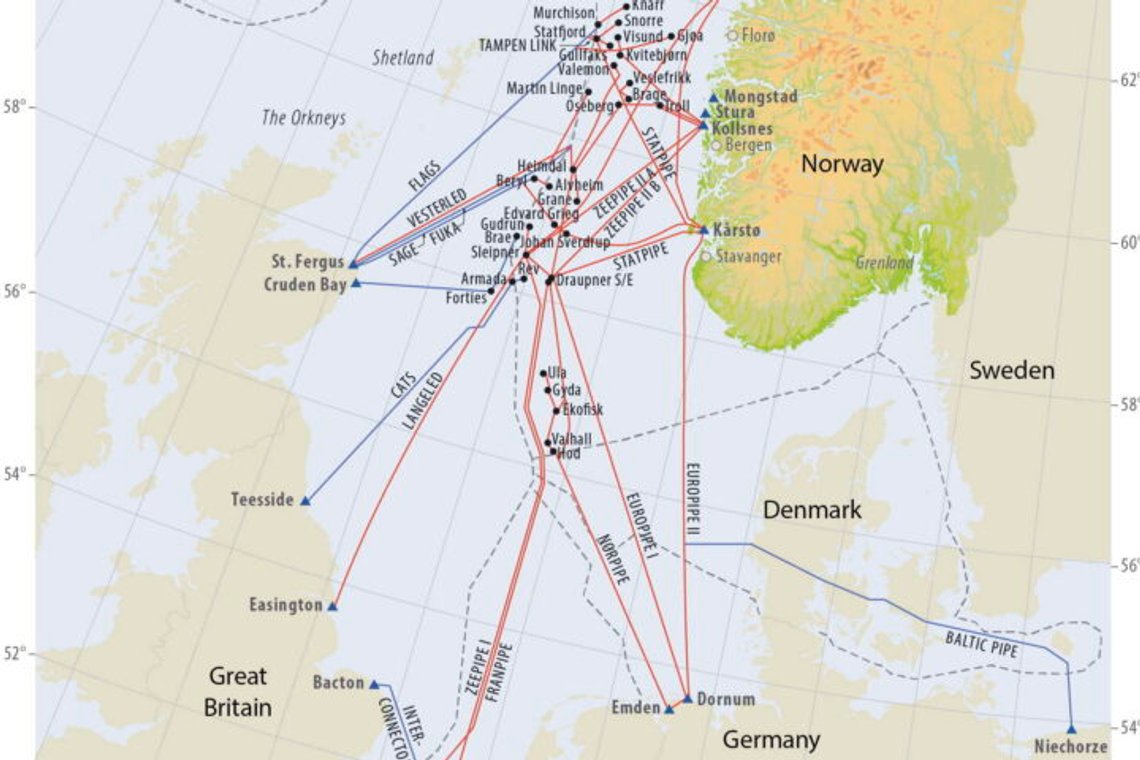
And while the war threatens to escalate further, the world’s largest subsea gas pipeline network, which supplies Europe with Norwegian gas, lies almost entirely unprotected in the North Sea. It is between 8,600 and 8,800 km long. It is difficult, and little is being done to protect it against sabotage.
Oil exports from Russia to the EU have admittedly been reduced, but oil still reaches the EU countries Hungary and Slovakia by pipeline over land, as well as several other countries in Europe through the re-export of oil and refined Russian petroleum products via third countries.
Exports of liquefied Russian natural gas to the EU, however, remain substantial, and they continue to increase. They reached a new record level of 10 million tonnes in 2026. Russian LNG worth approximately 60 billion kroner was sold to the EU in the first half of the year. Most of this gas comes with the Russian shadow fleet along the Norwegian coast.
The fact that Western European NATO countries assist Russia with export revenues, so that the Russians can keep the war in Ukraine going, while at the same time assisting Ukraine with weapons and financial support, so that the Ukrainians can keep going on their side, demonstrates the Western double standard with all possible clarity. It makes no sense. But that is not something people talk about openly in European capitals.
Today, around 17% of the EU’s oil and 30% of its gas comes from Norway. Roughly the same amount comes from the United States. But 15% of the gas still comes from Russia, the same amount as came through Nord Stream I until it was taken out of operation shortly before it was blown to pieces in 2022. The rest of the gas comes from “others”, primarily Algeria and the Middle East.
Leaving aside the war in Ukraine, the blowing up of Nord Stream I and II in the Baltic Sea on 26 September 2022 is the most extensive attack on civilian energy infrastructure in Europe in recent times. The Nord Stream explosions, however, are as nothing compared with the consequences if the gas tap in the North Sea were to be shut off by an act of sabotage.
The blowing up of Nord Stream apparently led to investigations, but these quickly ended in a deafening silence. Sweden and Denmark concluded their investigations without establishing who the perpetrators were. Germany has gone further, but four years later there is still no final, legally binding determination as to who was actually behind it.
Some believed that the Russians themselves were behind it, in order to demonstrate how dependent and vulnerable Europe is in terms of energy, and in that way put pressure on the West to bring Ukraine to the negotiating table. I myself was among those who leaned in that direction.
Others believed that the Americans were behind it, with considerable assistance from Norwegian naval forces. Document’s editorial staff took that line. The Germans now believe that the Ukrainians themselves were behind it. For the time being, the latter appears most likely. But there is still no clarification, and it is uncertain whether there ever will be.
Sweden concluded its investigation in February 2024. The prosecuting authority concluded that Swedish jurisdiction extended no further, that Swedish citizens were not involved, and that the sabotage did not threaten Swedish security. The investigative material was handed over to Germany.
Denmark did the same. The police and PET found no grounds for bringing criminal proceedings, even though the act was deliberate sabotage. It has only just emerged that in 2024 the Danish authorities rejected a German request for legal assistance with interviews on Bornholm and Christiansø, citing a possible threat to state security. The Danish authorities stated that the cooperation had moved into an intelligence track, which must be read as a signal that a full investigation and full transparency were not prioritised.
Germany, however, apparently has not closed the case entirely. The Federal Prosecutor’s Office has identified a group of around seven people, mainly Ukrainian nationals linked to the sailing yacht Andromeda. In July 2026, the Ukrainian Serhii K. was charged with complicity in a war crime, attacks on civilian objects, causing an explosion and destruction of infrastructure.
According to the accusation, he and other military personnel are alleged to have acted “on behalf of state bodies in Ukraine” in order to halt Russian revenues from gas exports. Another suspect, Vladimir Z., was arrested in Croatia on 19 August 2026.
Ukraine naturally denies state involvement and has apparently opened its own investigation. No one has been convicted. Who gave the order at the highest level remains unresolved. That is the politically explosive aspect of the case. With what we know now, I lean towards the view that the Ukrainian authorities and Zelenskyy himself were behind it.
The way the case has been handled by the Swedish and Danish authorities is striking. That it has not been investigated and prosecuted is strange. The answer to the mystery is probably too damaging to NATO and Kyiv to withstand the light of day while the war is still ongoing.
But particularly for Norway, which owns and operates Europe’s largest subsea gas pipeline network, this is not an insignificant and distant Baltic affair. It is a warning.
It is a warning that the international system of norms, international law and the law of the sea are set aside, even in the Nordic countries, when it suits and vital interests are at stake. There has simply been no interest in pursuing the case. As the owner and operator of the oil and gas infrastructure in the North Sea, this is directly contrary to Norwegian interests.
And it is a warning and a signal of how vulnerable that same infrastructure is, and of what could happen to it if the war in Ukraine escalates further.
In such a scenario, an attack on Norwegian infrastructure in the North Sea, and thus on European energy supplies, would have to be regarded not merely as a possibility, but as probable.
For the reality is that Russia, or whoever might see an advantage in doing so, can with simple means and without detection shut down the entire supply of gas, oil and electricity from Norway to Europe.
Electricity exports constitute such a small proportion of Europe’s electricity supply that it would make no difference if the power cables were cut, other than that Norwegian households would get cheaper electricity, as we did before the power cables were laid to Germany and England.
But if someone were to decide to shut off the petroleum tap, and the EU were to lose 30% of its gas supply and nearly 20% of its oil supply, it would have dramatic consequences both for volume and price in the European gas market, for the pricing of oil and gas globally and for the Norwegian economy. And it could have unforeseen military consequences.
This is the truly enormous elephant that is talked about as little as possible. That Europe continues to buy gas and oil from Russia while the war rages at full force in Ukraine is bad enough. The same is true of the fact that both Sweden and Denmark, and probably the other NATO countries, disregard international law and are not interested in investigating the blowing up of the Nord Stream pipelines. It says a great deal about the West’s pragmatic relationship with international law.
But worst of all is the vulnerability and the fact that the North Sea can be shut down by very simple means. Gassco operates a network of around 8,600–8,800 kilometres of pipelines – the most extensive of its kind in the world. With today’s technology, shutting it down is no difficult matter. It is easier to shut off the oil and gas tap in the North Sea than to close the Strait of Hormuz.
Langeled, Europipe, Franpipe, Zeepipe and the other systems are not merely commercial infrastructure. They are Norway’s most important contribution to Europe’s energy supply and the country’s most valuable strategic resource. The consequences for Norway and Europe would be severe and would affect energy prices for a long time to come.
The North Sea has become more, not less, important. After Russian pipeline gas to Europe was sabotaged, the North Sea has become a trade route, an energy province and a security and geopolitical hotspot.
Britain, Germany and France are the major players. The Netherlands forms part of the same picture. There are several possible scenarios for securing control of Europe’s energy supply.
A de facto joint condominium in which the great powers in practice coordinate surveillance, preparedness and control; a British-Dutch-French centre of gravity with Germany as both partner and potential competitor; or a more fragmented order in which each state secures its fields and pipelines in its own waters, while the small coastal states adapt as best they can. There are several alternatives.
Whichever variant prevails, the point is the same. Norway cannot content itself with being a supplier and ally. The country must position itself politically and militarily to secure ownership, jurisdiction and real influence over what happens both on and beneath the surface of the North Sea.
In a direct confrontation between East and West, the oil and gas tap in the North Sea is among the first targets that will be sabotaged or threatened. That is not speculation. It is the simple military-strategic logic of a great-power conflict. Whoever controls the flow of energy controls the opponent’s ability to wage war and maintain society.
Nord Stream showed that such installations can easily be struck without any great power openly taking responsibility, and without the international system of norms responding with the weight that international law would otherwise dictate.
So much for the Scandinavian rule of law when the case became too political. So much for international law when alliance considerations, intelligence cooperation and fear of “weakening Ukraine” or “giving Russia points” weigh more heavily than the requirement that someone be held accountable.
Norway does not need to pretend that Germany has not investigated. Germany has investigated. Nor does Norway need to pretend that Sweden and Denmark have finished the job. They have limited its scope.
What the Norwegian foreign-policy authorities should do is state clearly and unequivocally that sabotage of subsea energy infrastructure cannot become an exception to the international legal order, regardless of who carries it out. That allies, too, cannot be granted political immunity. That Norwegian pipelines and fields cannot depend on the goodwill of others when the next charge is attached at a depth of 80 metres.
There are many elephants here!
Who was actually behind the blowing up of the Nord Stream pipelines?
Why is the case not being pursued under international law?
Why does the EU continue to buy gas from Russia, thereby helping Russia to keep its war against Ukraine going?
Who stands to gain if the Norwegian gas tap in the North Sea is shut off? Cui bono?


