

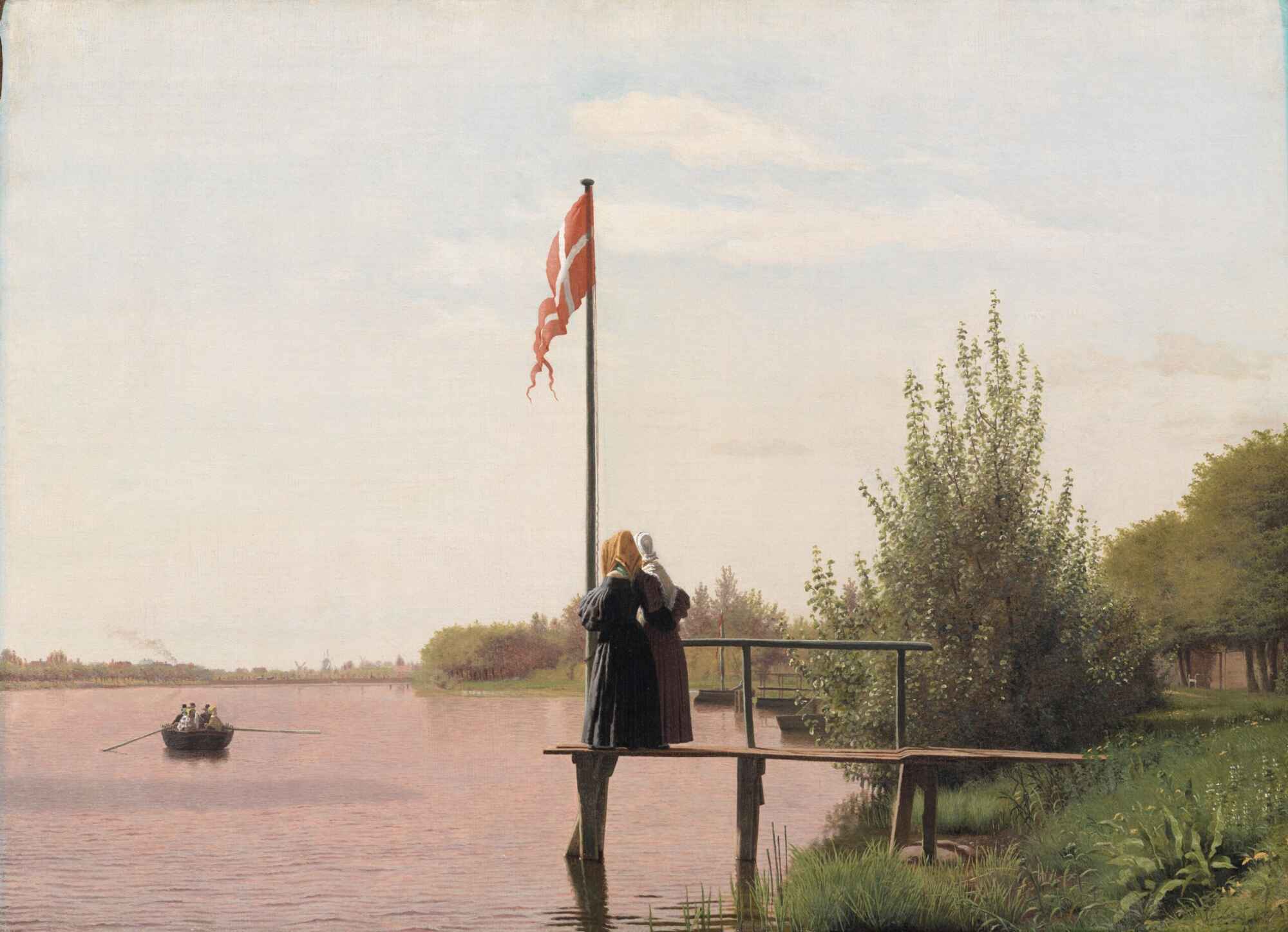
 Christen Købke (1810–1848), «View from the Dosseringen by Sortedamssøen towards Nørrebro», Statens Museum for Kunst, Copenhagen.
Mikkel Bjørn of the Danish People’s Party has written an important book about the most decisive question a people can ask itself: Who are we? And then: Who shall be one of us?
«En af os» [One of us] is precisely the title of Bjørn’s book on citizenship, and it accomplishes what others have failed to do, namely to take § 44 of the Constitution at face value and ask whom we in fact consider to be part of “we” the Danes.
 [One of us
The introduction, in which the notorious criminal Fasar Abrar Raja is described as “a foreign element in the Danish national soul” who nevertheless is a Danish citizen, demonstrates the book’s thesis: When citizenship is reduced to automatism and formalities, the state betrays both the people’s sense of justice and its own self-preservation.
The same can be said of Somalis, Syrians and Palestinians, who commit 15–20 times more rapes than persons of Danish origin. They should never under any circumstances have been granted residence, and certainly not citizenship in Denmark.
Bjørn reminds us that the right of citizenship (indfødsret) did not begin as a service law, but as national self-protection.
The Indfødsretsforordningen of 1776, drafted by Ove Høegh-Guldberg, was an original Danish work without foreign models, designed to ensure that the offices and privileges of the realm were reserved for those anchored in the Danish people, language and land.
Citizenship cannot be made into an individual claim. § 44(1) of the Constitution establishes that “no foreigner can obtain indfødsret [approximately ‘native / birth right’] except by statute”. This is a deliberate barrier against automatic entitlement. Indfødsret is instead a trust, granted by a people through its representatives, “if – and only if – it is deemed to be in Denmark’s interest”.
Danishness is not abstract principles and rights, but lived life. Mikkel Bjørn describes how his love of Denmark does not spring from a party programme, but from the hoisting of the flag in the schoolyard, communal singing and holidays around the table. Danishness is described as a “home built of generations’ memory and effort”, a house where “the scent lingers in the curtains and the stories in the walls”, and where one cannot simply move in and expect to belong, but must acquaint oneself with the essence of the rooms and be willing to bear both burdens and memories.
It is a rarely clear reckoning with the notion that Danishness can be reduced to labour-market attachment and passed tests: Danishness is not something one receives with a stamp; it is a reality one must grow into or remain outside, as Bjørn correctly writes.
The first indfødsretslov of 1850 granted citizenship to only ten persons – six Scandinavians, one Englishman and three Germans – but each name was accompanied by concrete justifications of good character, willingness to sacrifice and “patriotic disposition”.
Grundtvig, who was the first chairman of the Indfødsretsudvalget, emphasised that citizenship springs from the people’s right of ownership to their fatherland and should never be conferred without regard to “its own interest and the common good”. Today, Bjørn writes, this has been turned on its head: Where one previously asked whether someone had rendered extraordinary service meriting admission to the Danish family, the reasoning now is that everyone is entitled so long as they have not done anything extraordinarily wrong.
Bjørn’s well-founded principal attack is directed at the illusion of “objective criteria”. The so-called objective requirements in the citizenship circular are not rights, but technical minimum conditions for even being considered for the Government’s recommendation – and even then it is only a recommendation, not a guarantee, because the Parliament [Folketing] is free to amend and reject it.
It is both provocative and liberating that Bjørn openly defends a form of arbitrariness as a necessary part of citizenship policy. There exists no individual right to Danish indfødsret, only a possibility of being assessed by the representatives of the people.
Finally, the book delivers a rarely concrete reckoning with the automatism of the civil service state. Bjørn reviews one shocking example after another: politically adopted criminality controls that civil servants unilaterally set aside; a lifelong exclusion for certain convictions which in practice was never enforced because convictions are deleted from the registers; case documents that “disappear”, so that criminals such as Mohamed Jama Muse cannot be deprived of the citizenship they have acquired on defective grounds.
In the same manner, Bjørn defends character assessments and public political scrutiny of applicants’ attitudes when these clearly conflict with Danish democracy and legal order.
This is not an excess, but a consistent unfolding of the book’s fundamental view: Without political judgement and the courage to say no, citizenship becomes an empty formality, and Denmark “a name without a people”.
«En af os» is a defence of the nation’s right to define itself, and that citizenship is a gift and an obligation, not an automatic benefit. At a time when both the left and respectable conservatives prefer to avoid speaking about who in fact shall be counted as “one of us”, it is liberating that someone takes the words of the Constitution and the historical indfødsret seriously.
Denmark is not merely a system. Denmark is a home.


