

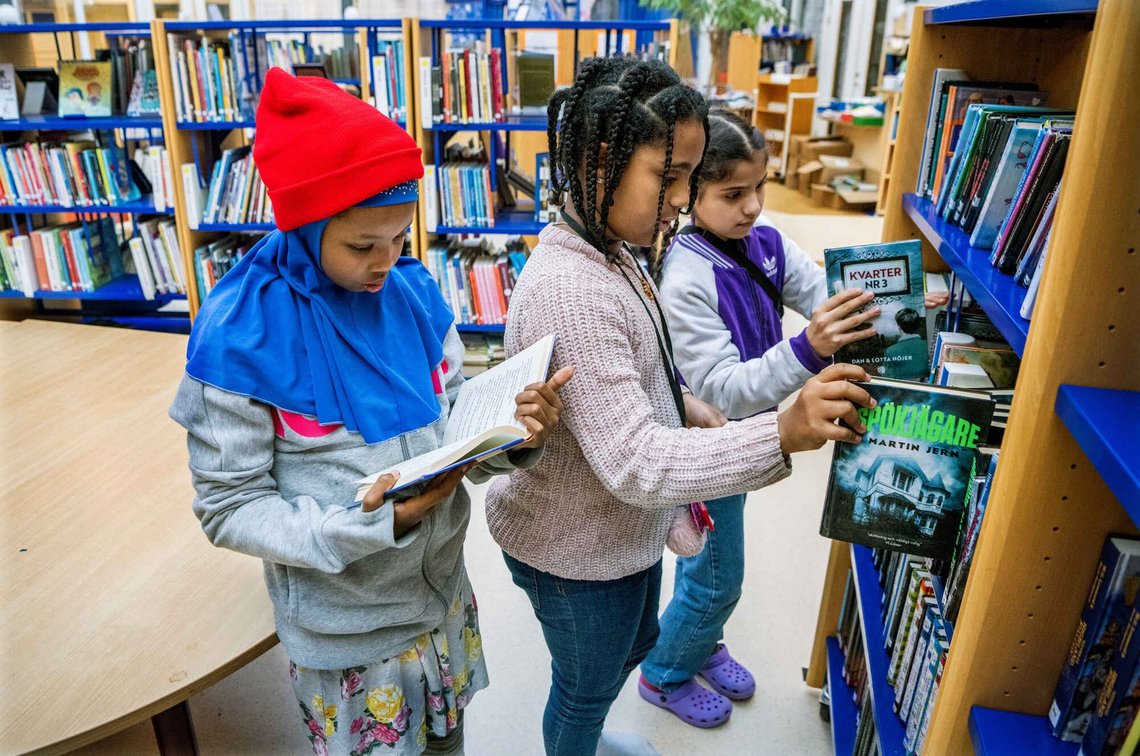


Every second 15-year-old with an immigrant background does not even possess basic skills in reading and mathematics. This is shown by a closer analysis of Swedish pupils’ results in the latest Pisa survey. Any improvement by the next survey appears unlikely. – It is catastrophic, says a teacher.
“A collapse in knowledge.” That is how the catastrophic results for Swedish pupils in the latest Pisa survey were described when it emerged that one quarter of 15-year-olds lacked basic skills in mathematics and reading comprehension.
But a closer review of the results shows that the “collapse” does not apply to ethnically Swedish pupils – they performed above average compared with peers in other countries. It is instead children with an immigrant background who are dragging the results down: In this group, every second pupil lacked basic skills in reading comprehension, mathematics and science, that is, all three subjects measured by the Pisa survey.
The differences between Swedes and immigrants are increasing
Compared with the Pisa survey in 2015, the gap between pupils with domestic and foreign backgrounds respectively has widened. The latter group includes pupils who were either born abroad or born in Sweden to parents from another country.
The Swedish National Agency for Education (Skolverket) has previously explained the differences by stating that some foreign-born pupils have spent less time in Swedish schools. But even pupils who were born in Sweden to parents from another country show significantly weaker results in all three subjects than ethnically Swedish pupils: Of the pupils who were born in Sweden but have an immigrant background, four out of ten fail to reach the minimum level in both mathematics and science.
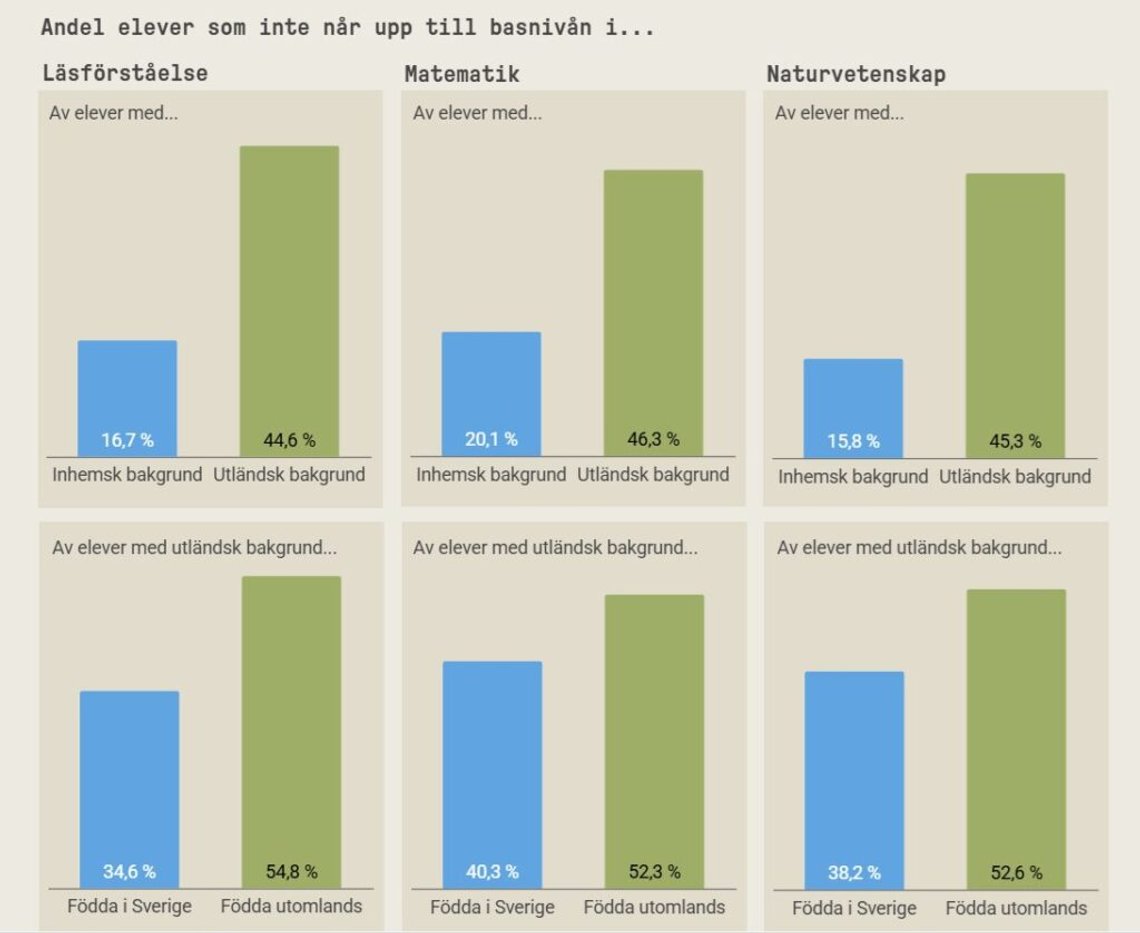
Illustration: Vi Lärare
Faults in mother-tongue instruction?
According to the teacher Anna Smit, a more probable explanation for the low performance of immigrant children is weak language proficiency. Children from families where Swedish is not spoken at home, who live in areas where they do not encounter Swedish in daily life, and who attend schools with few or no Swedish-speaking pupils, simply do not possess the prerequisites for understanding subject terminology and everyday language in teaching.
– It is catastrophic. If you do not have reading comprehension, you will not master mathematics or science either. Without the language, there are no possibilities. Swedish is alpha and omega, teacher Anna Smit tells the newspaper Vi Lärare.
This observation may simultaneously be interpreted as a defeat for the highly prioritised mother-tongue instruction. For several decades, children with an immigrant background have had the right to instruction in their mother tongue, because good proficiency in the mother tongue has been regarded as a prerequisite for learning Swedish.
The results from the Pisa survey suggest that this has been an erroneous assumption, and that it is insufficient Swedish-language skills that cause pupils with an immigrant background to fail in their schooling.
– The new normal
Between 20 and 25 per cent of Swedish schools can today be defined as low-performing, based on their weak Pisa results. According to Anders Jakobsson, professor of educational science at Malmö University, there is nothing to indicate that the results will improve in the next Pisa survey, which is to be presented in the autumn.
– The risk is that these figures become the new normal. Sweden was once world-leading in the school’s compensatory mission. Unfortunately, I cannot see that we are on our way back there.
About the Pisa survey
Pisa examines the skills of 15-year-old pupils in reading comprehension, mathematics and science. In Pisa, level 2 is regarded as a basic level necessary for further learning. Pupils who do not reach this level are defined as low-performing. The figures are taken from Pisa 2022. Source: Skolverket.


