



If you have four Norwegian-born grandparents, you will become a minority in 2048. The group to which you belong is shrinking by 10,000 people every year. Fertility does not offset natural attrition. At the same time, you are being diluted by immigration. The trend is clear, and it is linear.
On 16 June, we wrote that Norwegians are already a minority in the new Norway.
https://www.document.news/editorials/2026/06/norwegians-are-already-a-minority-in-the-new-norway
The article showed how Norwegians with family ties to Norway through their grandparents constitute a small minority among the nearly one and a half million new inhabitants who have arrived over the past 40 years. It also showed that this share accounted for less than one per cent of the increase during the past five years. Norway’s demographic transformation is dramatic. Yet politicians and the press speak largely about the “ageing wave”, while diametrically opposed cultural differences are swept under the carpet.
Despite declining educational results in spite of cross-party investment in schools, rising violence and gang crime despite massive spending on preventive measures and integration, growing healthcare waiting lists, and the fact that one in five people of working age are disabled, ill, or otherwise outside the workforce despite the OECD’s highest healthcare budget per capita, politicians and the press still offer no explanatory variables other than the ageing wave and the fact that Norway is, after all, the happiest country in the world.
Those who have familial ties to Norway still constitute a majority, but that majority is shrinking in favour of immigrants and Norwegian-born persons with immigrant parents.
And especially in favour of the fastest-growing group in Norway: third-generation immigrants and the children of imported brides, as described in the article “When Non-Norwegian Becomes Norwegian”.
https://www.document.news/opinion/2026/06/when-non-norwegian-becomes-norwegian
A minority in 22 years’ time
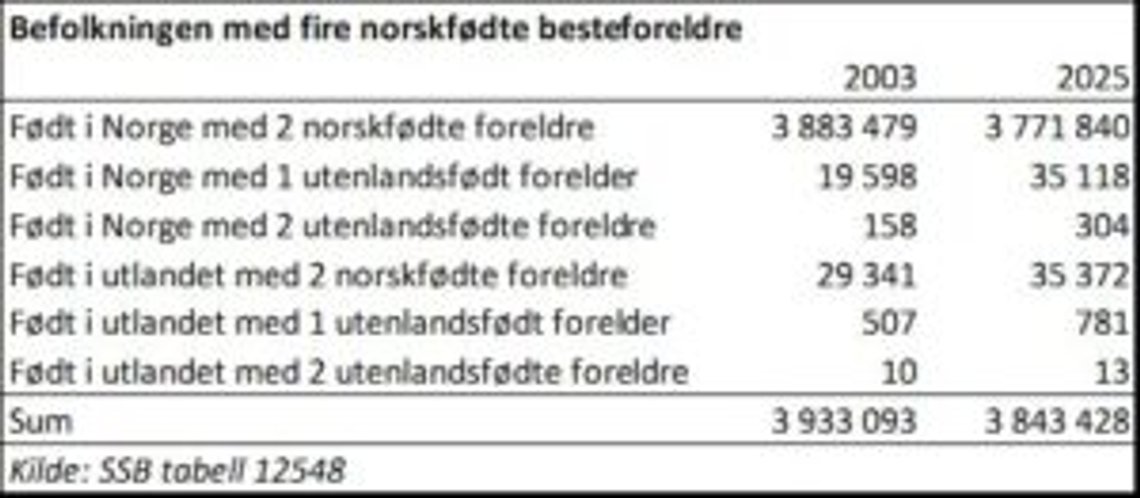
In Statistics Norway (SSB) Table 12548, Norway’s population is divided into 30 different categories across three generations: whether one is born in Norway or not, whether one has one, two, or no Norwegian-born parents, and whether one has one, two, three, four, or no Norwegian-born grandparents.
Here we take a closer look at the category consisting of those who have four Norwegian-born grandparents.
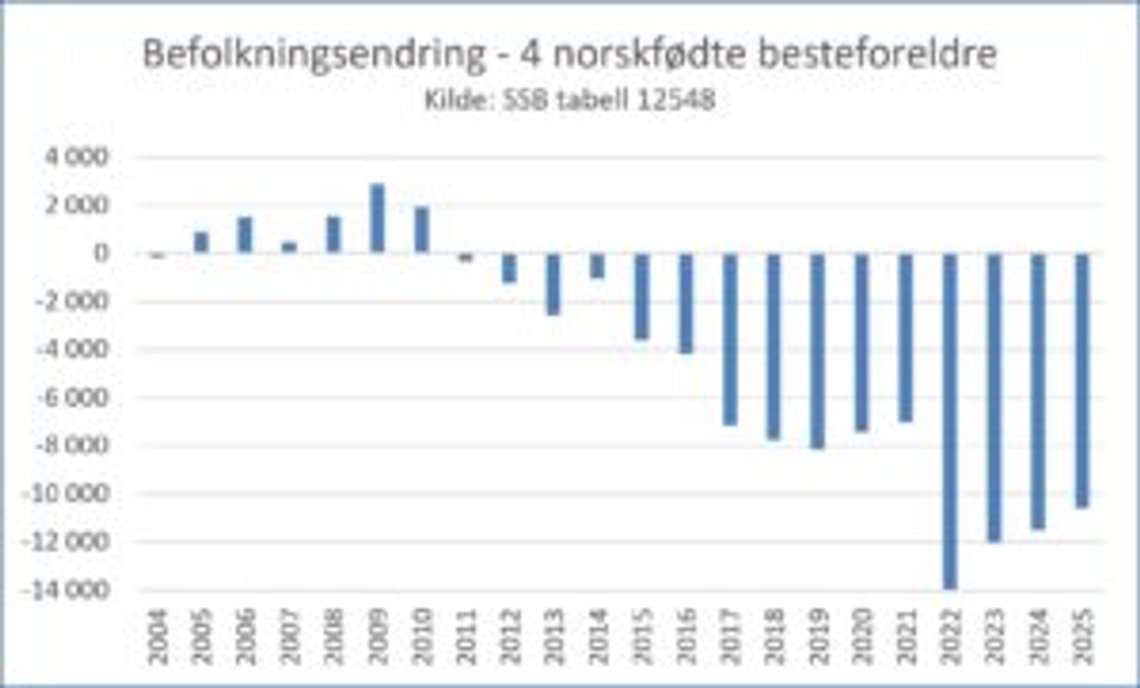
This group shows a declining trend. As illustrated in the following chart, the group has decreased by more than 10,000 persons annually over the past four years.
When this is combined with high immigration and generous tax-funded welfare benefits, the declining trend for this group will be reinforced. Consequently, what we may describe as ethnic Norwegians acquire ever less significance in defining what it means to be Norwegian.
The following chart explains this by means of a so-called correlation coefficient of 99.4 per cent. It shows this group’s share of the total population.
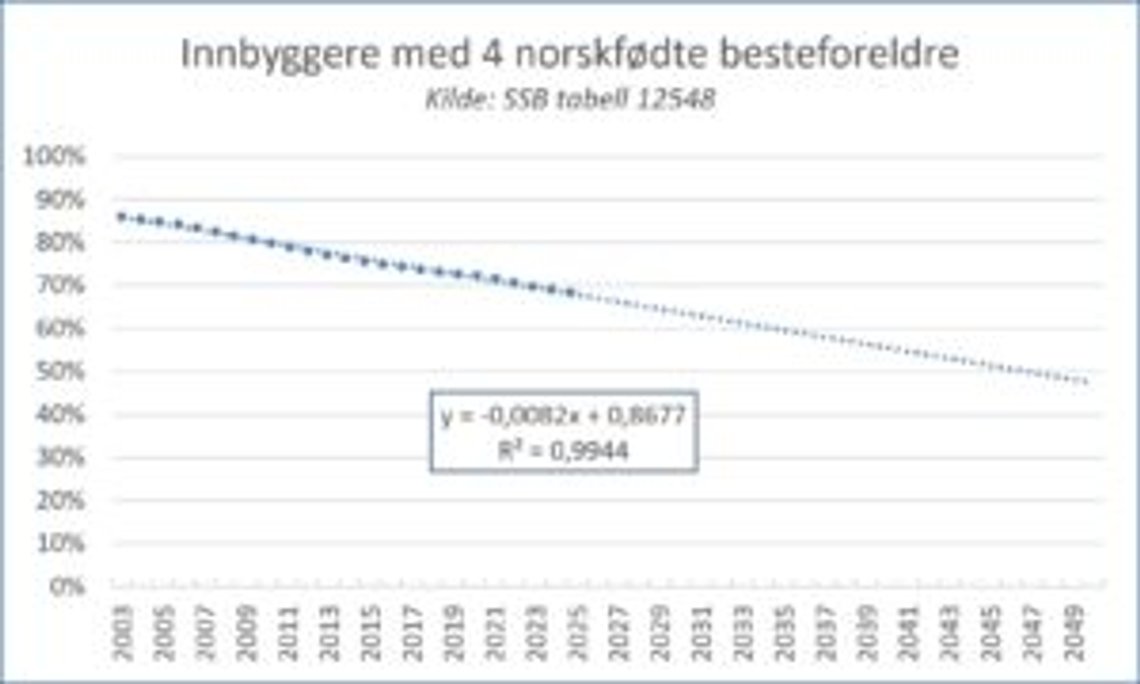
The population with four Norwegian-born grandparents has declined from constituting 86 per cent in 2003 to 68 per cent in 2025. This group’s share of the total population exhibits a linearly declining trend.
While the total population increased by 23 per cent during the period, the population with four Norwegian-born grandparents declined by 2 per cent.
The trend line through the 23 measurement points from 2003 to 2025 is linear, with a correlation coefficient of 99.4 per cent. This means that if the conditions prevailing during the measurement period remain unchanged in the future, one may estimate future outcomes with a probability of 99.4 per cent.
If the immigration policy practised during the measurement period is maintained going forward, ethnic Norwegians will constitute less than 50 per cent of the population in 2048.
If we include everyone with three Norwegian-born grandparents, they will attain minority status in 2055, that is, in 29 years. And if we are even more inclusive and include everyone with two Norwegian-born grandparents, minority status will be reached in 2065.
Current policy produces an indisputable trend. It points towards those who have family ties to Norway through their grandparents becoming a minority around the middle of this century. For today’s infants and nursery-school children, it is relevant to look at family ties to Norway through Norwegian-born great-grandparents.
This is a direct result of a deliberate policy. If it is not deliberate, then it is time for a reality check. It is important that broad sections of the population are aware of this. Attention to these facts ought to form the basis for a debate on whether such a development of Norway is desirable for oneself, one’s children, grandchildren, and great-grandchildren.


