

In 2025, Norway’s population increased by 33,000. People without kinship ties to Norway accounted for 96 per cent of the increase. Since 1985, Norway’s population has grown by one and a half million. Fewer than one quarter of these have kinship ties to Norway. Ethnic Norwegians are declining by 10,000 annually.
On Friday 12 June, Statistics Norway (Statistisk sentralbyrå, SSB) released its latest population projection. It expects Norway’s population to increase from 5.6 million to 6.2 million inhabitants by 2050, and then further to 6.4 million by the year 2100.
During the period 2000–2025, Norway’s population increased by 1.1 million. Over the next 25 years, SSB thus expects an increase reduced by almost half. This is explained by a steadily lower natural increase in births generally, which is expected to become a natural decrease in births in 2046, as well as lower net immigration compared with the preceding 25 years.
Lower net immigration is pure guesswork and something SSB has underestimated in all previous population projections.
It was also calculated that in 2032 there will be more inhabitants over the age of 65 than under the age of 20. This provided the media with a safe entry point into the issue complex – the ageing wave (eldrebølgen). Other aspects of the demographic change that is already well underway are downplayed.
What is, however, a reality is that the native Norwegian population is on its way to becoming a minority. This becomes clear when one examines SSB’s population statistics more closely.
10,000 fewer ethnic Norwegians every year
The first impression is that eight per cent of the 33,000 new inhabitants added during the past year are without an immigrant background. But that is not correct.
SSB’s definition of immigrants and Norwegian-born descendants is persons with two foreign-born parents and four foreign-born grandparents.
All other categories are regarded as part of the majority population. For example, a person with one or two Norwegian-born parents, but four foreign-born grandparents. These account for more than 20,000 people and are growing rapidly. This is typically the third generation of immigrants, often where one of the parents has come from the country of origin.
The population with four Norwegian-born grandparents, by contrast, declined by more than 10,000 for the fourth consecutive year and now constitutes only 68 per cent of the population. Twenty years ago, they constituted 85 per cent.
The following figure shows the annual change in the part of the population with four Norwegian-born grandparents.
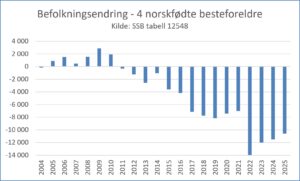
If we also include those with two and three Norwegian-born grandparents in the group, it increased by a modest 219 individuals and constitutes 77 per cent of the population.
This means that the overwhelming majority among the aforementioned eight per cent had only one or no grandparents born in Norway and therefore at most highly limited kinship ties to the country.
Norwegians – a minority in the new Norway
SSB has annual population figures from 1985. During the 40 years up to and including 2025, Norway has experienced tremendous population growth and demographic change. During the period, the population increased by almost 1.5 million, to 5.6 million. Three out of four new compatriots have either immigrated or were born in Norway to two immigrant parents.
The following table shows population growth in Norway during the period 1985 to 2025, using the definition of immigrants and Norwegian-born descendants, divided into five-year intervals.
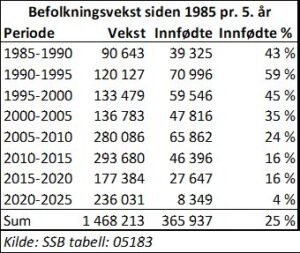
At the beginning of the 1990s, people with Norwegian-born parents accounted for more than half of the increase. Thereafter, people with kinship ties to Norway have become a small minority among new inhabitants. In the five-year period 2020–2025, they apparently accounted for only 4 per cent of the increase. A fraction of the level in preceding periods. This is because increasing life expectancy no longer compensates for low birth rates in the original population.
But the dilution is greater than the table suggests.
Underreporting immigrant background
The table above shows that only one in four new inhabitants over the last 40 years has one or two Norwegian-born parents. Even fewer have Norwegian-born grandparents.
If we include more detailed data from 2005 onwards, the picture becomes quite different. In the following table, everyone with four foreign-born grandparents is defined as having an immigrant background.
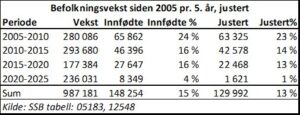
We then see that the 8,349 who constituted 4 per cent of the increase in the latest five-year period were reduced to 1,621 and only 1 per cent.
We may therefore conclude that of a net population increase of 236,031 in the period 2020–2025, only 1,621, i.e. 0.7 per cent, have any kinship ties to Norway. And we may establish that of a population increase over the last 20 years of more than 987,000 inhabitants, only 13 per cent have such kinship ties.
This naturally has major cultural implications, while academia, politicians and the press in general largely focus on the ageing wave, as though immigrants do not also grow older.
Asians and Africans in the majority
But who are the new inhabitants and where do they come from?
Half (49 per cent) of the new population since 1985 originates from non-Western countries; Asia, Africa, Europe outside the EU/EFTA, and Latin America and Oceania excluding Australia and New Zealand.
Thirty-five per cent of all new inhabitants since 1985 originate from Africa and Asia, either as immigrants or Norwegian-born with immigrant parents. The figure is probably somewhat higher with reference to the observations above.
Altogether, the population of African or Asian origin numbers at least 552,000 and today constitutes one in ten inhabitants of the country. In Oslo, they constitute one in five. But among the new population since 1985, they account for more than one in three. In addition come those with one or two Norwegian-born parents, but four foreign-born grandparents.
African and Asian inhabitants often originate from an Islamic country, defined as a member of the Organisation of Islamic Cooperation (OIC). These now constitute 6 per cent of Norway’s population, but as much as 21 per cent of the new population since 1985.
The following table shows developments over the last ten years.
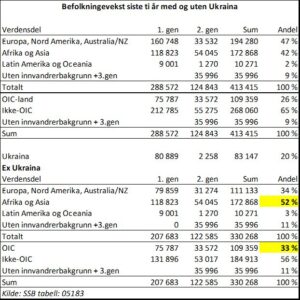
Here we see that people from Africa and Asia account for 42 per cent of population growth over the last ten years. This decade has been characterised by refugees from Ukraine since Russia’s invasion in 2022.
If we assume that Ukrainians return home when the war is over, and remove the growth in the number of Ukrainians from the equation, 52 per cent of new inhabitants over the last ten years originate from an African or Asian country. And one third of our new compatriots are from an Islamic country.
In addition, we see that Norwegian-born persons with parents from Islamic countries accounted for approximately the same increase as that among those with Norwegian-born parents. And it is accelerating. During the last five years, the increase among Norwegian-born persons with parents from Islamic countries was twice as large as the growth in the majority population.
With this development, people with origins in Africa and Asia will sooner or later become a majority in Norway.
This ought to give rise to more important discussions than merely those concerning challenges associated with the ageing wave. Because ageing waves, like all other waves, pass. But not necessarily cultures and religions that come into conflict with Western values and ideals of freedom.


