


NAV proclaims that the ‘ageing wave’ will drive National Insurance expenditure skywards, and signals higher taxes. But most of the National Insurance expenditure is spent on people of working age. Statistics Norway’s (SSB) figures show that this group is dominated by non-Western immigrants, especially from Islamic countries. But Nav does not disclose this. Nor does the Minister of Finance Jens Stoltenberg, who is responsible for the policy that has made this possible.
As Minister of Trade and Industry and Energy, and subsequently Minister of Finance in the 1990s, Prime Minister twice after the turn of the millennium, and now again Minister of Finance, Jens Stoltenberg – through a series of sins of omission (unnlatelsessynder) that include the absence of pension reform in the public sector and political short circuits such as the notion that immigration is profitable – is responsible for something that has resulted in a seemingly unmanageable growth in public expenditure.
Since Stoltenberg in 1993 first joined the Council of State (statsrådkollegiet) as Minister of Trade and Industry and Energy in Gro Harlem Brundtland’s third government, state expenditure has increased nominally from 374 billion kroner to last year’s 2,100 billion kroner. The state has become more extensive than ever, with National Insurance accounting for one third of expenditure last year.
“The cannot-work wave”
Most people think of old-age pension when the term National Insurance arises. But old-age pension constitutes less than half of National Insurance expenditure.
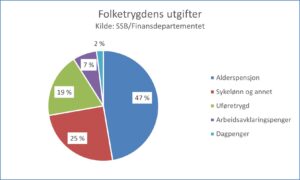 Old-age pension constitutes only 47 per cent of National Insurance expenditure.
National Insurance is, as is known, financed through National Insurance contributions (folketrygdavgift) via the tax assessment and through employer’s contributions. In National Insurance, one is not credited for income higher than 7.1 G. Thus, a significant redistribution is already built into the scheme.
But when the “ageing wave” is pointed to in describing the future financial challenges of National Insurance, one could just as well explain it by the “cannot-work wave”. Generous schemes for sickness absence, disability, and work assessment allowance (arbeidsavklaringspenger) for people in the age group 18–66 place a greater burden on National Insurance than old-age pensioners. And those who benefit from these schemes have not paid in anywhere near what old-age pensioners have done.
The latter, moreover, have 85 per cent deducted from their accrued pension if they should be unfortunate enough to end up in a nursing home.
Revised National Budget is explicit
Document assumes that Director of Department in Nav, Ole Christian Lien, has read what is stated about National Insurance in the Revised National Budget (revidert nasjonalbudsjett) for 2025.
Page 9:
It is thus stated in black and white that it is increased expenditure on people of working age that pushes upwards. In this stratum, non-Western immigrants are overrepresented, especially those from Islamic countries, as we shall demonstrate below.
Furthermore, the pension reform for National Insurance has already begun to bear fruit, seen from a public finance standpoint, as described on page 34 of the Revised National Budget.
and
The positive effect of the pension reform becomes apparent when National Insurance expenditure is viewed in relation to the state’s total expenditure and total transfers.
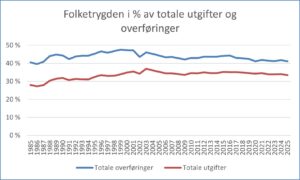 National Insurance expenditure in relation to the state’s total expenditure and transfers. Source: SSB.
The following figure shows that National Insurance old-age pension has been between 45 and 48 per cent of National Insurance’s total expenditure over the past ten years.
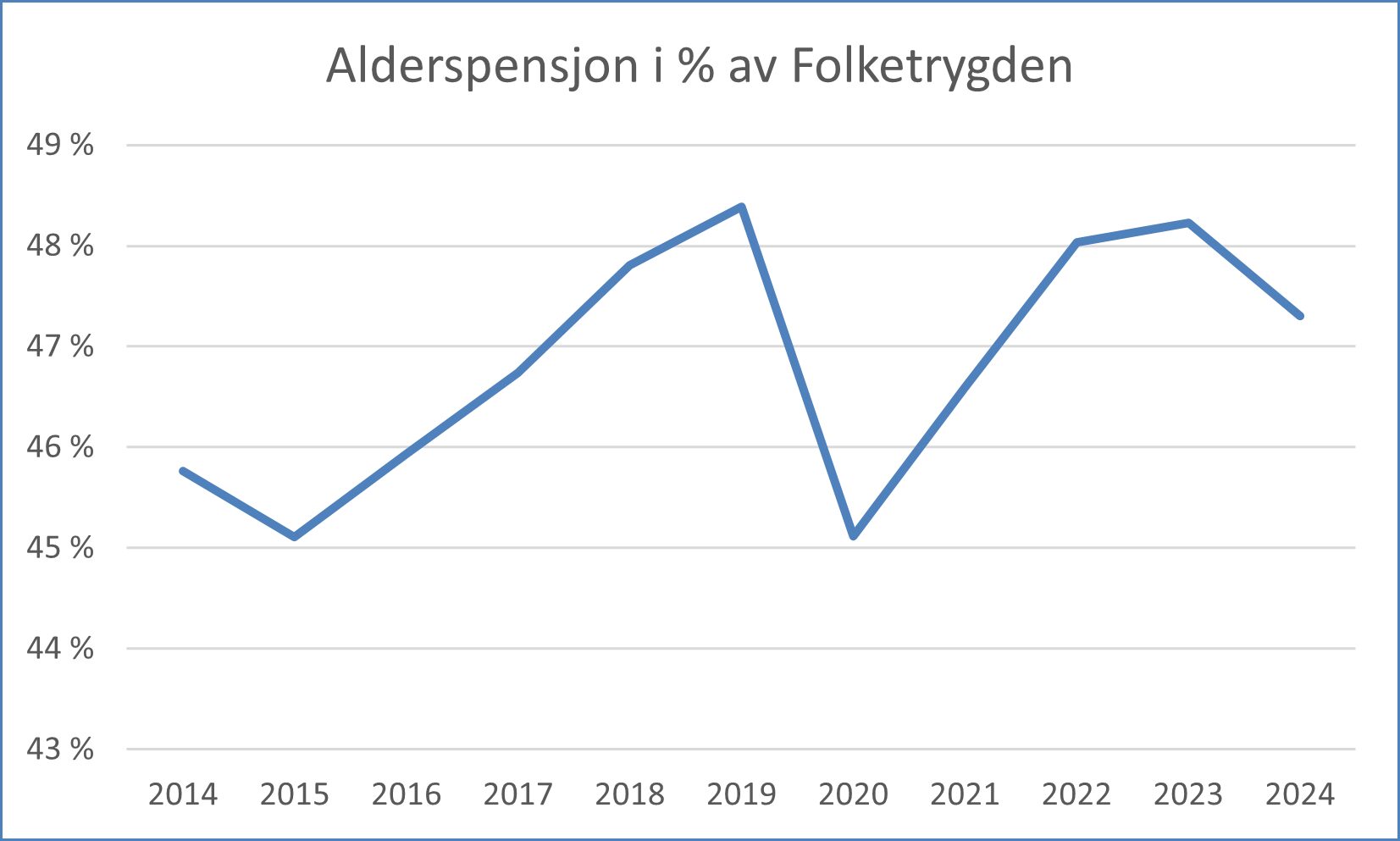 Old-age pension as a percentage of National Insurance expenditure. Source: SSB
But this is omitted in the following statement from the Nav official:
– That more of value creation going forward must be used for National Insurance is due to the share of those over 67 years increasing, and because there is likely to be weak growth in the population of working age, says Director of Department in Nav, Ole Christian Lien, in a press release.
– If the entire increase in National Insurance were to be financed through higher taxes, each taxpayer would on average pay 13,000 kroner extra per year, he adds.
Immigrants from Islamic countries drive up expenditure
It is convenient to point to the elderly who through a working life have paid the National Insurance contribution via the tax assessment and are approaching retirement age. It becomes immediately more difficult to illuminate the facts when the crux of the matter lies among non-Western immigrants, and not least if it concerns immigrants from Islamic countries. Then, as is known, the label of racism is readily applied.
In SSB’s publication of 16 January on social assistance (sosialhjelp), they wrote the following:
Document wrote about the matter on 10 April 2026.
Innvandrere i arbeidsfør alder mottar 74 prosent av utbetalt sosialhjelp
Social assistance admittedly falls outside National Insurance. But social assistance is connected to lack of participation in the labour market. So too are disability benefit, sickness benefit, and work assessment allowance, which together constitute a greater burden on National Insurance than old-age pension. And there is a clear connection between these expenditures and lack of employment.
The following table shows immigrant groups with seven years’ residence or more, which qualifies for Norwegian citizenship, in the age interval 20–66 years, sorted by employment rate of 60 per cent and lower.
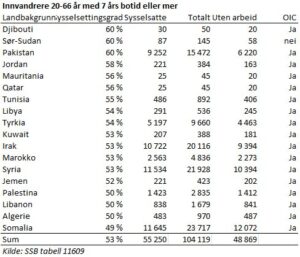 Immigrants with seven years’ residence or more are at the bottom of employment statistics. OIC = Organisation of Islamic Cooperation.
Of well over 104,000 immigrants in the age group 20–66 years with seven years’ residence or more, and an employment rate of 60 per cent or lower, nearly 49,000 (47 per cent) are completely outside the labour market. All, with the exception of 58 individuals from South Sudan, come from countries that are members of the OIC: Islamic countries.
The contrast is large with immigrant groups in the same age interval, with the same length of residence, but with an employment rate of 80 per cent or higher.
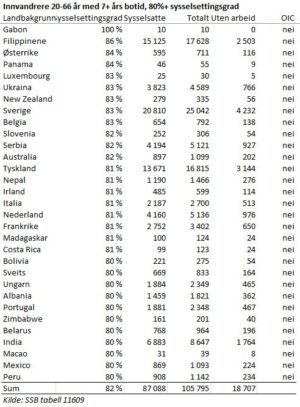 Immigrants with seven years’ residence or more who are at the top of employment statistics.
The group is approximately the same size as the previous one, just under 106,000 individuals. None have a background from Islamic countries. Also note the Ukrainians who have been in Norway for some time.
This undoubtedly has an impact on National Insurance, social expenditure, and the entire spectrum of tax-financed services that the welfare state provides.
Increased life expectancy without a corresponding increase in retirement age, combined with a population of working age that contributes less than previously, is an obvious challenge. And it is naturally not reduced when the lack of contribution is linked to immigration combined with generous tax-financed schemes, the burden of which is distributed among ever fewer. But these are political choices over which, among others, Jens Stoltenberg has presided for more than 30 years in Norwegian politics.


