

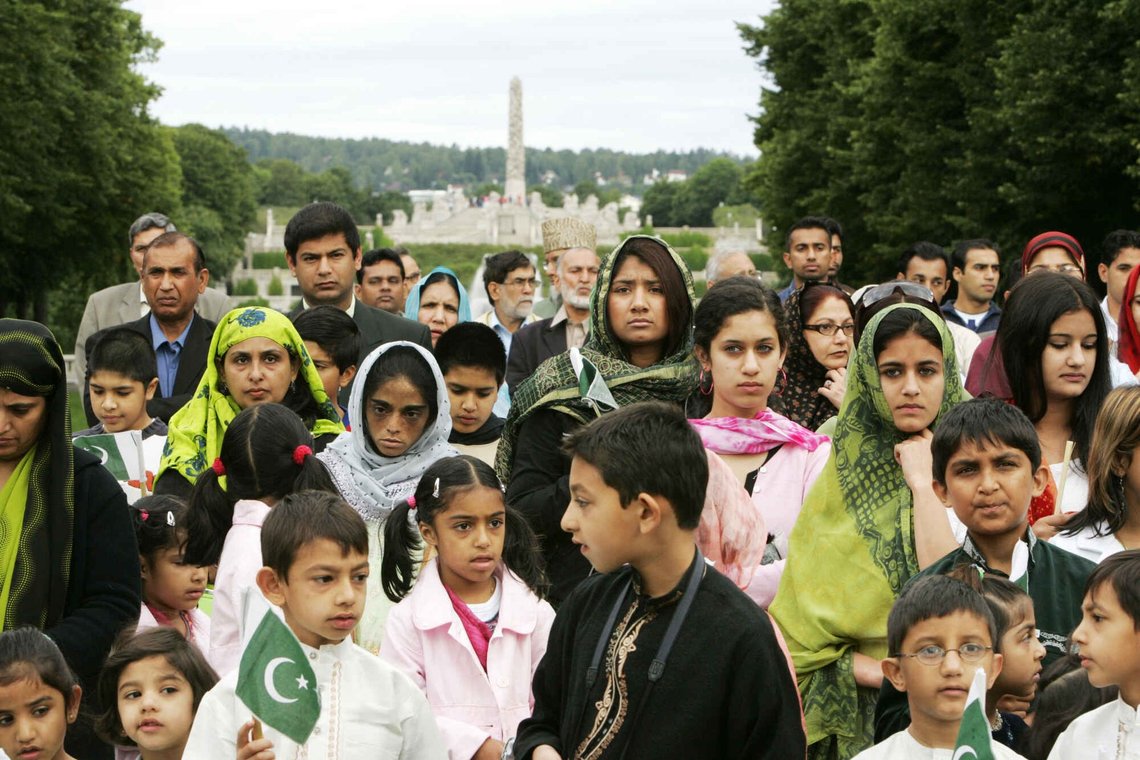
If you have grandparents from Pakistan and a mother who was a marriage migrant bride, you are as Norwegian as the Hardanger fiddle and brown goat’s cheese. At any rate, you are counted as part of the majority population. It requires only that one of your parents was born in Norway.
First: If the reader reacts to the term “marriage migrant bride”, reference is made to a linked article from Aftenposten in 2014.
To become a citizen of Kuwait, your grandfather must have been born in Kuwait. Similar and even stricter rules are practised in the wealthy Gulf states. But not in Norway. Here, you may have four grandparents born abroad and still be part of the majority population. It is sufficient that just one of your parents was born in Norway.
The official statistics as of 1 January 2026 showed a population of 5,627,400 persons. Of these, 987,121 have the status of immigrants in Statistics Norway’s (SSB’s) statistics, while 238,504 have the status of Norwegian-born with immigrant parents. Consequently, 4,401,775 are counted as the “remaining population” or as having “no immigrant background”.
But is that entirely accurate? SSB presents a more nuanced picture that is less well known (SSB Table 12458). There one finds the population divided into 30 different groups, depending on whether one was born in Norway or not, whether one has one, two or no Norwegian-born parents, and whether one has one to four or no Norwegian-born grandparents.
Those who in the official statistics are defined as immigrants or Norwegian-born with immigrant parents have two foreign-born parents and four foreign-born grandparents.
This means that you may have four foreign-born grandparents, one or two Norwegian-born parents, and yourself either have immigrated or been born in Norway; nevertheless, you are counted as part of the majority population.
Statistically speaking, one is then Norwegian (in addition to holding a Norwegian passport), even if family ties and roots in Norway neither exist nor are cultivated.
For example, many Norwegians appeared in Gaza after the war there broke out on 7 October 2023. Aftenposten wrote about the “Gaza Norwegians” that 130 of the evacuees had no residence in Norway. It turned out that many of them had no connection to Norway and did not speak Norwegian either. Yet under the current rules they are nevertheless Norwegians and part of the majority population.
Those with No Family Ties to Norway Are Growing Fastest
If we exclude SSB’s categories of “immigrants” and “Norwegian-born with immigrant parents”, the majority population appears as in the following table, ranked according to how many Norwegian-born grandparents one has.
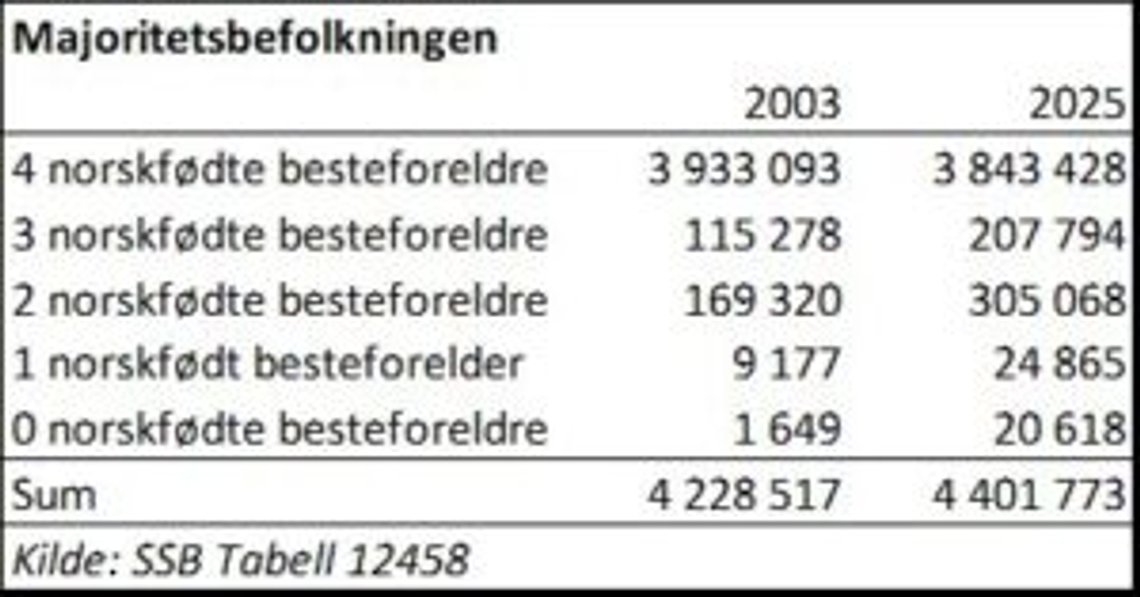
The figures shown are for 2003, when the SSB data series began, and for 2025.
The part of the majority population that has no Norwegian-born grandparents has now grown to more than 20,000 people. That corresponds to the population of towns such as Horten, Harstad and Lillehammer. This segment of the majority population is the fastest-growing in Norway.
The following chart compares growth in the different parts of the majority population depending on whether one has grandparents born in Norway or not, and, if so, how many Norwegian-born grandparents one has.
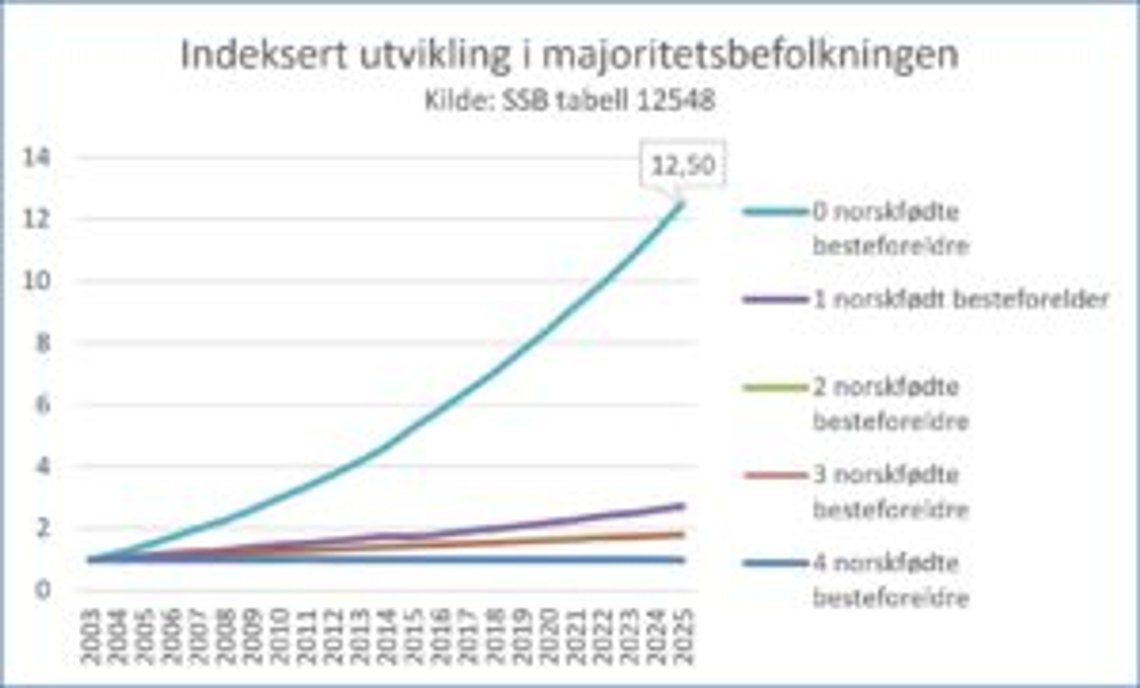
The chart shows that the part of the majority population that has no family ties to Norway through grandparents is growing exponentially compared with the other segments. Indeed, even compared with those who have only one grandparent born in Norway.
Explosive Growth of “Third-Generation Immigrants”
The segment of the majority population that has no Norwegian-born grandparents is shown in the following table:
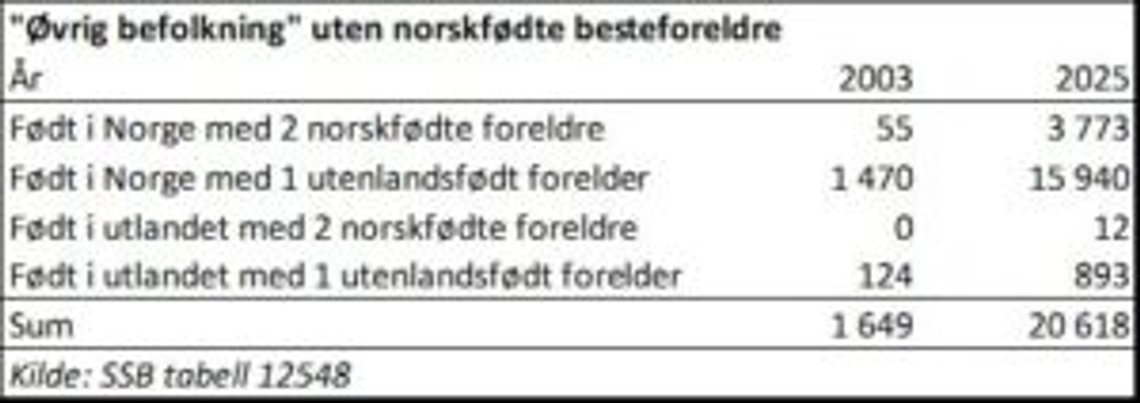
What dominates is Norwegian-born persons for whom one or two parents were born in Norway. This is what is typically referred to in everyday speech as “third-generation immigrants”. It is by far the fastest-growing part of the population. The largest subgroup is that in which one parent was born in Norway while the other immigrated. This often involves a “marriage migrant bride”, as Aftenposten described it, or a “marriage migrant groom”, as VG writes about in the following.
This is widespread among residents of Pakistani and Somali origin, but also among residents with family ties to other countries in Africa, the Middle East and South Asia. Marriage migrant brides and marriage migrant grooms are a reality. With Norway’s highly generous oil-funded welfare state, a marriageable Norwegian-born bride or groom is a valuable bargaining chip in typical clan cultures.
We were reminded of this when the Venstre politician Abid Raja had his reconciliation meeting with his father in Pakistan, reported by VG. What VG did not write was that the reconciliation meeting took place at a wedding in Raja’s extended family, where a developmentally disabled Norwegian-born woman married a close relative from Pakistan, described by Sarah Gaulin in Nettavisen. The newly married couple may move to Norway, and their children will become part of the majority population.
The conclusion is that being Norwegian has come to mean many different things. There are probably as many definitions as there will eventually be emerging subcategories.


