

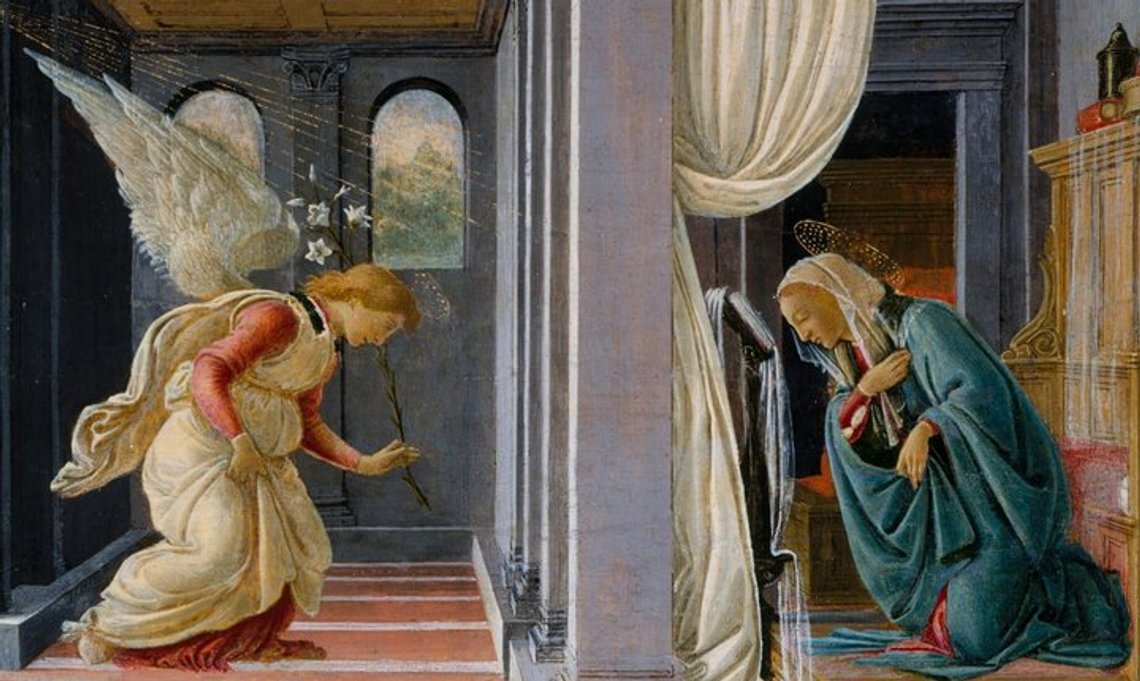


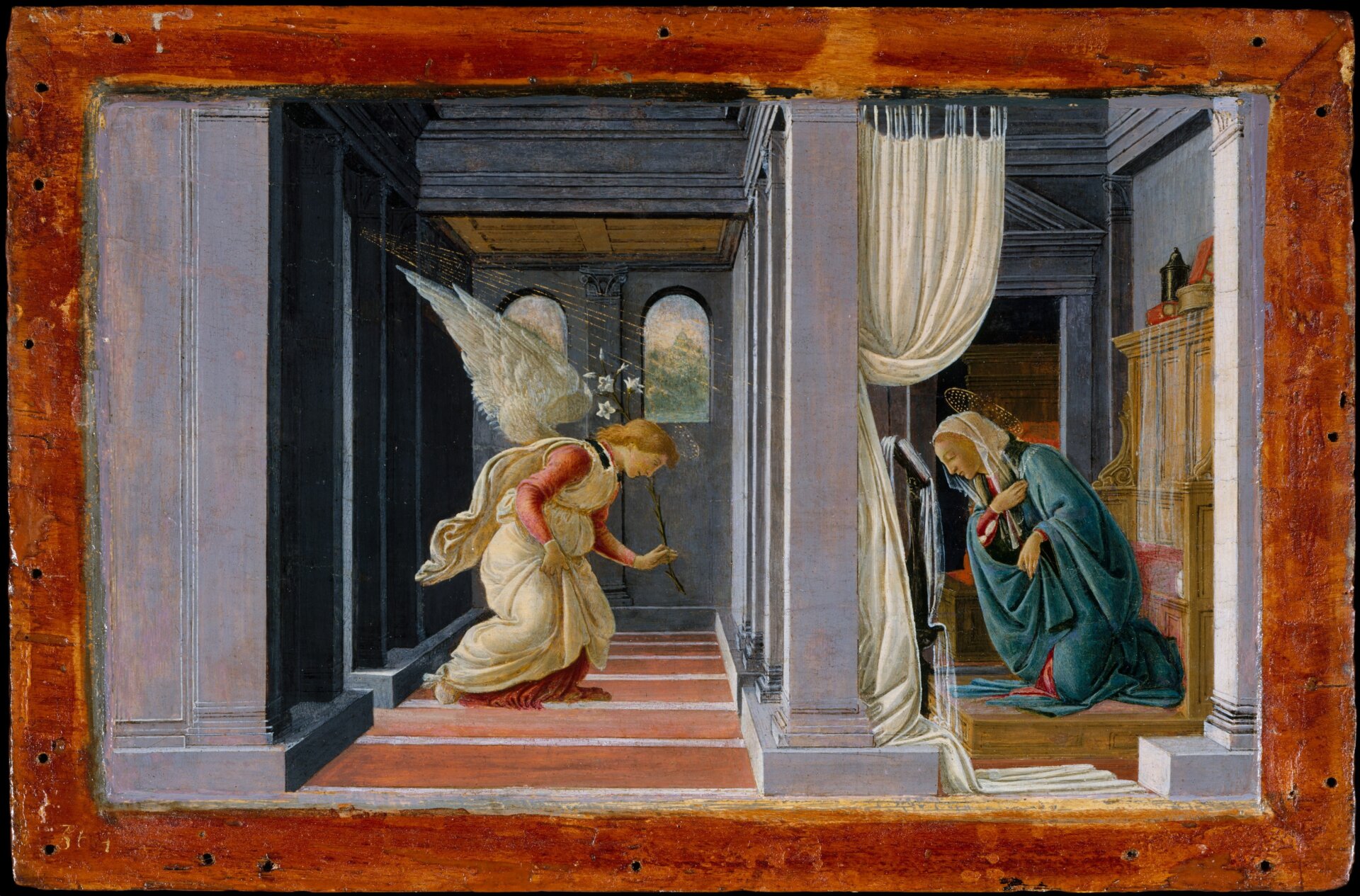
Sandro Botticelli (1445–1510), ‘The Annunciation’, Metropolitan Museum of Art, New York.
16 He also went to Nazareth, where he had been brought up, and on the Sabbath he went into the synagogue, as was his custom. When he stood up to read, 17 they handed him the book of the prophet Isaiah. He unrolled the scroll and found the passage where it is written:
18 The Spirit of the Lord is upon me,
for he has anointed me
to proclaim good news to the poor.
He has sent me to proclaim
that captives shall be set free
and the blind to see again,
to set the oppressed free
19 and to proclaim a year of the Lord’s favour.
20 Then he rolled up the scroll, handed it back to the synagogue attendant and sat down. Everyone in the synagogue was watching him intently. 21 He then began by saying, ‘Today this scripture has been fulfilled in your hearing.’ 22 Everyone praised him and marvelled at the gracious words that came from his mouth. ‘Isn’t this Joseph’s son?’ they asked.
Luke 4:16–22
Today is the first Sunday in Advent, the first Sunday of a new church year and the start of what is, for me, the most beautiful time of the year. We wait and prepare for the great miracle, the Incarnation, when God came down to us and became human. The word ‘Advent’ comes from the Latin ‘Adventus Domini’, which means ‘the coming of the Lord’.
However, fewer and fewer people are observing the Advent season; it has almost disappeared from public life. It is as though we cannot bear to wait, but go straight to the festive season and celebrate it throughout December. At the same time, it strikes me that it is not the substance of the festive season that is celebrated, but the trappings, with their decorations and fine food. The infant Jesus as the Son of God is scarcely mentioned; he has become a stranger in public Norway.
The claim that those who reject him will be damned is perceived as blasphemy. Secular, individualistic and open-minded Norway likes Jesus as a great teacher of ethics and morality, but not as the incarnate God who says ‘follow me’. Modern people, after all, prefer to follow their own path and their own will. We therefore reject a God whom we perceive as ‘discriminatory’, because he does not allow us to determine the path to salvation for ourselves. Yet it is a God who takes the initiative and comes to meet us that we hear about in the readings on this first Sunday in Advent. It is only in Him that it is possible to find salvation, and God cannot set this aside without denying Himself, yet He will do everything to ensure that we find it.
The Gospel reading from Luke 4:16–22 is particularly interesting at the start of the Advent season. It is not merely about Jesus’ public ministry, but about who Jesus is, what mission he has been given, and how he himself understands the relationship between his ministry and the prophecies of the Old Testament.
Jesus is handed a scroll containing the Book of Isaiah and reads from Isaiah 61:1–2, adding a passage from Isaiah 58:6. He chooses the text himself and concludes his reading with a remarkable declaration:
‘Today this scripture has been fulfilled in your hearing.’
This is a powerful messianic self-revelation. Jesus is in effect saying: What Isaiah prophesied has now come to pass; I am the one to whom the prophecy points. He places himself at the very heart of Israel’s history and in the fulfilment of God’s promises to his people. But it is not only himself that he presents; it is the Trinity that is revealed to us in the light of Jesus’ words.
When Jesus says that the Spirit of the Lord is upon him, that the Lord has anointed him and that he himself is the one sent to carry out the mission, this is a pattern that recurs throughout the New Testament. We bear witness to the fact that the Lord sends the Son, and the Holy Spirit is upon him and equips him for the mission. Jesus does not stand alone in his mission. He comes from the Lord and works in the power of the Spirit.
We thus encounter a clear triad: the Spirit, the Lord who anoints, and, in addition, the one who is anointed.
Some might say that this is not ‘proof’ enough for the doctrine of the Trinity, but it is hard to ignore the fact that Jesus repeatedly points to the three persons of the Godhead. It is particularly interesting that Jesus does not present himself exclusively as a moral teacher, but as the Son of God. He comes with a mission from the Father, empowered by the Spirit, to save his people in the fullest sense of the word.
We should therefore also take note of what Jesus does not read in the synagogue on this Sabbath: Jesus stops short of Isaiah 61:2, where it says ‘a day of vengeance from our God’.
This does not mean that judgement has been cancelled. But it emphasises that Jesus’ first coming is characterised by the offer of grace. He comes to save.
It is the celebration of this – that the Son of God became human, with the aim of saving us – that we are to prepare for during Advent. If Jesus is not the Son of God, there is nothing to celebrate. He could have left humanity in its lost state, but love had other plans. He chose to become one of us, to bring us back to himself. The world has never seen a greater declaration of love.
Have a blessed Advent season!


