
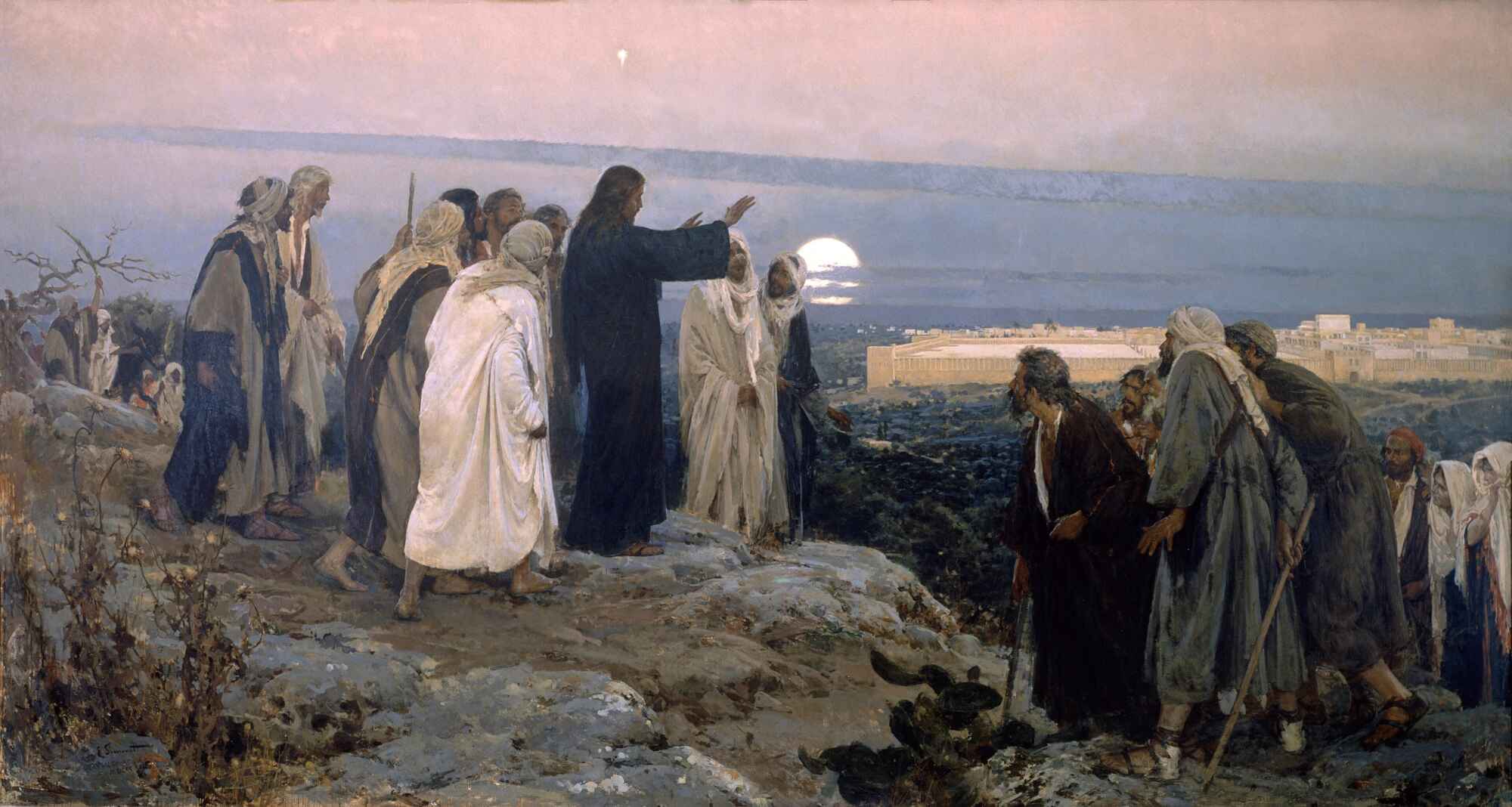
Enrique Simonet (1866–1927), «Jesus weeps over Jerusalem», Museo del Prado, Madrid.
41 As he came nearer and saw the city, he wept over it 42 and said: “If you, even you, had only understood on this day what serves for peace! But now it is hidden from your eyes. 43 Days will come upon you when your enemies will cast up a rampart around you, surround you and press in on you from all sides. 44 They will dash you and your children to the ground, and they will not leave one stone upon another in you, because you did not understand that the time had come when the Lord visited you.”
Luke 41–44
Even among those who do not remember much of the background to the feast we are now entering, many will recall three things: the entry into Jerusalem, commemorated this Palm Sunday, where jubilant crowds lay down palm branches and their cloaks for Jesus as he approaches the city riding on a donkey; the crucifixion on Good Friday; and the resurrection on Easter Day.
But from beginning to end, the four evangelists’ accounts of what took place during these days are so rich in memorable events that they make the Easter Gospel the most condensed narrative in the entire New Testament. Jesus drives the money changers out of the temple, he tells important parables, he resists the attempts of power to lead him onto slippery ground, he prophesies and exhorts vigilance as he sweats blood at the thought of what awaits him: humiliation, torture and death – and resurrection.
It is also thought-provoking. During his entry, Jesus is hailed as a king, even though it would have been more fitting for a triumphant conqueror to arrive on horseback, and not on a donkey. As Jesus is arrested and brought to trial less than a week later, the mood among the people of Jerusalem turns. They demand the crucifixion of the man they had shortly before hailed, and would rather set free the murderer Barabbas than the peaceful Jesus.
The central figure himself knew what was in the offing, that the acclamation would be short-lived and that it was his own way of suffering and death that awaited him in Jerusalem. He was not the only one who would suffer. Just beforehand he weeps over the city: it does not understand what serves for the peace that he himself proclaims. A few decades later, Jerusalem would be besieged and the Second Temple destroyed during the Jews’ revolt against the Romans.
The fall of Jerusalem also stands as an image of fallen man, who does not understand what serves for the peace of his soul. It is this untenable situation that God makes himself man in order to remedy. He himself shall perform the heavy labour, but humanity must continue the work.
Man who is also God undoubtedly understands that it is a ground crew with major defects and clear limitations he is dealing with. In the first disciples he has found some who can carry the burden further. These are eventually given the task of making entire nations disciples of Jesus.
But perhaps from time to time he thought that it was quite a rabble he had at his disposal. One of them would betray him, and the one appointed as the foremost among them would deny him three times. Was it any wonder that he wept over the world?
Nevertheless, the twelve (minus Judas plus Paul) must be said to have succeeded, more or less. They grew with the task. They themselves made great efforts, and most of them are assumed to have suffered martyrdom.
Jesus came into the world at a time when Jerusalem was on the decline. Two thousand years later, things are not going particularly well with many other cities in our part of the world either. Christian temples also fall with some regularity. And it is still uncomfortable to tell people that they must beware of powerful scribes and Pharisees.
Whether one believes he is the Son of God or not, the historical person Jesus serves to teach all that it costs to fight for what is true and right, that the work is never finished, that it is bound up with renunciation, suffering, betrayal and death, that many will turn their backs on one if one finds oneself opposed by the apparatus of power, for public opinion is not to be trusted.
But we have not come into this world to leave it gently used. If we renounce the task, we also lose ourselves. And what does it profit a man if he gains the whole world, yet loses his soul? We are created in the image of God. Let us look at it from time to time.