

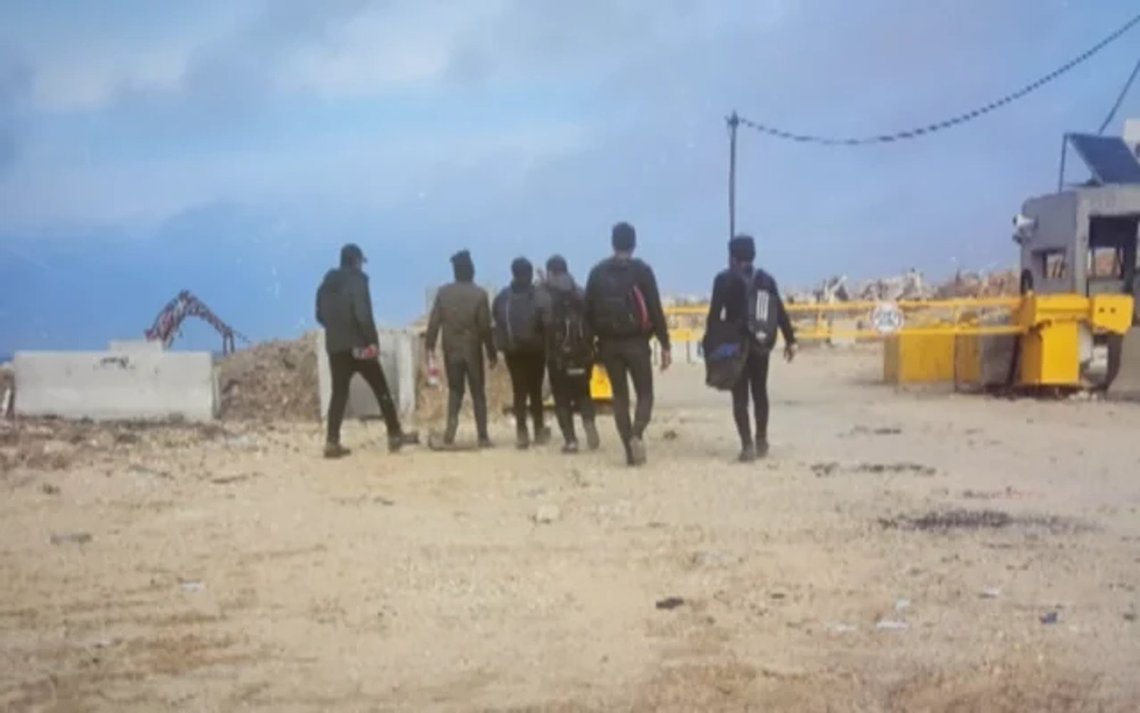


On Wednesday, the TV channel Kan broadcast a documentary in which Israeli soldiers described how they used Palestinian civilians to lead the way into unsecured buildings. This was after the dogs had died and there were no longer any bulldozers available. It was sheer necessity that drove the soldiers.
The documentary detailed how troops encountered booby traps laid by Hamas in nearly every home, forcing the army to adapt and develop new methods of neutralizing the explosives before sending soldiers inside.
Troops described firing tank shells or shoulder-launched missiles at a building to try and set off any bombs, using a D9 armored bulldozer to dig around it to uncover any wiring, sending in a dog of the Oketz canine unit to search, or using a small drone.
But these capabilities gradually became unavailable, and troops said they were ultimately forced to carry out the tasks themselves.
“In those days, all capabilities had deficiencies. Very quickly, we no longer had dogs because they all sacrificed their lives for us. Drones were not as widespread as they are today in the army. Also, engineering vehicles were used in moderation,” said Lt. Col. (res.) Elitzafan Granevich, deputy commander of the Kiryati Reserve Armored Brigade.
“Ultimately, you want to provide a solution, as a commander, in which you are reducing the danger [to troops] as much as possible,” he said.
The soldiers did not know what awaited them inside the buildings where Hamas had laid mines and set traps.
Necessity is the mother of invention. The special forces soldiers are the most valuable, and they were the first to send in Palestinian civilians. The other soldiers followed suit.
“Everyone wants all the capabilities; everyone wants everything. But resources are limited; you can’t give everyone everything,” said Col. (res.) Eli Gino, former chief of staff of the Givati Infantry Brigade and a member of the People of Israel political party, which failed to cross the electoral threshold in the recent election.
According to soldiers who testified in the documentary, the practice began during fighting in southern Gaza’s Khan Younis in early 2024, when infantry and armored units began operating alongside special forces tasked with tackling Hamas’s underground infrastructure. They saw that the special forces would send a Palestinian into a site before entering themselves.
“We found out that when it’s a special forces soldier, he doesn’t use his [assault rifle]; he sends a Palestinian in front of him,” an infantry officer in the reserves with the rank of major recalled. Another soldier said that they saw “a handcuffed Palestinian in an area where there are tunnels,” next to special forces.
The orders prohibited the use of human scouts, but it was widely known that the practice was different. What brought an end to the practice was that the soldiers on the ground found it too troublesome.
Many of the Palestinians used as human shields were released alive and have since been interviewed about their experiences. However, some were accidentally killed by Israeli fire because troops mistook them for terrorists.
In one incident described by soldiers in the documentary, a Palestinian being used by the forces exited an armored personnel carrier. Despite radio calls warning that the man, who was not dressed like a soldier, was walking in the area, other troops opened fire and killed him.
After such incidents, many of the human shields were dressed in army uniform, but without any protective gear, according to the documentary.
“What brought an end to the phenomenon was not us, the commanders at the tactical level, nor the senior officers, the brigade and division commanders. Ultimately, it was the soldiers on the ground, below us,” the major said.
“They dared to stand up and say: ‘Are you sure this Palestinian we took, and is going to explode on a bomb, is the best solution you can give us?’ They started to ask questions,” he said.
The fact that the foot soldiers themselves took the initiative to put an end to the arrangement is proof that the IDF has a moral standard.
Several media outlets have attempted to spin the story as the opposite.
Defence Minister Israel Katz tried to halt the broadcast, knowing full well that it would be a PR disaster.
Following Haaretz’s initial reporting, a New York Times investigation published in October 2024 provided further details of the practice. The Associated Press published similar claims in May 2025. And a British documentary in November 2025 also detailed the military’s use of human shields in Gaza, citing testimony from soldiers.


