

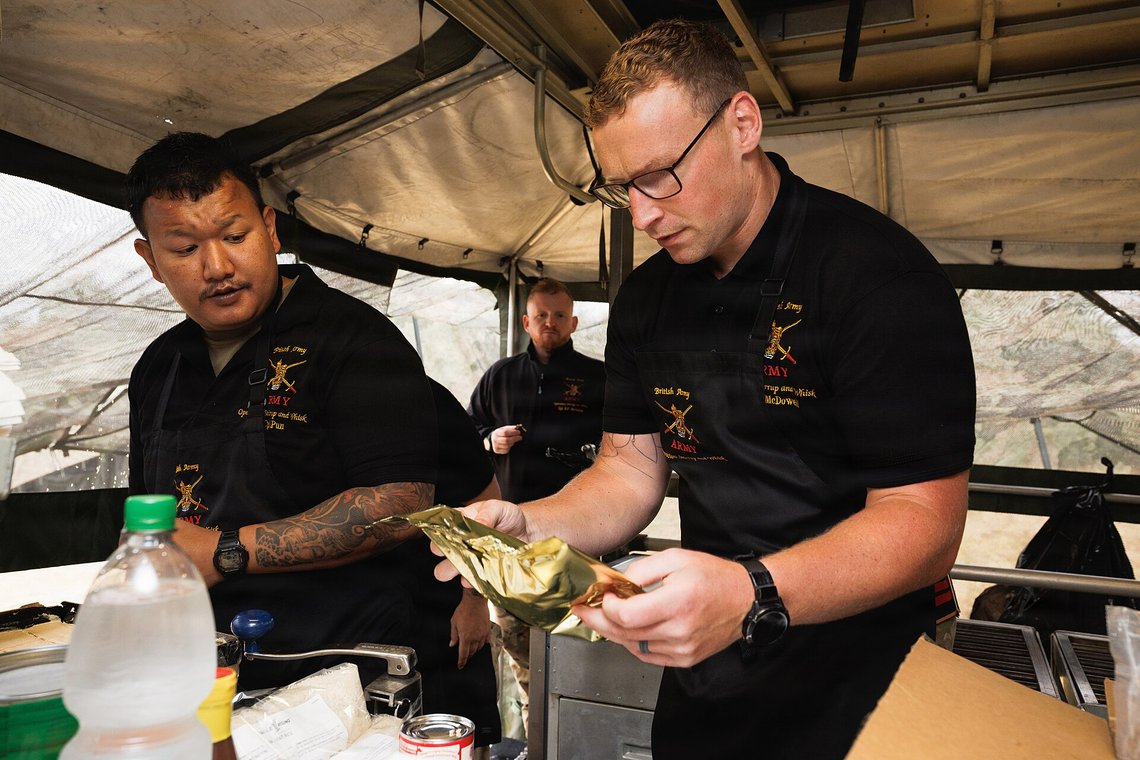


The British Army has entered into a partnership with one of the country’s largest halal producers. Among other things, the agreement is intended to help recruit more Muslims into the Armed Forces. At the same time, official documents show that people with coeliac disease are being excluded from military service because the Army cannot guarantee gluten-free food. And whilst allergens must be labelled, there is no corresponding general requirement to state whether the meat has been halal-slaughtered.
The partnership was established in connection with the commemoration of Armistice Day on 11 November, between Major General Karl Harris and Tariq Sheikh, the Pakistani-born founder of Tariq Halal Meats. The agreement forms part of the Armed Forces Covenant, a scheme under which companies commit to supporting military personnel, veterans and their families.
Among other things, Tariq Halal Meats will offer job interviews to former soldiers, grant reservists paid leave for military training and encourage its customers to consider military service.
“This is their country and their army. Serve in it, join the reserves, send your children to the cadets and carry on the tradition”, said Sheikh during the event.
He also stated that the company receives over three million customer visits annually, and that calls to enlist in the Armed Forces will be prominently displayed in the shops.
A small minority
The partnership has attracted attention because Muslims make up a very small proportion of the British military. The Islam-critical commentator Harris Sultan has responded on X, in which he claims that Muslims make up less than 0.9 per cent of the army. According to figures from the Ministry of Defence’s statistics as at 1 April 2026, it is correct that Muslims make up less than one per cent of the personnel in the British Army. Around 680 soldiers in the regular army were registered as Muslims, corresponding to 0.9 per cent of the personnel who had declared their religious affiliation. Across the entire regular Armed Forces, the figure was around 930, spread across the Army, Navy and Air Force.
These figures illustrate just how small the Muslim minority is within the British military, whilst at the same time the Armed Forces offer their own halal options and have now entered into a formal partnership with a major halal producer.
It has not yet been confirmed that everyone, including non-Muslim soldiers, will now be served halal meat. The British Ministry of Defence has previously clarified that halal food is not to be the standard option in the Norwegian Armed Forces, and that no military institutions offer exclusively halal food.
Such assurances are, however, of little value if soldiers do not know what sort of meat they are being served.
Halal meat does not need to be labelled
A published letter from the Ministry of Defence in December 2024, it is stated that soldiers themselves must inform the authorities of any special dietary requirements. Allergens must be labelled in accordance with the law, and vegetarian and vegan meals are normally labelled. However, there is no general requirement for meals to be labelled in accordance with religious dietary rules. Such information must be made available on request. This is also confirmed by an earlier letter from the Ministry of Defence, which states that there is no requirement to specify on the menu whether the meat is halal or kosher.
This does not necessarily mean that soldiers are served halal meat without knowing it. But it does raise questions about how easy it is in practice to opt out of such food.
Can a British soldier who, for religious, ethical or other reasons, does not wish to eat halal-slaughtered meat, always be told what is being served? And is there always an alternative?
Halal food is offered – but coeliacs are turned away
Another interesting aspect of this issue is that whilst the army accommodates religious dietary requirements, people with medically justified dietary needs face restrictions.
In a written response to Parliament on 8 September 2026, the Ministry of Defence confirmed that people with coeliac disease (gluten allergy) cannot be recruited into the British Armed Forces. The reason given is that the military cannot guarantee gluten-free food throughout an entire career. The Ministry cites, amongst other things, field exercises, makeshift kitchens, the sharing of field rations and the risk of cross-contamination. The Ministry of Defence therefore believes that the risk is unacceptable under military conditions.
At the same time, the Norwegian Armed Forces offer halal and kosher food for religious reasons, including in the form of separate field rations. Vegetarian and vegan options are also available.
This distinction raises questions about where the boundaries lie for individual accommodation within the Armed Forces. Whilst religious dietary requirements can be accommodated, the need for a consistently gluten-free diet is considered incompatible with the demands of military service.
Calls for a response from the government
The debate surrounding halal food has now reached the British Parliament.
On 12 November, Lord Lord Pearson of Rannoch tabled a written question to the government. He wants to know what proportion of the British armed forces are Muslim, what proportion of the meat served is halal, and what alternatives are available for soldiers who do not wish to eat it. The questions touch on both freedom of religion and the practical implementation of the Armed Forces’ dietary policy.
How widespread is the use of halal meat in the British military? Is the provision limited to those who request it, or is halal food also served as part of the standard diet for soldiers who are not Muslim? And if the latter is the case, how easy is it to choose something else?
The answers are not yet known. The Ministry of Defence has until 26 November to reply to Lord Pearson.


