



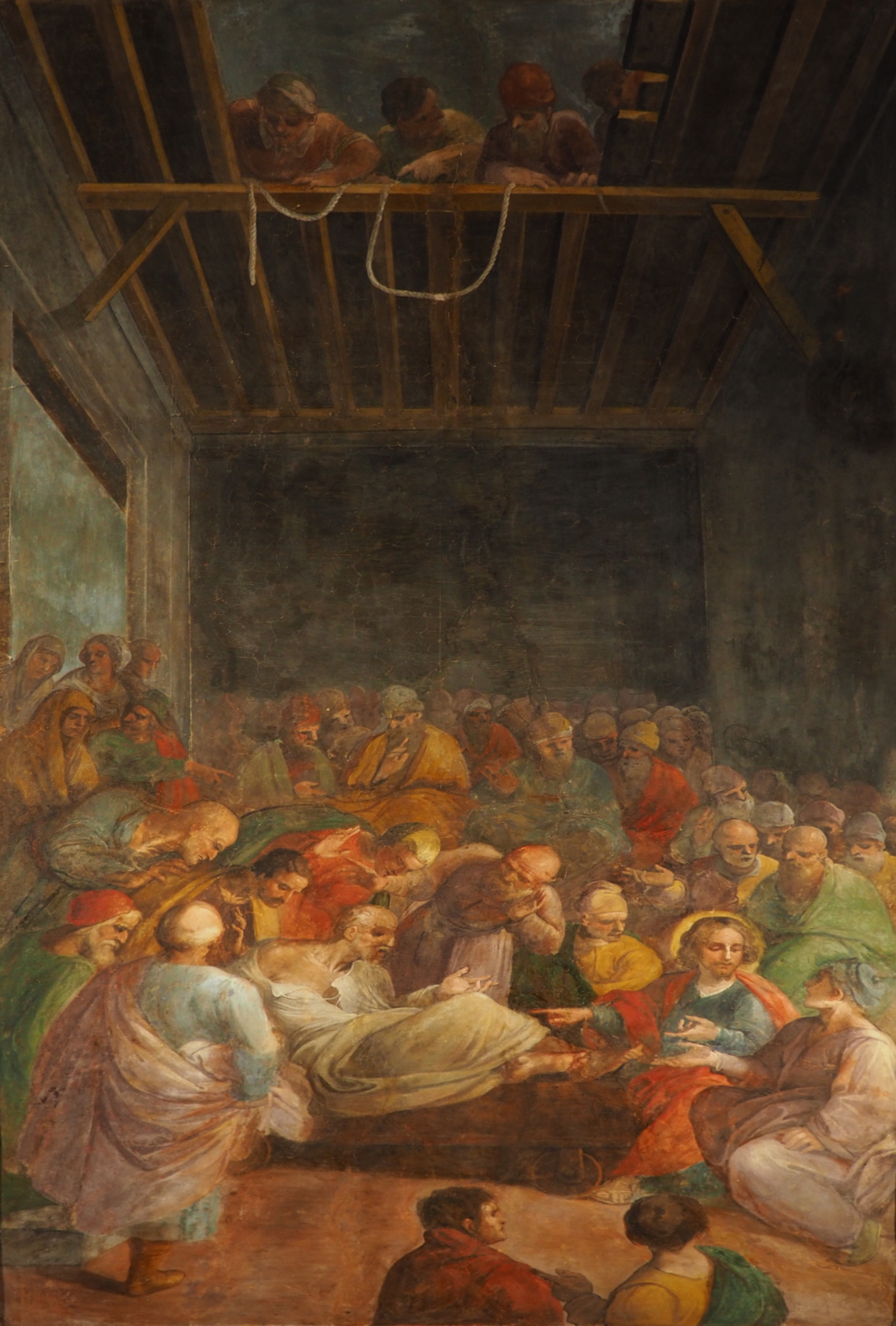
Belisario Corenzio (1558–1646), ‘The Healing of the Paralysed Man in Capernaum’, ceiling of the chapter house at the Monastery of Saints Severino and Sossio, Naples. Photo: Mattia Luigi Nappi, CC BY-SA 4.0, via Wikimedia Commons.
1 A few days later, Jesus returned to Capernaum, and word spread that he was at home. 2 Such a crowd gathered that there was no room for them, not even outside the door. Whilst he was preaching the Word to them, 3 they brought to him a man who was paralysed. Four men were carrying him. 4 But they could not get near him because of the crowd. So they broke through the roof above the place where he was, made an opening, and lowered the stretcher on which the paralysed man was lying. 5 When Jesus saw their faith, he said to the paralysed man, ‘Son, your sins are forgiven.’
6 Now some of the scribes were sitting there, and they were thinking to themselves: 7 ‘How can he say such things? He is blaspheming God! Who else can forgive sins but one – that is, God?’ 8 Immediately Jesus knew in his spirit that they were thinking this, and he said to them, ‘Why do you harbour such thoughts in your hearts? 9 Which is easier to say to the paralysed man: “Your sins are forgiven” or “Get up, take your stretcher and walk”? 10 But so that you may know that the Son of Man has authority on earth to forgive sins’ – and now he turns to the paralysed man – 11 ‘I tell you: Get up, take your stretcher and go home!’ 12 And the man got up, immediately took his stretcher and walked out in full view of them, so that everyone was filled with amazement. They praised God and said, ‘We have never seen anything like this.’
Mark 2:1–12
In Germany, Christian footballers are causing a stir and provoking anger. On Saturday 7 November 2026, in the Bundesliga match between Borussia Dortmund and Elversberg, Felix Nmecha scored both goals as Dortmund won 2–1. After scoring, he made a special gesture:
- He pointed towards the sky.
- He pretended to remove a crown from his head.
- He symbolically laid it on the ground to show that he was laying down his own crown before Jesus Christ, his Saviour and King.
This also has biblical overtones. In Revelation 4:10, the 24 elders fall down before God and lay their victory wreaths before the throne. It is an image of worship, humility and recognition of God’s sovereignty.
The gesture was linked to the ‘The King’s Return’ campaign, which is associated with the Ballers in God network.
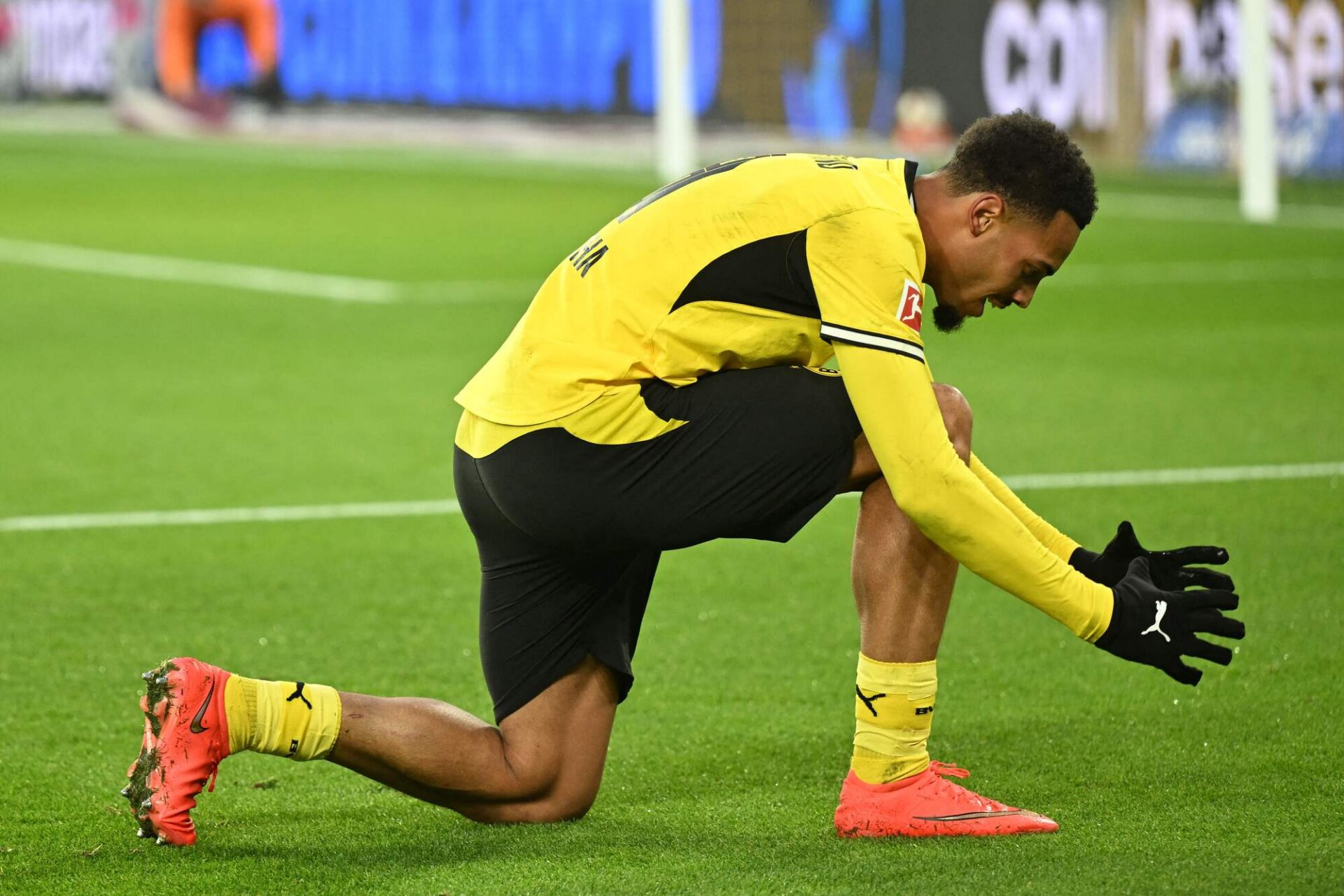
Photo: Ina Fassbender / AFP / NTB.
Dortmund’s official supporters’ group reacted particularly strongly. The criticism centred on the network being linked to conservative Christians and their views on sexuality and gender identity.
Even national team manager Jürgen Klopp has become involved, and on 12 November he told the press that he had spoken to Nmecha, who has agreed not to repeat the gesture whilst on the German national team.
We often discuss the cause of the West’s decline, but sometimes it becomes so obvious that it is almost unbearable. It is not without reason that it is the classical Christian understanding of sexuality and gender that is under attack and not accepted. The West of today cannot tolerate the assertion that something stands above us, that there are moral standards, or that we need forgiveness for our sins.
‘Your sins are forgiven,’ Jesus said to the paralysed man, provoking the Pharisees in much the same way as Germany’s football supporters. Whilst the Pharisees understood that there were sinners to be forgiven, sins that only God could forgive, the Germans believe there are no sins for which they need forgiveness, nor any God to fear.
Yet it is the God of the paralysed man who laid the foundations for Europe as we know it. That is why something dramatic has taken place when the German football crowd cannot tolerate a player who pays homage to his King and His great message—that He will forgive everyone’s sins and invite us to eternal life with Him. To the lame man, he also had the joy of saying that he could take up his stretcher and walk, but in Germany they are crying out about discrimination by Christian footballers, which shows what this is really all about. Christianity, after all, teaches that we must choose between a God who does not tolerate sin but who will purify us, and a life that leads to damnation. But for the Germans, this is too hard to swallow; they demand that God should not discriminate, but let everyone in, even those who oppose him.
In Germany, and in large parts of Europe in general, the demand not to discriminate has evolved into a modern secular sacrament. Residents of such secular-humanist societies are not permitted to say that one thing is better than another when it comes to religion, worldviews or moral standards relating to gender and sexuality, or that we should approach God with humility.
To give an example, in today’s Germany, Jesus is not seen as an embodiment of love for having saved an adulterous woman from being stoned; after all, he dared to tell her that she must change her way of life and stop sinning. But to claim that something is a sin – something for which we need forgiveness and from which we must subsequently turn away – has thus become an unforgivable transgression that undermines faith in the inclusive and generous diversity comprising sovereign and autonomous individuals. The West does not want the return of a king who dares to tell us that we have strayed from the right path.
The consequences of the Germans’ rejection of Felix Nmecha are, however, far-reaching. There is a clear link between a rejection of the God of love and the decline that this country and other countries in the West are experiencing. Christianity does not leave a void; something else takes its place, and it is not necessarily a pretty sight. Germany’s history should serve as a warning sufficient in itself.
It is up to us to prevent this from happening.


