

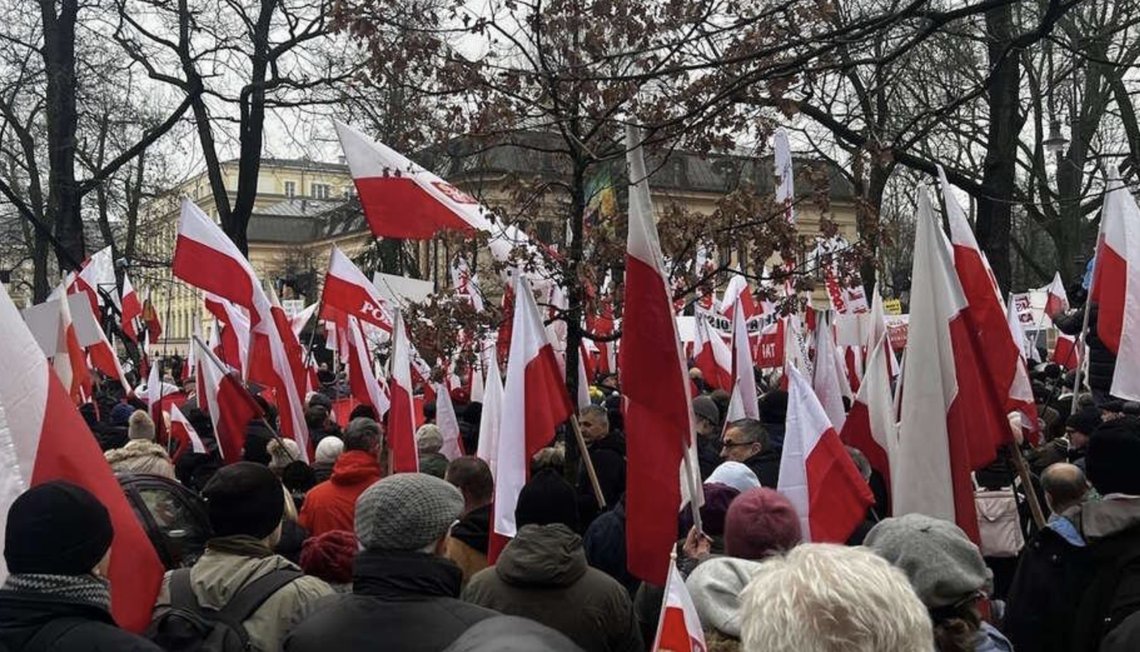


Turnout for the Independence March in Poland’s capital, Warsaw, on Wednesday was a record high. According to the Polish authorities, at least 250,000 people turned out to mark the country’s regaining of sovereignty in 1918. Other sources put the number of participants at over half a million (!).
Despite deep divisions in Polish politics and the mass shooting in Kraków just a few days ago, the march proceeded entirely peacefully – without a single clash or other serious incident.
Poles carrying white-and-red flags marched peacefully, singing and chanting slogans. Fireworks were banned, but many ignored the ban and carried flares. However, no dangerous situations arose.
Central Polish authorities report that between 250,000 and 300,000 people took part in the march, whilst the organisers put the figure at well over half a million. It is believed that the Polish authorities wish to keep the figure as low as possible, as the march largely appeared to be a massive popular protest against Donald Tusk and his pro-EU regime.
– Tusk protest
“The turnout at the independence march is an expression of opposition to Donald Tusk’s government,” said Paweł Lisicki, editor-in-chief of the conservative Polish news magazine Do Rzeczy: “It is clear that for a large group of people, the changes to the Constitutional Tribunal are unacceptable. It was Tusk who implemented these, with the help of the police,” he concluded.
Many have recently expressed their dislike of Tusk and their frustration with him, something that was clearly evident during the march. Prime Minister Tusk himself did not take part – instead, he travelled to Szczecin on Independence Day.
Poland’s President, Karol Nawrocki, on the other hand, led the march in Warsaw. In his speech, he criticised the government for undermining the Constitutional Tribunal, which caused a stir in the newspaper Gazeta Wyborcza, which is close to the Tusk government.
Want to decide on their own country
The march took place under the EU-critical slogan “Polak w Polsce gospodarzem!” (“Poles are masters in their own country!”). The march’s organiser, Bartosz Malewski, emphasised in a speech that it is the host who makes the laws and rules; the host has the right to invite people, but also the right to ask them to leave:
«Poland can cooperate with the EU and the world, but Poles want to determine their own destiny», said Malewski, with a clear reference to migration pressures and to the EU: “Poland must remain strong and retain an independent structure.”
Antifa held their own march and accused the main march of being xenophobic because of the aforementioned slogans.
Attracting attention
The official motto of the Polish Army, ‘God, Honour, Fatherland’, is a traditional patriotic slogan and was chanted extensively during the record-breaking Independence March, which marks Poland’s regaining of its sovereignty as a separate state after the First World War, after having been wiped off the map for 123 years.
Across Poland, Independence Day was marked in a similar manner, with large turnouts. Nor have any clashes been reported in other cities. It is described as remarkable that the massive celebration in Warsaw took place entirely without violence in an otherwise somewhat volatile Europe.


