

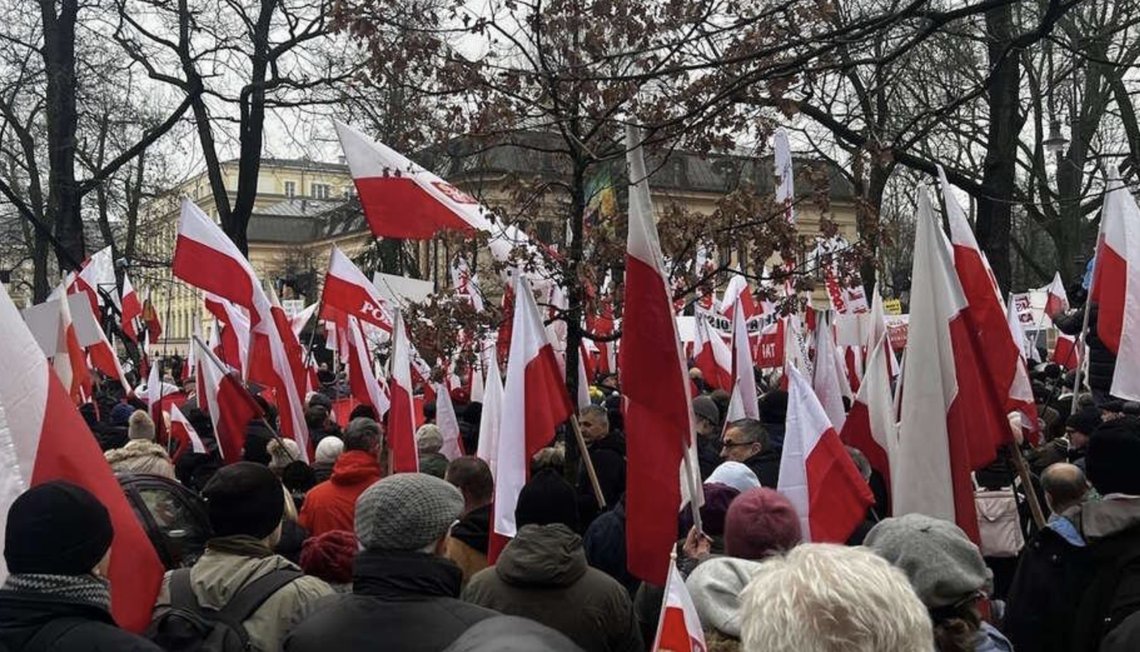


On Friday, Polish President Karol Nawrocki cut short a flight to Senegal when large numbers of police stormed the premises of the Constitutional Tribunal in Warsaw. The Tribunal’s leadership was declared suspended, but it has rejected the decision as unlawful. The national-conservative opposition accuses Prime Minister Donald Tusk of staging a coup d’état.
President Nawrocki was on his way to Senegal when reports of the police operation emerged on Friday 30 October.
– At a time like this, the President must be in Poland. I am cancelling my flight to Senegal. I am returning, he wrote on X.
After landing in Warsaw on Friday evening, Nawrocki went straight to the Presidential Palace. There he met with the suspended President of the Constitutional Tribunal, Bogdan Święczkowski, and the President of the Supreme Court, Zbigniew Kapiński, for urgent talks on the constitutional crisis, reports AFP.
🚨🇵🇱 President Karol Nawrocki has entered the premises of the Constitutional Tribunal in Warsaw!
After cutting short his trip abroad, the President arrived at the scene of the ongoing constitutional crisis.
Protesters, politicians and a large police presence had gathered at the scene. Towards the end of the footage, scuffles with officers can also be seen.
🎥 Footage by a NEXTA Polska reporter.
— NEXTA Polska (@nexta_polska) 30 October 2026
Large numbers of police officers were deployed outside the Constitutional Tribunal in Warsaw. Judge Anna Korwin-Piotrowska had declared the Tribunal’s President, Bogdan Święczkowski, and Vice-President, Bartłomiej Sochański, suspended for one month.
Korwin-Piotrowska claims to have taken over temporary leadership. Święczkowski rejects the decision and considers it unlawful. The court’s official account on X describes the events as a ‘coup d’état’.
The police confirm the operation on the court’s premises but deny that they stormed the building itself. Three demonstrators were arrested during the unrest. Reuters and Notes from Poland have reported on the sequence of events.
Two political camps
For several years, Poland has been characterised by a bitter power struggle over the courts. Prime Minister Donald Tusk leads a pro-EU coalition of liberal, centre-right and left-wing parties. He was President of the European Council from 2014 to 2019.
On the opposite side stands the national-conservative Law and Justice (PiS) party, which governed Poland from 2015 to 2023. The party emphasises national sovereignty, Christian values and traditional social institutions. President Nawrocki was elected with the support of PiS. Poland thus has a president and a government from different political camps.
The dispute centres, amongst other things, on who can legally be appointed to the Constitutional Tribunal. The President has refused to accept several of the parliament’s candidates, whilst the Tribunal’s leadership has prevented government-backed judges from taking up their posts.
– There is no other way
Tusk claims that the courts were politicised under the PiS government, and that he must now restore their independence.
– Restoring the rule of law is our duty. After years of lawlessness under PiS, this is a difficult, at times painful process that requires decisive action. There is no other way, Tusk wrote on X.
Minister of Justice Waldemar Żurek wishes to lift the immunity of the President and Vice-President of the Supreme Court. He accuses them of preventing lawfully elected judges from carrying out their work. The opposition, however, believes that the government is attempting to take control of an independent court.
The former PiS Prime Minister Beata Szydło accuses the Tusk government of using the police for this purpose. PiS leader Jarosław Kaczyński turned up outside the court alongside the demonstrators.
Even lawyers who have previously criticised PiS are questioning the approach.
– “I never thought I’d end up defending him, but this legal basis does not exist,” wrote law professor Marcin Matczak regarding Święczkowski’s suspension, according to Notes from Poland.
The EU in the background
The dispute over the courts is also part of Poland’s long-standing conflict with the EU. Under the PiS government, the European Commission criticised several judicial reforms and withheld substantial EU funds. In 2021, Poland’s Constitutional Tribunal challenged the primacy of EU law by ruling that certain EU provisions, as interpreted by the Court of Justice of the European Union, were contrary to the Polish Constitution.
When Tusk took office in 2023, he promised to restore the rule of law and improve relations with Brussels. PiS, for its part, believes that the government’s policies are undermining Poland’s independence.
These disputes have also brought EU membership to the fore. As Document reported on Thursday, PiS leader Kaczyński has raised the possibility of a ‘Polexit’ if the EU does not implement comprehensive reforms. Tusk vows to fight back.
The EU has long been involved in the dispute over Poland’s judiciary, but there is no confirmed information that Brussels was directly involved in Friday’s police operation.
It is currently unclear who has the authority to head the Constitutional Tribunal. The government claims it is restoring the rule of law. The opposition believes it is violating the constitution.
This story is developing and will be updated.


