

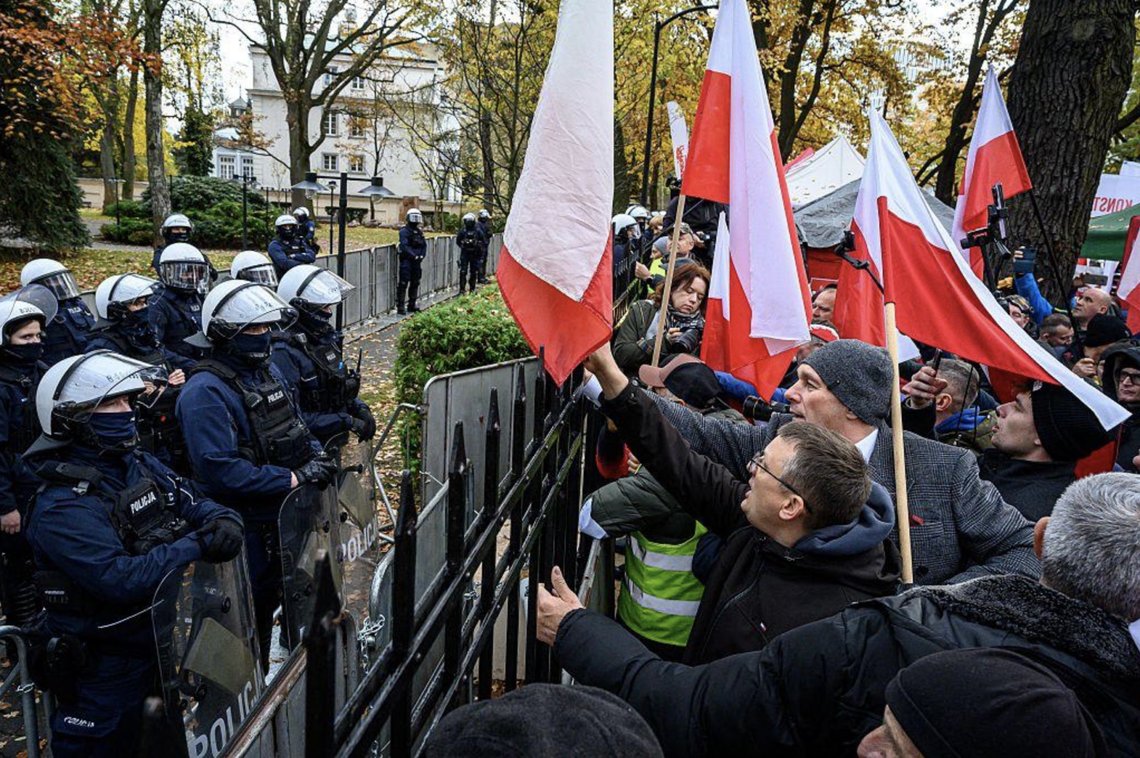


On Friday, the Sejm (the lower house of parliament) passed the so-called Act on Restrictive Measures (parliamentary document 3003). Its aim is to implement EU Directive 2024/1226 on breaches of EU sanctions and to introduce national sanctions against foreign interference and manipulation of the information environment.
Under the guise of implementing the EU Directive, the government is proposing an autonomous and strict administrative regime involving confiscation and economic paralysis, interspersed with further censorship measures – something which EU legislation does not require of Poland at all.
The original text of the bill lacked a definition of ‘foreign interference and manipulation of the information environment’.
During committee deliberations, a definition was added. The Norwegian translation describes it as follows:
«Targeted, systematic, coordinated and inauthentic behaviour in the information domain, aimed at influencing the opinions, attitudes or actions of recipients, in a manner that creates a risk of a real and serious threat to Poland’s interests, international standing, security or electoral processes.»
This is an abridged translation of the definition discussed in the committee.
What is ‘inauthentic’?This raises an important legal question: How are the authorities to determine whether an information campaign is ‘non-authentic’, and what constitutes a serious threat to Poland’s international standing?
The Polish Banking Association had already warned that the original wording was unclear and could leave the door open to arbitrary decisions. (ChatGPT)
The most striking aspect of Form No. 3003 is the provisions of Article 4, which introduce an unprecedented censorship and surveillance mechanism. These provisions grant Marcin Kierwiński, Minister of the Interior and Administration, the authority to include individuals, Polish entrepreneurs and independent publishers on the so-called national sanctions list.
One risks being placed on that list on the basis of vague and discretionary allegations of direct or indirect support for foreign interference in the information sphere. Without a judgement from an independent court, without prior notice to the party concerned, and without presenting any evidence, a public official is granted the power to immediately freeze all assets and block bank accounts.
At the same time, the review confirms that decisions to impose sanctions by placing an individual on the list may be implemented immediately, and that a court appeal does not automatically halt their implementation.
This raises a genuine issue of legal certainty. (ChatGPT)
No right of appeal
Worse still, the administrative procedure that has been initiated can be enforced immediately. A potential appeal to an administrative court does not suspend the enforcement of the sanction, which in practice means that by the time a citizen or entrepreneur completes the years-long appeal process, their livelihood and business will have been completely destroyed. The regime set out in Form 3003 provides for drastic administrative penalties of up to 20 million PLN (approx. USD 5 million) and criminal sanctions of up to 12 years’ imprisonment.
‘Russian fear’
The procedure for inclusion on the list creates a real risk that Form 3003 will be used by the government, particularly in the run-up to the election. This fear is justified because Prime Minister Tusk and circles close to the government see Russian influence everywhere, and in their view, criticism of the EU or climate policy is part of a Russian information war. “I hope that President Karol Nawrocki will uphold the constitution and veto this bill,” remarked Anna Bryłka of the Konfederacja WiN party and Member of the European Parliament.
Putting the Constitutional Tribunal in check
This fits perfectly with Donald Tusk’s government’s attempt to take over Poland’s Constitutional Tribunal. An attempt that has, in fact, been successful. They have taken over the building and installed Anna Korwin Piotrowska, who calls herself ‘President of the Constitutional Tribunal’ and now heads its work. She has issued an order suspending Bogdan Święczkowski and Vice-President Bartłomiej Sochański from their official duties. (Bogdan Święczkowski and President Karol Nawrocki regard these actions as unlawful and maintain that Święczkowski remains the legal president of the court.)
The role of the Constitutional Court is to protect citizens against abuses of power, and under normal circumstances it would have blocked this Act on Restrictive Measures. However, it now appears that the leadership currently in place there is there to ensure that the Act is not blocked.
The Restrictive Measures Act still has to pass through the Senate, but this is unlikely to pose a major obstacle as Tusk and his supporting parties hold a majority there.
The (only) real obstacle is that President Nawrocki can exercise a veto.
ChatGPT notes:
During the vote on 6 November, proposals for stronger legal safeguards in Articles 8 and 9 were rejected.
The shootings in Kraków
Due to the shocking mass shooting in Krakow on Sunday, many people may lose focus and forget about parliamentary document 3003. Here, the government, through the Minister of the Interior, has come out and stated that it was a right-wing extremist who carried out the shooting, thereby attempting to capitalise politically on the incident already – at least before it is known whether the man was, first and foremost, completely insane. Other media outlets are reporting the opposite, namely that the terrorist was a left-wing radical. The mass murderer survived, so the facts will come to light – at least in podcasts and the international media – before Tusk and co. have time to exploit the tragic massacre for political gain.


