



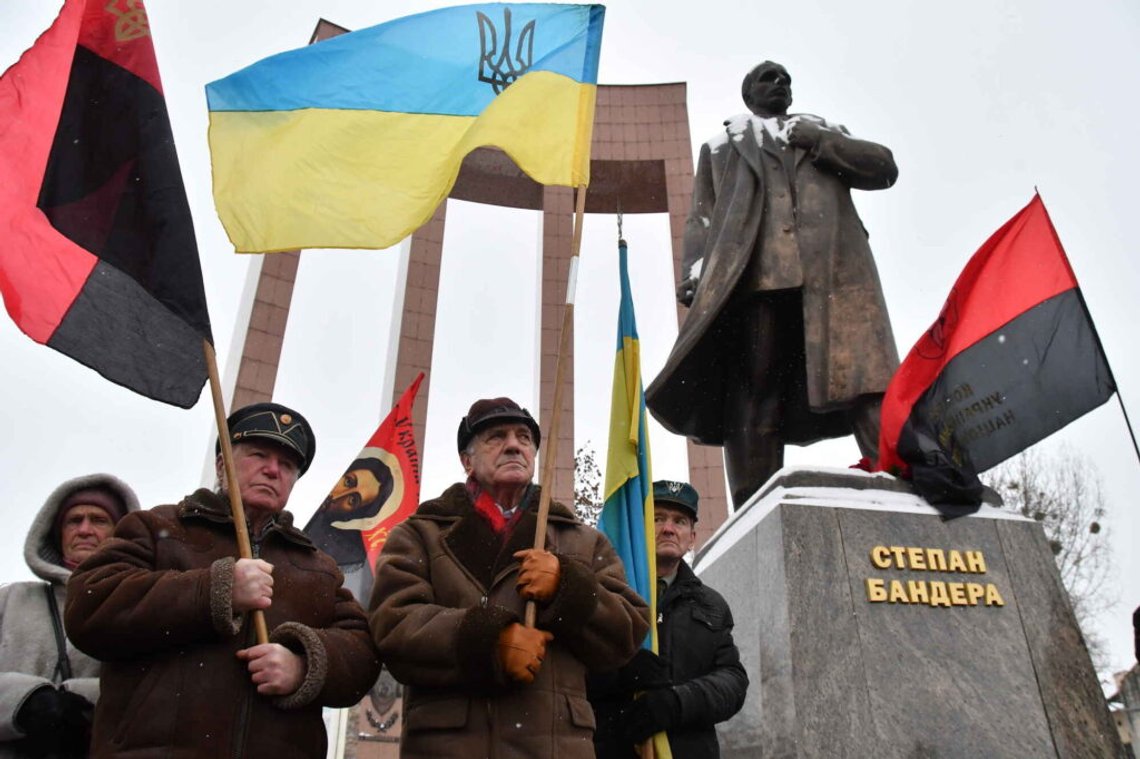
 People gather at the monument to Stepan Bandera, founder of a rebel army that fought against the Soviet regime to mark the 117th anniversary of his birth in Lviv, Ukraine, Thursday, Jan. 1, 2026. (AP Photo/Mykola Tys) The red-and-black flag is the UPA flag that Bandera and his militia used. For Poles it is a symbol of death. The monument to him already stands in Kyiv, and his birthday is commemorated.
Zelenskyj reacted to the dispute with Poland over the massacres of Poles and Jews during the Second World War by announcing that his government will build a large-scale monument to Ukraine’s heroes, including Stepan Bandera. 11 July is the anniversary of the massacre of Poles, and the revival of the far-right nationalist militia suddenly brings history back to life. Poland says that they may come to block Ukrainian EU membership.
– No one shall dictate which heroes we honour, said Zelenskyj when Poland’s president withdrew the award of Poland’s highest honour, the White Eagle, to Zelenskyj. By then three Polish presidents had returned their Ukrainian medals.
If Zelenskyj carries out his plans to erect such a monument, it could have serious consequences for Ukraine’s relations with Poland.
It began with Zelenskyj calling a special unit the “Heroes of the UPA”. It was these who murdered Poles and Jews, inter alia in Babij Jar, where 50,000 Jews were massacred. When you begin to dig into the crimes of the Second World War and revive mass murderers, you are asking for trouble. That happened when Kurt Waldheim became Secretary-General of the UN and it emerged that he had a past as an officer in the Wehrmacht in the Balkans, where he among other things participated in the transport of Jews from Thessaloniki. Waldheim remained as Secretary-General for the rest of his term and was later President of Austria in the period 1986–1992.
It would have been unthinkable today, when “nazi” forms part of woke rhetoric for a multicultural society.
But the media and politicians have a problem: They are allied with Zelenskyj and are fighting his war. But at the same time Putin’s justification for the invasion has been to remove the Nazis in Kyiv. Zelenskyj scores an own goal.
But what for everyone is a PR disaster does not seem to affect Zelenskyj. It is alarming that this dispute has not already been settled, for it has the potential to shatter support for Ukraine.
Norwegian News Agency NTB has a story that is surprisingly factual and damning.
Relations between Poland and Ukraine have in a short time become strained, triggered by events that lie more than 80 years back in time. But the feud could have consequences for the Ukrainians’ desire for EU membership and the West’s weapons support to the country.
11 July is the anniversary of the Volhynia massacres, in which around 100,000 Polish civilians in what is today western Ukraine were killed in 1943.
The massacres were committed by Ukrainian nationalists in the insurgent army UPA, and many of the victims were elderly, women and children.
UPA was part of the Organisation of Ukrainian Nationalists (OUN), which at the beginning of the Second World War collaborated with Nazi Germany in the hope of obtaining an independent Ukrainian state.
The Ukrainian nationalists established, among other things, battalions that under German command actively participated in the extermination of Jews.
Hitler became furiousLarge parts of western Ukraine were annexed by the Soviet Union in 1939, and when the German forces in June 1941 advanced into the area, the OUN proclaimed an independent Ukrainian state.
Hitler became furious, and many of the OUN’s leaders, among them Stepan Bandera, ended up in German captivity.
The war on the Eastern Front went badly for Germany after a while, and the OUN then established the UPA. The insurgent army attacked primarily Soviet partisans, military units and supply lines, but also German forces.
Ethnic cleansingBetween 1943 and 1945 the UPA also carried out a systematic ethnic cleansing of the Polish civilian population in the two regions of Volhynia and eastern Galicia, which today form part of western Ukraine.
At least 100,000 civilians were killed, according to some estimates as many as 130,000.
In line with the post-Second World War policy of reckoning and reconciliation, the massacres were used for reconciliation.
The anniversary of the massacres is marked on 11 July and has for many years been an occasion for dialogue and reconciliation between Ukraine and Poland.
The leaders of the two countries have together honoured the victims of the UPA massacres, but also those killed in retaliatory actions by Polish partisans. This year it will be different.
A Ukrainian nationalist carries a portrait of Stepan Bandera, founder of the Ukrainian rebel army that fought against the Soviet regime, during a rally in downtown Kiev, Ukraine, late Wednesday, Jan. 1, 2014. The rally was organized on the occasion of Bandera’s birth anniversary.(AP Photo/Efrem Lukatsky) From the commemoration of Bandera’s birthday 1 January 2014. Bandera was a symbol in Ukrainian nationalism during Maidan, but at that time it was left-wing newspapers that pointed it out. The Church was involved. Now Bandera has been given a more prominent role that is no longer attempted to be concealed.
But now Zelenskyj raises the Bandera banner. What has happened?
Poland is indispensable as a transit country to Ukraine. Yet the regime in Kyiv has become so full of itself that it dares to trample on the Poles.
The friendship between Poland and Ukraine reached new heights when Russian forces advanced into Ukraine in 2022.
Millions of Ukrainians fled across the border to Poland, which also became a very important transit country for Western weapons aid to the Ukrainian defence.
Relations between the two neighbouring countries soured, however, and many Poles complain that the Ukrainian refugees have pushed up rental prices. Polish grain farmers also complain that Ukraine is allowed to export duty-free to the EU.
But the conflict reveals how the media has changed its rhetoric.
In an NTB article by Kristian Skårdalsmo from 2014, when the Maidan revolution was ongoing, it emerges that the far-right nationalists were already then a driving force that many feared but did not dare to distance themselves from.
Support for nationalist forces is due in part to Ukraine’s history. The then Soviet republic of Ukraine suffered greatly under the Soviet communist regime in the interwar period and was subjected to forced collectivisation and famine.
This led many Ukrainians, particularly in the west of the country, to fight against both Russian, Polish and German forces during the Second World War. At times Ukrainian nationalists also fought alongside German Nazi forces. One of the leaders whom the nationalists see as part of an independence struggle in the 1930s and 1940s was Stepan Bandera from the UPA group.
Far-right extremists still hail Bandera as a hero, among other things by waving red-and-black Bandera flags on Independence Square in Kyiv.
– Bandera and other radical nationalists from the 1930s and 1940s are problematic heroes. They are not particularly well suited to uniting all Ukrainians around them, says Serhij Jekeltsjyk from Victoria University in British Columbia to AFP.
He simultaneously emphasises that the use of UPA symbols today is to a greater extent a potent symbol of protest against the Yanukovych regime and Russia than a tribute to controversial nationalist leaders. (©NTB)
It is difficult to escape the conclusion that Pravij Sektor and the far-right nationalists from 2014 now hold power in Kyiv when they wish to erect statues to Bandera and name special units after him.
Already President Yanukovych awarded Bandera a medal in 2010. Then the “grandmothers” in Moscow demonstrated.
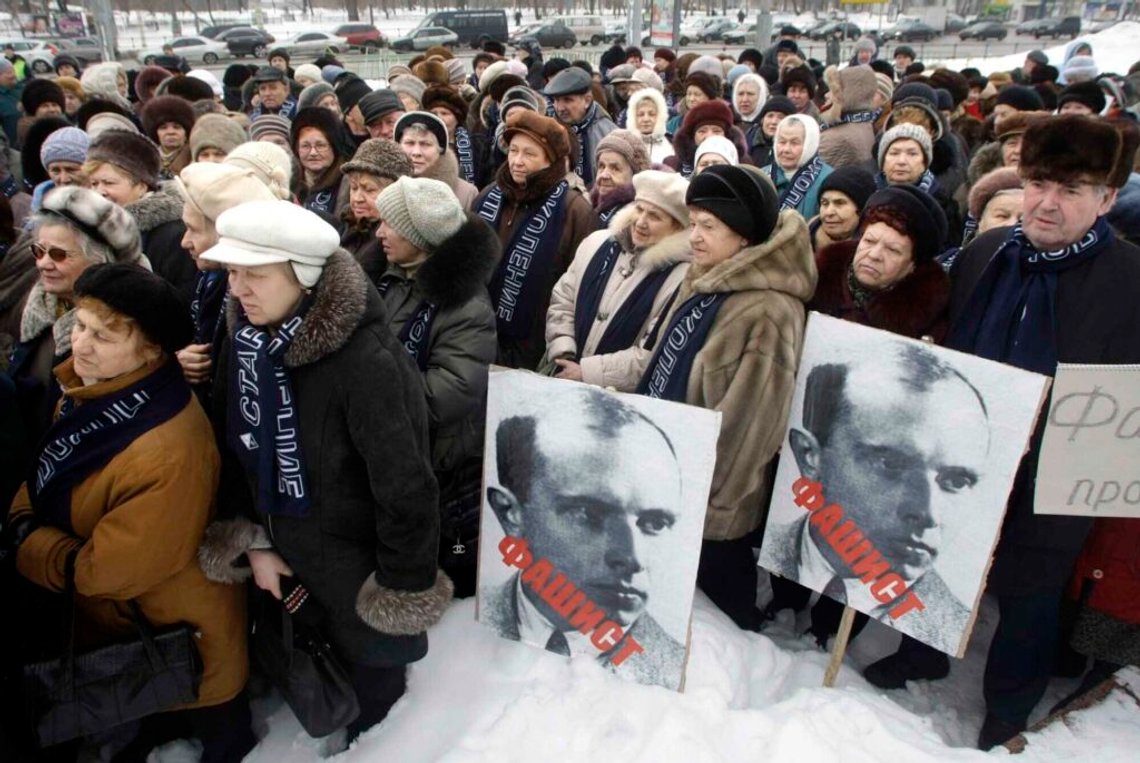 Participants in a protest against former Ukrainian President Viktor Yushchenko’s move to award Stepan Bandera with the highest state medal gather in downtown Moscow on Friday, Feb. 26, 2010. They hold Bandera’s portraits with “Fascist” written over them. Bandera was a leader of Ukraine’s nationalist movement, which included an insurgent army that sided with Nazi Germany during part of World War II. (AP Photo/Mikhail Metzel)
NTB attempts to rescue the narrative by calling President Nawrocki and the Law and Justice Party in Poland “right-wing populist”. Thereby their attitudes and opinions are devalued. They are suspect, and everything they do is coloured by it; they attempt to use history to their advantage.
Nawrocki and the far-right nationalist Polish party Law and Justice (PiS) have done their best to stoke discontent and hope thereby to steal voters from Prime Minister Donald Tusk and the Civic Platform ahead of next year’s parliamentary election.
– It is easy to see what Nawrocki is trying to do; he is trying in every way to make life difficult for Tusk, said a government source to Reuters last month.
Observe the development in the media’s presentation: What they called far-right nationalists in 2014 is now transferred to the president and conservative PiS in 2026. The term has gone from being descriptive in 2014 to becoming a brand of shame in 2026 against all who oppose the current regime, whether it is in Oslo, Copenhagen, Berlin, Paris or Kyiv.
Zelenskyj’s behaviour is therefore also a threat to his supporters. How can they support him if he honours a bandit and mass murderer?
It may be that the voters discover that they have been led up the garden path. They too are called far-right nationalists if they dare to think of protecting their country.
But they have nothing in common with the mass murderer Bandera? That is what Espen Barth Eide and Jonas Gahr Støre and Mette Frederiksen indirectly have. We have heard no criticism either from them or Ursula von der Leyen against Zelenskyj.
But literally digging up the past and revising it as Zelenskyj is doing is a gamble.
For Ukraine the dispute could have serious consequences, several warn.
– Poland’s support for Ukraine’s EU membership, military assistance and even economic cooperation could be at stake, says Poland’s former ambassador to Ukraine, Bartosz Cichocki, to The Economist.
Poland’s Deputy Prime Minister Władysław Kosiniak-Kamysz recently confirmed in an interview with the broadcaster Polsat that the country may come to put its foot down regarding Ukrainian EU membership.
– Zelenskyj says that no one can tell them whom they should honour, but neither is there anyone who can tell us how we should vote when it comes to who gets to become an EU member, he said in the interview.
Poland is divided between a conservative bloc and an EU-friendly one that is hostile to Trump and wants war with Russia. For them the conflict is unwelcome.
Poland’s Foreign Minister Radoslaw Sikorski and his Ukrainian counterpart Andrij Sybiha have attempted to dampen the tension.
Earlier this month they met in Warsaw, where according to the Polish Ministry of Foreign Affairs they agreed to de-escalate the conflict and ‘develop tools for historical dialogue’.
Good bilateral intentions nevertheless presuppose also ‘reciprocity’ from Ukraine’s side, Tusk emphasised. (NTB)
Those who attempt to revive Nazi collaborators rarely come out of it well.
Many Poles view the Ukrainian insurgent army as Nazi collaborators and have accused Zelenskyj of honouring a genocide.
Now Poland’s Prime Minister Donald Tusk will build a memorial wall for the victims of the UPA’s brutal wave of killings, which he too describes as a genocide.
– A memorial wall will be erected in Warsaw with an eternal flame and the names of all victims who have been found and identified, he writes in a post on social media on the memorial day 11 July.
https://www.document.news/news/2026/06/zelensky-honours-unit-that-killed-100000-poles-during-the-war-diplomatic-crisis-erupts
https://www.document.news/news/2026/06/zelensky-escalates-dispute-returns-medal
Polens visestatsminister: Ukraina blir ikke EU-medlem hvis de hedrer Bandera


