

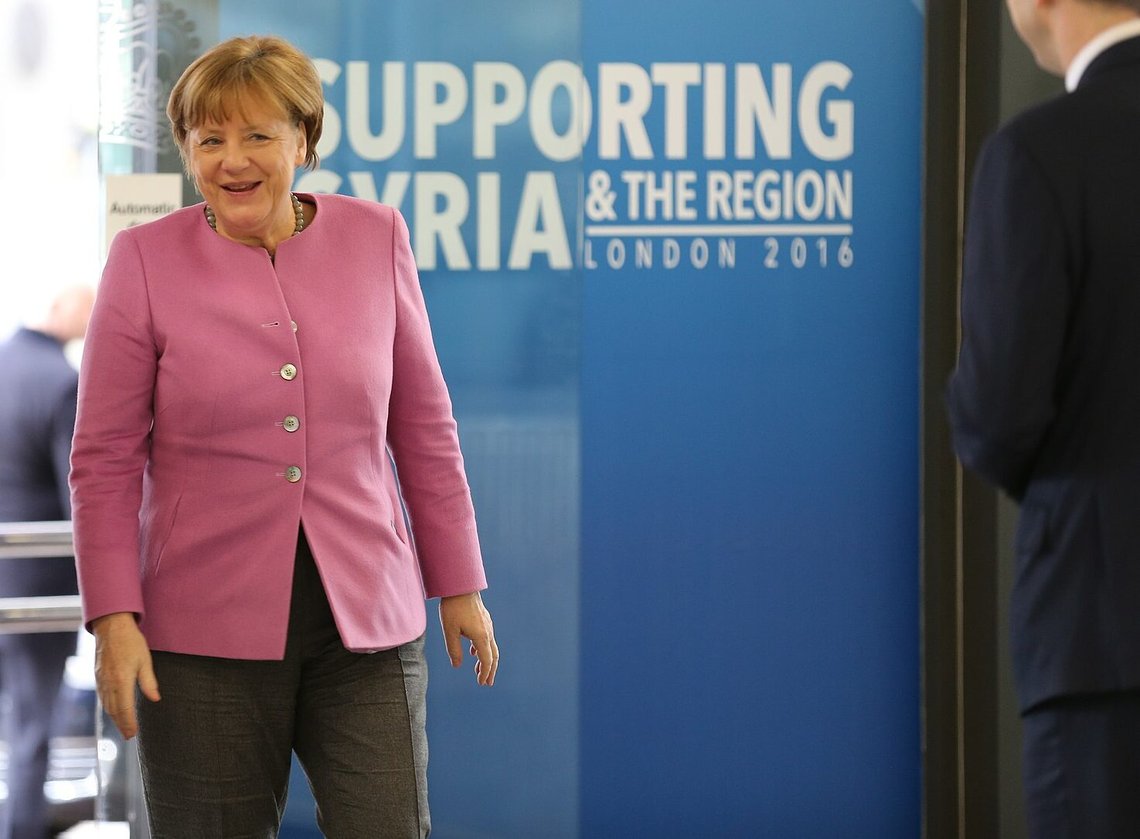


Angela Merkel opened Germany’s borders – and thus those of the whole of Europe – to the massive influx of migrants in 2014–2016 with her famous ‘Wir schaffen das’.
Now ‘Mutti’ Merkel claims that the migrants who have since been granted German citizenship are just as much Germans as the rest of the country’s population.
As an example, the former CDU Chancellor compares new German citizens from Syria with East Germans. In a speech on Sunday, Merkel also attacked anti-immigration forces, whom she accuses of dividing the German people and whipping up hatred and envy.
According to Angela Merkel, the promise of a life of freedom is under pressure. Populist parties are attempting to draw a distinction between the people, the elites and citizens who have been naturalised at different times, writes Die Welt.
It is unclear who made the promise Merkel is referring to. Surely it wasn’t a majority of free Europeans who decided to open the borders and provide for millions of migrants from Africa and the Middle East? When, exactly, did Europeans vote in favour of mass immigration in a free election?
The remarks were made at the Gewandhaus in Leipzig during the presentation of the International Mendelssohn Prize, where Merkel was honoured for ‘her efforts on behalf of Europe’. Document has reported on the ceremony.
Merkel speaks out against an ethnic interpretation of the term ‘people’
Merkel accused populist parties of dividing human dignity.
‘There are the people, then there are the elites, then there are those who have recently become citizens, and then there are those who have been citizens for a little longer, and they are trying to create divisions, they are trying to incite hatred, they are trying to differentiate and thereby provoke envy.”
In Germany, all power emanates from the people – “but the people are all German citizens”, Merkel emphasised.
“And no one asks: ‘Did you come later from East Germany, or did you perhaps arrive as a Syrian just three years ago?’ All German citizens are the people.”
For the record: the areas that were previously behind the Iron Curtain were part of Germany until the end of the Second World War. The state of East Germany was established on 7 October 1949. German reunification took place on 3 October 1990.
In other words: all East Germans who were over 41 years old in 1990, as well as everyone born since 1990, came into the world as citizens of a country called Germany. Many families, friends and couples lived on different sides of what, for a historically very short period, became separate countries.
This led to many tragedies in the form of a real division, particularly after the communists began construction of the Berlin Wall on 13 August 1961.
West Germany fared extremely well following the division, a fact marked by the country’s latest victory in the World Cup in the summer of 1990, which heightened the national euphoria in the final months before Germany was reunified. It did not take long before things began to go in the wrong direction.
For when the Wall fell, socialist ideas found new ways to take hold in Europe, and historian Fukuyama’s prediction of The End of History never became a reality.
The economic crisis is only part of the picture
Merkel also called for a stronger and more self-assured EU. If Europe fails to deliver on its promise of prosperity, nationalism will grow stronger, she warned.
Everyone except Europeans, Americans and Israelis is allowed to display their nationalism, and are praised for doing so. Hamas flags fly in front of Oslo City Hall, but if you carry a Norwegian, English or German flag, you risk having the police on your back.
Moreover, mass immigration, climate hysteria, street riots and an automotive industry in freefall are hardly likely to create prosperity. Merkel undoubtedly bears a large share of the responsibility for the crises currently facing both Germany and other European countries.
The statements by the European leader who, in the opinion of many, has been one of the main causes of Europe’s greatest crises are, as expected, yet still difficult to comprehend. It was Merkel who opened the borders because of the war in Syria, and the mass immigration that followed has caused great, perhaps irreparable, damage to Europe, costing European taxpayers thousands of billions of euros.
As a reward, we have seen an explosion in crime, particularly the most serious offences such as violence, murder and sexual assault. In addition, Muslim immigrants have been behind a series of terrorist attacks both in Germany and other European countries.
In recent weeks, riots have spread from Paris to several countries in Western Europe, and even German politicians must now admit the obvious:
A combination of immigrants and far-left hooligans such as Black Bloc and Antifa are behind the violence and destruction that the Norwegian media still claim is the work of disgruntled school pupils or people fed up with the high cost of living.
We live in a world described by a phrase wrongly attributed to Winston Churchill:
‘The fascists of the future will call themselves anti-fascists.’
One might add: The tyrants of the future will call themselves democrats.
Hesse’s Minister for the Interior: Immigrants and the far left were behind the riots in Frankfurt
As Chancellor, Merkel was also one of the architects behind the energy crisis that has affected the entire EU. She phased out nuclear power and launched her Energiewende project, which made Germany dependent on Russian gas.
The warnings from US President Donald Trump were ridiculed and ignored. This had catastrophic consequences when Russia invaded Ukraine on 24 February 2022, and the final nail in the coffin was the sabotage of the Nord Stream gas pipelines.
The migrants from Syria, who we were told consisted of doctors and engineers, turned out to be extremely poorly educated. The vast majority were unable to find work and support themselves, but possessed an impressive ability to commit criminal acts. Immigration has therefore contributed significantly to the economic disaster that has struck the whole of Europe.
Germany alone has granted citizenship to 330,000 Syrians. Due to low birth rates, immigration is the only form of population growth in almost all European countries.
Nevertheless, it is not acceptable to describe what is happening as a population replacement, or to express one’s opinion on the costs and other negative consequences of Merkel’s open borders and Energiewende. The EU’s roll-out of Digital Services Act , spearheaded by Merkel’s former defence minister Ursula von der Leyen, is merely a natural consequence, for which Norway too must pay the price.
Europe’s modern political class simply cannot tolerate freedom of expression. The fact that it has become forbidden to discuss the crises that Europe has brought upon itself is probably a key part of the explanation for why support for so-called right-wing populist parties is growing so rapidly.
The German economist Hans-Werner Sinn believes that Germany needs a drastic reversal to repair the damage caused by Merkel’s 15 years in power to the country that was once Europe’s economic powerhouse.
Germany needs to reverse 15 years of Merkel, says German economist
Passport Germans
The question of who should be considered part of the German people has become a contentious issue in German politics. Representatives of Alternative für Deutschland describe the new citizens as ‘passport Germans’, a term that critics describe as racist.
But when our King Harald stated that Norwegians came from all over the world, he was hailed. The whole of Western Europe is in the process of falling into the trap that the philosopher Karl Popper described as the ‘paradox of tolerance’:
If an open and tolerant society is unlimitedly tolerant towards everyone – even towards the intolerant – then the intolerant will eventually have the opportunity to abolish and destroy tolerance in society.
Europe is practising a form of what Gad Saad describes as ‘suicidal empathy’ – at breakneck speed.
Although Merkel did not mention any specific party in her speech, it is clear that the criticism was primarily directed at the AfD, which has become the largest party in Germany, according to a number of opinion polls.
AfD leader Alice Weidel clearly advocates that refugees should return to their home countries once the war is over. This is, in fact, a fundamental principle of the Refugee Convention, which was adopted by the UN General Assembly on 28 July 1951, and is set out in Article 1C. The Immigration Appeals Board explains:
The Convention provides that a person ceases to be a refugee if the circumstances that led to them being granted refugee status no longer exist. This means that protection ceases if conditions in the country of origin have changed in a lasting and fundamental way (for example, lasting peace, a change of regime or the cause of the persecution no longer exists), so that the fear of persecution no longer exists.
The problem is simply that many countries refuse to take back their own citizens, and European politicians show a lack of willingness to send people back to their own countries. The term ‘remigration’ is perceived as racist and xenophobic.
The reason Merkel gave her speech was that she had been awarded a prize ‘for her commitment to Europe’. The prize is named after the composer Felix Mendelssohn.
Mayor Burkhard Jung (SPD) emphasised that Merkel had always been guided by humanist ideals and that, as a former Chancellor, she had shouldered the highest level of responsibility.
Merkel herself emphasised that Europe has always been ‘an asset to us’, adding that it is also important to ‘put oneself in the other person’s shoes’ and not assume that one already knows everything.
However, the arguments of critics on political issues such as mass immigration and climate hysteria are rarely well received by the political ‘elites’ in Merkel’s Europe.
The former Chancellor also spoke about the concerns of young people. She did not mention the current riots, which on Saturday also spread to dozens of towns and cities across Germany.


