



Day 5: Ivano-Frankivsk -> the Carpathians
\4 August. \Hiring a car in Ukraine is easily arranged via Telegram, with delivery to a location of one’s choice. From Ivano-Frankivsk, the route initially heads south-east. Endless fields of sunflowers come into view along the road. With blue sky above the yellow plains, the landscape could scarcely be more Ukrainian.
Sunflowers in Kornivska, south-east of Ivano-Frankivsk. Photo: CB
But it is about to become even more so, for the next stop is a genuine time capsule: an invitation to a Ukrainian village among the sunflowers. For a Norwegian, it is like visiting the Norwegian Museum of Cultural History, except that the houses are still inhabited. Like arriving for tea with one’s great-great-grandmother.
Along the way, pensioners can be seen harvesting chestnuts, a local favourite, or apples, which are sold by old women in colourful headscarves from benches outside their homes. These grandmotherly headscarves, impervious to the trends of the age, never cease to fascinate. Someone ought to publish a picture book of regional fashions – are brown-and-pink flowers on a murky green background in\ in the Carpathians this summer? Or is that a little Donbas 2014\?
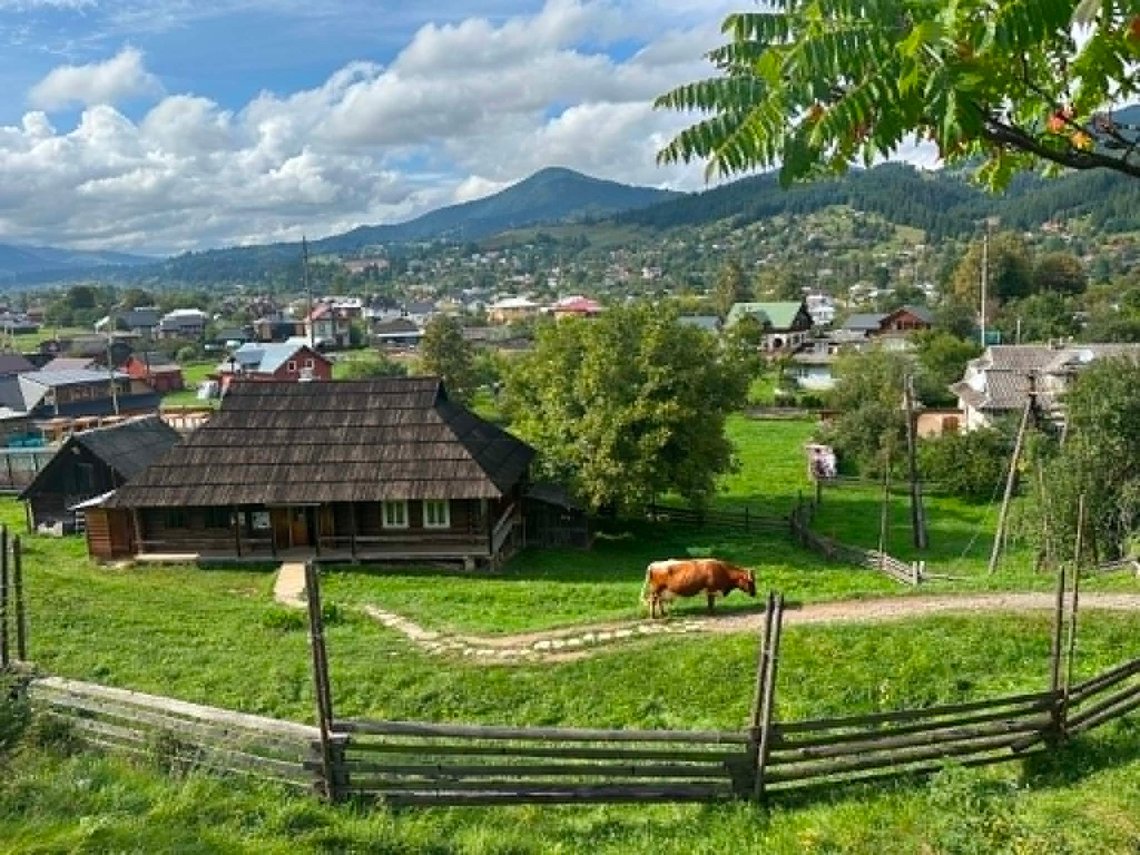
The car bumps cautiously along the main street, which looks poorly maintained now that most of the young people have moved away, and parks beside a long wrought-iron gate. Inside lies a farmyard surrounded by what may be the finest buildings in the village, painted blue with green trim along the bottom. On the left are the farm buildings, with stalls for pigs and goats. There is also a henhouse, with a ladder leading up to the perches. At the end of the row of buildings is the modern privy, the first in the village to be built “indoors” rather than outside among the fields and fruit trees behind the houses.
On the right are two elongated farmhouses. The larger contains a massive, two-metre-high baking oven of a kind also found in Finland, built of brick with a flat top on which one can sleep when the winter becomes exceptionally cold. For the same reason, an elongated storeroom runs along the outer wall of the house; when necessary, it can serve as an additional stall for the livestock.
The retirement house, where the elderly lived, has been preserved as a museum. The cupboards are filled with beautifully embroidered and folded tablecloths, dresses and blouses. One’s thoughts turn to all the beautiful things women’s hands have created through the ages, a value seldom appreciated or upheld.
 Ukrainian embroidered guest pillows (vyshyvani podushky). They were a measure of how prosperous a family was, showing that the household had the time and means to make these “useless” pillows, which are far too fine to sleep on; a guest would politely set the pillows aside and choose ordinary ones from the cupboard. Photo: CB
During the Second World War, the Germans requisitioned this farmstead as their headquarters in the area. They were not popular among the relatives, but everyone agreed that the Soviet soldiers were worse.
The family albums are brought out. Soviet childhoods are pointed out, the young people lined up in their school Pioneer uniforms, flanked by busts of Marx and Engels, and on the back wall, Gagarin floating in space.
The older generation had harsher memories, both men and women. Of the Holodomor, the World War, Stalin’s persecutions. On the mother’s side there were four brothers; only the youngest survived, as he had been forbidden from joining the partisans. On the father’s side, the sons were exiled to Crimea, while the father barely made it home from Siberia. Towards the end of his life, he was allowed to see them for a few days once a year.
There is nothing new about socialists liking to lord it over people. We simply hear so much about their idealised images.


