

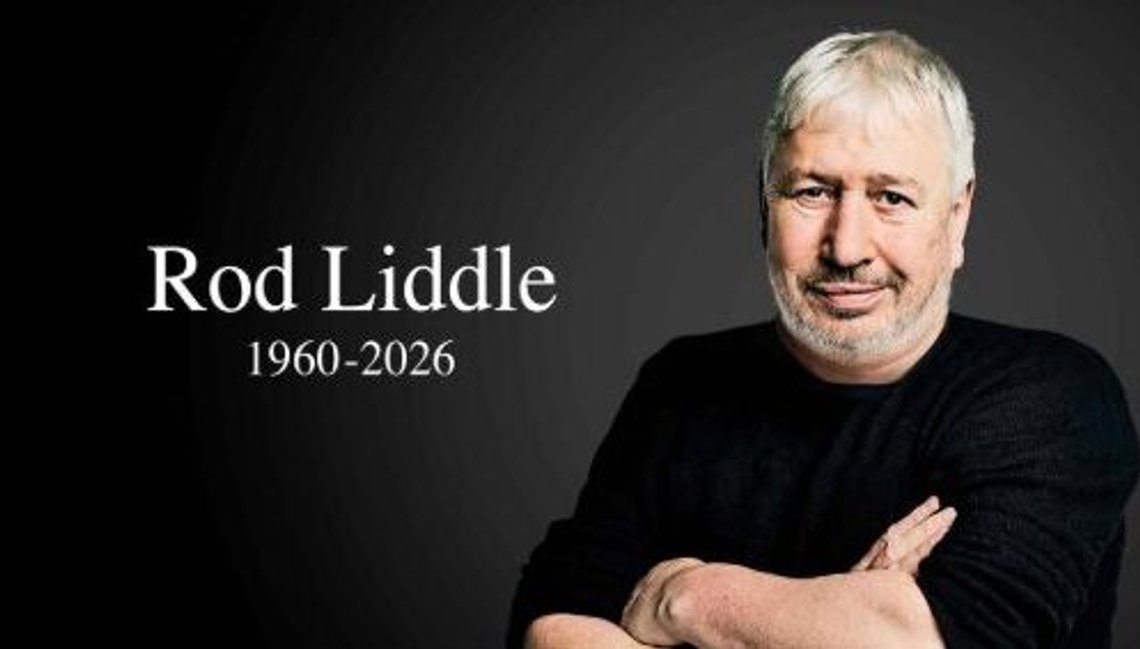
According to George Orwell, a journalist should always be a guerrilla soldier on the flank of the regular army who “never marches in step”.
Today, most journalists are preoccupied with currying favour with the elite and securing invitations to the right dinner parties. But not Rod Liddle. He embraced the role of the guerrilla with unmatched enthusiasm.
Rod was a crack shot who took aim at the latest fashionable nonsense from his home in Middlesbrough, and he rarely missed.
His fans – and there are many of us – are deeply saddened by the news of his death, announced today. He loved the anthem of his beloved football club, Millwall FC: “No one likes us, we don’t care!” That is why far too many people mistakenly regarded him merely as a provocateur, when deep down he was a moralist.
This is how his friend and partner in crime, Allison Pearson, remembers him in her tribute in The Telegraph. Rod Liddle died yesterday at the age of just 66.
In his weekly columns for The Spectator, The Sun and The Sunday Times, Liddle attacked the hypersensitive professional “offence class”, the aggressive promotion of transgender rights in particular, and the madness of identity politics in general.
He criticised the denigration of British history and traditions, the destruction and degradation of working-class communities through an unrestrained free market, and the appalling betrayal of the decent people who lived there. Liddle championed the freedom of speech that Britain’s elite had abolished and was a fierce critic of what he regarded as the BBC’s scandalous left-wing bias.
Liddle was originally a social democrat and a member of the Labour Party for 40 years. This placed him in a unique position to expose how Labour had betrayed its original voters: the working class, ordinary Britons.
They were the people hardest hit by disastrous economic policies, mass immigration and pointless wars in which their children risked – and lost – their lives. This occurred under both Labour and the Conservatives, but it was Labour that, in his view, broke its promises to the British people most profoundly.
He was a staunch friend of Israel and deeply disliked what he saw as the BBC’s instinctive anti-Semitism, expressed by the corporation’s supposedly “objective” reporters:
“Israel is an example of something else that the BBC, under its charter, disapproves of: bullying. Then you have [BBC correspondent] Barbara Plett weeping over the death of the tea-towel-clad murderer Arafat, and Orla Guerin frowning over every subsequent Israeli ‘atrocity’.”
“The tea-towel-clad murderer” is a classic Liddle combination of the absurd and the condemnatory. (The sarcasm becomes all the more devastating precisely because of the absurdity.)
Liddle recognised the same condescending attitude among “Remainers” towards the dreadful, misguided “Brexiteers”:
“Europe, after all, is a lovely place full of lovely people. Those who are suspicious of it either dislike foreigners or have based their views on unfortunate incidents that really ought to have been forgotten by now – namely Auschwitz and Ypres.”
Boom, boom! Notice Rod’s magnificent, powerful prose: first the “unfortunate incidents”, delivered in a smooth Sir Humphrey voice, followed by the decisive blow – “namely Auschwitz”. Pure genius, because the Holocaust can never be an afterthought.
Class consciousness was never far away in a Rod Liddle column. He did not hate the wealthy as so many bitter Labour politicians did, but possessed a generous, romantic sense of human potential. As a young boy he dreamed of becoming a train driver, and took the ambition rather further than most children.
“When I was five, I’d sit all day on Darlington station with my packed lunch – can you imagine that today? – and sometimes the drivers would let me ride with them.”
Rod attended church from childhood, twice every Sunday without exception, and retained his faith. At the very least he remained a member of the Church of England, “if you can call it Christian”.
Even as a child, he was never afraid of confrontation.
“I was expelled from nursery school for hitting another child over the head with a chair. I had to give him my favourite Batman car because I’d fractured his skull.”
Such “diplomatic skills” served him well as a columnist, Pearson writes, with the kind of tongue-in-cheek humour Liddle himself would surely have appreciated.
As a teenager, Liddle discovered George Orwell and Daniel Defoe, later Hunter S. Thompson and Tom Wolfe. He joined the Socialist Workers Party (SWP).
“I believed in the social values of the Left. I believed we had a responsibility towards our fellow human beings, and I believed very strongly in the welfare state. The issues that mattered to me then were women’s rights and equality for black and Asian people – and, of course, those were the two causes the SWP was really committed to.”
At the age of fifteen he became only the third person in the country to join Rock Against Racism. He played in a punk band and recalled that they refused to support The Motors because the band was allegedly sympathetic to the fascist National Front.
This was despite being offered a fee greater than the boys had ever imagined. So much for Rod Liddle the racist and misogynist.
It reminds me of a song by Nigel Williams that I heard as a boy around that time, with the following chorus:
My mother’s name is Herbert Pork
And she votes for the National Front
She really can’t read or write or walk
But I really do admire her front…
Liddle quickly mastered the written word and won a national essay competition at the age of fifteen. He wanted to become a writer.
“Oh, Rod! Don’t do it. Don’t do it,” his parents cried.
But his childhood was not one of oppression. “It was exactly the same as everyone else’s in my class, which was narrow,” Liddle later wrote.
He left school at eighteen with A-levels, and when a career as a punk rock star failed to materialise, he joined the South Wales Echo.
His aim was to hold the powerful to account and secure social justice. But not in the distorted manner of today’s advocates of social justice, who sacrifice nothing because they enjoy the backing of the elite. Today’s social justice bears little resemblance to the social justice Liddle believed in.
Rod worked full-time as a speechwriter for the Labour Party while studying. Later he was attacked as a member of the “far Right”, despite his views having changed very little; it was Labour that abandoned the working class’s common sense and decency.
We recognise the same pattern all too well in our own pitiful version, the Norwegian Labour Party.
Pearson believes Liddle’s development into a moralist stemmed from witnessing the decay and abandonment of the part of the world he regarded as home.
“You know, there was a time [in the early 1970s] when Teesside accounted for about 26 per cent of Britain’s GDP. Bloody incredible! Europe’s biggest steelworks, two of Europe’s biggest chemical plants, nuclear power, shipping – everything. Twenty-six per cent of GDP!
“And what did the people of ‘Boro get out of it? Pollution, dreadful housing; they got jobs, but they were low-paid jobs – mostly manual or semi-skilled. Then Thatcher took it all away and replaced it with absolutely nothing. Unemployment reached 27 per cent. It was terrible. This place, which had kept Britain going, was left with nothing. You simply can’t do that!”
In 1988 he joined the Today programme as a junior producer. It was quite a culture shock. Of the roughly fifty people working on the programme, six had attended Eton.
“Six! Can you imagine if six had gone to my school, Laurence Jackson Comp in Guisborough? They were charming people; but if you wanted to investigate drug dealing, you’d send a reporter into a housing estate in Deptford asking: ‘Excuse me, can I buy some crack?’ It was utterly hopeless!”
Rod was able to observe the liberal intelligentsia in its natural habitat.
“They are almost exclusively white, middle-class liberals. I don’t particularly dislike them – I genuinely think they have good intentions. I just don’t think they understand a damn thing.
“In my early days on the Today programme this became obvious in the assumption that anyone opposed to Britain’s joining the ERM [Exchange Rate Mechanism] was xenophobic.”
This applied to the Conservative Party, Labour, certainly the Liberal Party, and, of course, the BBC.
“Yet as soon as you got north of Loughborough – perhaps even Watford – the entire population opposed the ERM. Nobody wanted it. The same could be said of almost every issue. Crime. Race. Immigration. Foreign policy. The BBC does not reflect the views of the people outside this golden crescent around London that governs us.”
For the rest of his life, Rod satirised this elite of media and politics, and its “complete and utter detachment from the way the rest of the country lives. I simply don’t think they get it. They don’t experience it. They don’t understand it. It simply doesn’t exist where they live.”
Rod Liddle exposed how the opinions of the majority were despised and ignored, with occasional flashes of brutality and abundant dark humour.
It is extraordinarily rare to find someone with such sympathies at the highest levels of the media. “Rod had a genuine love and admiration for so-called ordinary people and contempt for so-called important people,” said a close friend. “He hated pretension, self-importance and phoniness more than anything. He treated himself terribly, looked after everyone except himself, and never realised how brilliant he was.
“He loved the Britain where poor children could succeed and ultimately improve their miserable lot. He was furious and heartbroken by the country’s decline, and his Social Democratic Party politics reflected that commitment to fairness, merit, truth and common sense.” [He stood as an SDP candidate and finished fourth, which he found hilarious.]
Liddle was also an early and outspoken critic of the way official Britain failed the young British girls who became victims of the euphemistically named grooming gangs. In practice, perhaps as many as 250,000 vulnerable girls were subjected to organised serial rape and outright torture (and some murders), perpetrated predominantly by Pakistani Muslims.
Whenever you saw Rod Liddle’s name beneath an article, you knew you were in for something special. Part of his genius was that he could write about unbearably grim subjects such as the grooming gangs and still leave you feeling cheerful. His jokes produced a cathartic laughter, and despite everything, he gave you hope. I am devastated that he has gone so young – only 66. We needed him until he was 86.
Pearson met Rod only a handful of times but regarded him as a friend. She says he was enormously supportive when she herself was subjected to scrutiny by Essex Police in exactly the kind of authoritarian intervention he so fiercely condemned.
When you met him in person, he would make you cry with laughter because his observational humour was every bit as good as Ricky Gervais’s. He was an outrageous figure, charismatic and slightly scruffy, yet there was no malice in him. One of his favourite words was “tickled”.
Even as he lay dying in his hospital bed in Middlesbrough, Liddle was still making people laugh.
In Rod’s final hours, I am told, nurse after nurse came into his room because they sensed the end was near and somehow wanted to pay tribute to the wonderful, gentle man who had been so kind and grateful.
“No one likes us, we don’t care?” No, don’t believe it, writes Pearson.
Rod Liddle was loved, and he cared – that was what made him so damned good. His readers in The Sun will be just as heartbroken as his readers in The Times and The Spectator. Our brave warrior in the culture wars, the champion of ordinary people, the guerrilla soldier on the flank of the regular army: Rod Liddle united everyone with both a brain and a heart.
On behalf of Document, I would simply like to say to the wonderful writer Rod Liddle:
Rest in peace, and have a beer wherever you are. I’ll buy the first round!


