

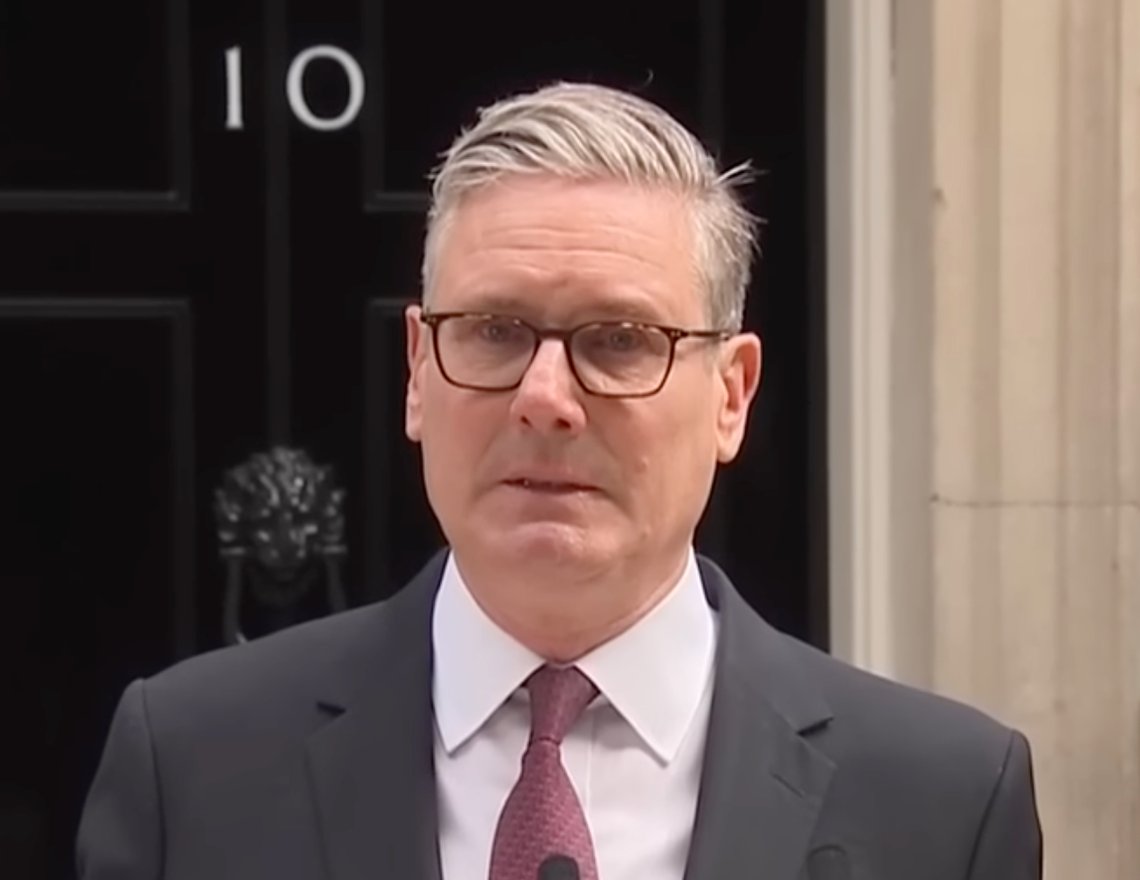
Keir Starmer was visibly moved when he announced his resignation as Prime Minister of the United Kingdom. When he finally mentioned his wife and children, his voice broke. It was a revealing moment. Not because there is anything inappropriate about being moved at the thought of one’s family, but because it was the only point that genuinely moved him. Not when he spoke about the country and the office. Starmer kept the mask in place – until the mask was no longer necessary.
Starmer leaves behind a United Kingdom in deep crisis. Now Andy Burnham awaits. Within the party, the mood is almost euphoric. At last, a man of the people who can speak to the working class. At last, someone who does not look like a robot in a suit.
But it will not change a thing. For the misdiagnosis remains the same as ever, and Burnham is cut from the same political cloth. Oxbridge-educated, shaped by Labour in the Blair era, technocratic and globalist in his fundamental outlook. He is progressive on every cultural front, where Labour has for years been drifting away from the voter base it once represented.
The crisis of trust between the people and the elite will not be resolved, and neither, therefore, will the bottomless swamp of immigration, crime, Islamisation, woke ideology, and other nonsense that is destroying the country.
The revolt is not irrational
To understand what is really happening in Britain, it is necessary to look at the millions of voters who have turned their backs on the traditional parties, especially Labour. According to a study by the National Centre for Social Research, those who support Reform are not a frustrated and irrational rabble protesting from the bottom of society, as the political class likes to imagine.
Quite the contrary. They are workers, tradesmen, and the self-employed. People rooted in their local communities, shaped by responsibility and obligations to others besides themselves.
The political class has a simple explanation for the revolt: people are stupid. It is an explanation that has the advantage of requiring no self-examination.
Nor is it primarily economic dissatisfaction that drives these voters. It is cultural and values-based concerns. That is also why Brexit is no explanation whatsoever for the crisis of trust.
People want control of the borders and less immigration. They believe that the left’s identity politics has run out of control, and they feel that their national identity and shared culture are under pressure from demographic change, an aggressive woke ideology, and a political class that does not represent them.
In other words, it is a well-founded cultural revolt against a political establishment that has governed in one direction for decades while the majority of the population has wanted another.
The great hypocrisy
The Henry Nowak case illustrates this better than any statistic. A young Briton died in police custody while repeating the words “I can’t breathe”, precisely the same words uttered by George Floyd in Minneapolis in 2020. But the reaction from the political class was diametrically opposed.
When Floyd died, British politicians across party lines encouraged anger, demonstrations, and system-wide change. Keir Starmer declared that Floyd’s death should be “a catalyst for change” in Britain. Sadiq Khan said it had “rightly” sparked outrage around the world. Members of Parliament took the knee, and institutions bent accordingly.
When Nowak died, the message was different. Nigel Farage raised the issue of anti-white racism within the police and public authorities and was denounced by Starmer.
Remarkably, on the very day Starmer stood in Parliament dismissing the notion that people of other skin colours receive better treatment than native Britons, the country’s most senior police leaders acknowledged in The Times that they were reviewing guidelines on whether police officers should treat ethnic minorities differently from other citizens.
The gap widens
The fundamental divide between the people and the elite will not be closed by replacing one technocrat with another.
Starmer’s tears were genuine enough, because they were about himself. They ought to have been about the country he was given the opportunity to change, but instead failed.
Until his resignation, Starmer was the worst of the leaders currently in power in the West. It is a good thing that he is gone. But it will not solve Britain’s enormous problems.


