
When hospitals are built like fortresses and elderly people no longer dare to take the bus, you realize just how much a society has changed. A trip to Vrinnevi Hospital becomes a story about a Sweden where insecurity can no longer be ignored.
I leave Kvarsebo and drive to the hospital. I lived in Beijing for several years at the beginning of my career as an IT consultant. Now I wonder whether all of Norrköping has become a no-go zone.
The road to Vrinnevi forces you through the area whether you want to or not. You have to pass the large residential parking lots in Navestad, along Guldringen and Silverringen, and the open asphalt expanses around Hageby and Mirum.
Norrköping – or Mogadishu?
It smells like smoke. I press the button so the car recirculates the air inside the cabin. Another one of those deliberately set car fires whose stench is constantly in the air. I try to look away to avoid feeling depressed, but my eyes are drawn toward the parking spaces anyway. The smoke has long since disappeared into the cool evening, but gray flakes of soot still drift through the air like dirty snow.
I look at the soot and wonder whether I am still in Norrköping—or whether I have somehow been transported to Beirut or Mogadishu.
A black BMW brakes hard right outside the emergency entrance. The heat from the grille hits my hand. I avoid the driver’s gaze. The arrogance of the driving makes me cautious.
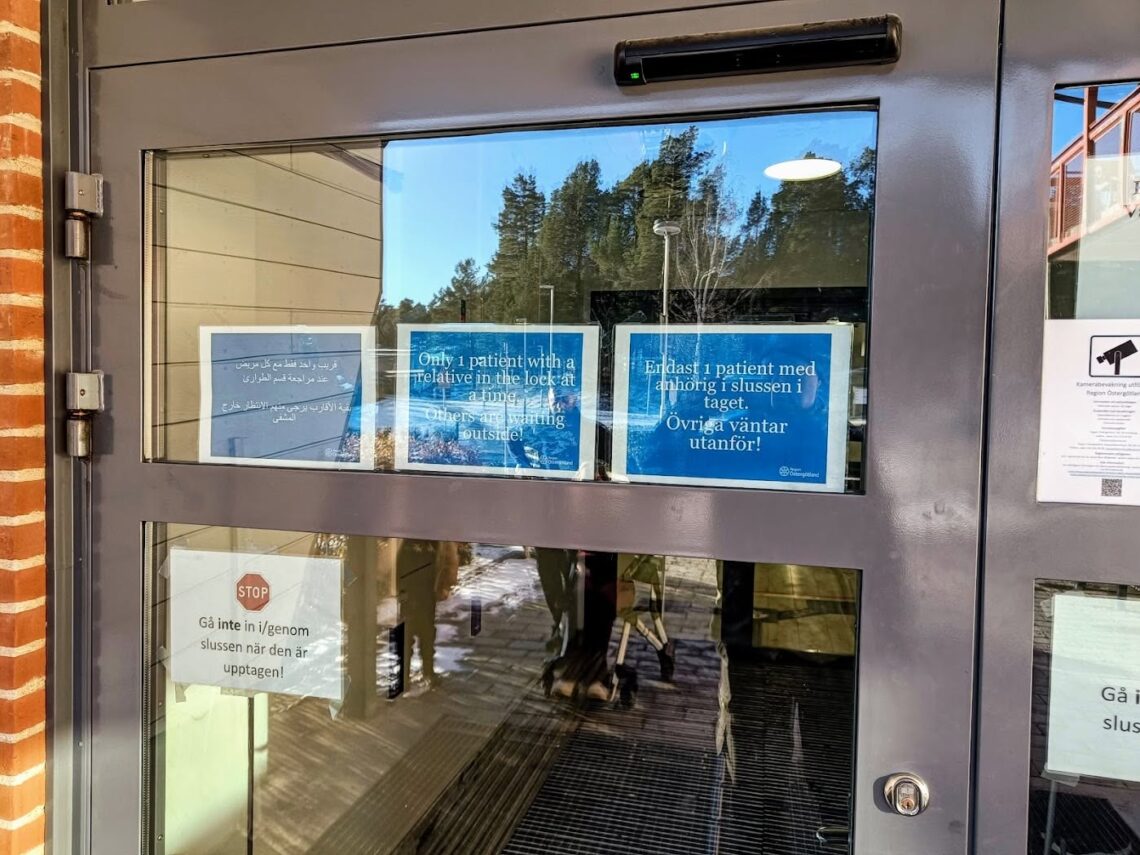
In the past, you simply walked straight in. Vrinnevi’s old entrance was open, bright, and welcoming. Now you are met by a security vestibule, just like the visitor’s entrance at a prison. On the door, your eyes first meet a blue sign in Arabic before, all the way to the right, you finally find one in Swedish.
Behind thick, bulletproof glass sits a security guard whom I cannot even see. A button is pressed, and the doors open for one person at a time. Is it the old local drunks—Ante, Börje, Magnus, and Sven—who have suddenly become so dangerous that the entire hospital has had to be armored like a fortress? Or is it the newcomers who have forced these changes, those with names like Ali, Bilal, Mohammed, and Samir?
Destroying the Last Things We Have Left
My old Social Democratic friends vote these things through. They approve prison-style security entrances at emergency rooms and pretend nothing is wrong whenever people talk about the growing threat. In the next breath, they speak about solving integration—even if it takes three generations. Through Social Democratic social engineering and forced mixing of populations.
It will never work. Entire residential neighborhoods across the country have already collapsed in exactly this way. Deliberately, they are tearing down the last things we have left.
They refuse to admit that they are being forced to build fortresses because of their own political decisions. They dismiss all criticism as racism or prejudice. They refuse to listen when I tell them that the elderly people I help in my spare time are living in genuine fear. People who have paid more than 12 million kronor in lifetime taxes.
A Welfare State Turned Into a Reign of Fear
And this is how they are repaid by politicians who still stand there claiming that healthcare is free. Nothing is free. We have paid for every single brick throughout our entire lives. We have also paid to be treated paternalistically by both home-care services and the healthcare system. A welfare state transformed into a reign of fear.
The bus is no longer an option. The sense of safety has disappeared, even though we continue paying for it through our taxes whether we use it or not. Elderly people with meager pensions cling desperately to their old rusty cars. Gasoline and insurance can cost whatever they cost—as long as they don’t have to ride the bus and can drive past the local shopping center to stores where the gangs don’t hang around. At least most of the time. You never know where they’ll show up.
In the waiting room, the chairs and benches are bolted to the floor. Everything is fixed to the walls, just like in prison. No loose objects are allowed. Anything could become a weapon.
Better Death Than Home Care
Lillemor sits at home behind what has now become a completely worthless front door. She fears the digital keys the municipality has installed and handed out to dozens of strangers. Her home is no longer her castle. Who will walk in today?
Staff turnover is enormous. A stranger’s eyes behind a niqab, or a young man she cannot understand, sent to wash her private parts.
The municipal care administrators couldn’t care less that she has said no.
Her request to have at least a female caregiver on the day she is bathed is ignored, despite repeated promises that a woman would come. Lillemor confides in me: she wants to die. She is in pain. She is frightened. She simply wants to fall asleep peacefully and quietly in her own home.
Billions for the Gangs – Bolted Benches for the People
At the shopping center that elderly people no longer dare to visit, I watch cash and small plastic bags change hands in broad daylight. Personally, I am what would be called drug-liberal. I would much rather see this trade regulated through pharmacies or Sweden’s state alcohol monopoly. Cannabis is less harmful than alcohol, has legitimate medical uses, and the market is estimated to be worth around 16 billion kronor.
That money should be taxed by the state instead of enriching gang leaders, fueling more car fires in parking lots, and financing bombings of apartment buildings.
There is nothing hidden about the threat anymore. Yet politicians continue pretending it does not exist, trapped in an ideology-driven unwillingness to face reality.
Violence is everywhere now. It has even entered the hospital lobby and bolted the benches into the concrete where I now sit waiting for my turn.
This text was originally published on the author’s Facebook page and is republished with permission.