

Major changes are not always detected through major events. Sometimes they are first noticed as small disturbances or deviations in everyday life, in what surrounds us.
In the short story ‘The Invisible Collection’, Stefan Zweig gave this insight literary form. The story takes place in Berlin during the economic crisis between the First and Second World Wars. An art dealer visits an old customer who has spent a lifetime building up a famous collection of graphic prints. The customer, who has become blind with age, does not know that his family has sold the original prints one by one in order to survive. The original works have instead been replaced with blank sheets and cheap reproductions.
Although the pictures have long since disappeared, the old collector describes each of them with impressive precision. It is only when he runs his finger over Rembrandt’s proof print of the sleeping Antiope that he notices it: The indentation left in the sheet by the copper plate is gone. He can still picture the collection – in his memory it is intact – but his hand tells him that something important is missing. The art dealer, who has been let in on the secret beforehand, plays along and declares how magnificent the work is. Calm is restored.
Perhaps it is the same with cultural changes. We can continue to believe that we live in a Christian country, while the traces of Christianity gradually disappear.
An everyday and seemingly trivial conversation in a podcast is revealing in this respect. The ‘art talk’ between a section head from the agency that manages Oslo Municipality’s art collection and two journalists concerns how the collection is managed and the municipality’s acquisition policy.
– Are there certain works that cannot be purchased? the two journalists wonder.
– In a museum, one accepts works of art that are outdated, purely in terms of time, the section head begins firmly. The museum safeguards the historical perspective, but for the municipality it is about the present. The municipality cannot purchase works that are explicit in a way that means they cannot be displayed anywhere. The works must withstand a different kind of public sphere from the art world, he explains.
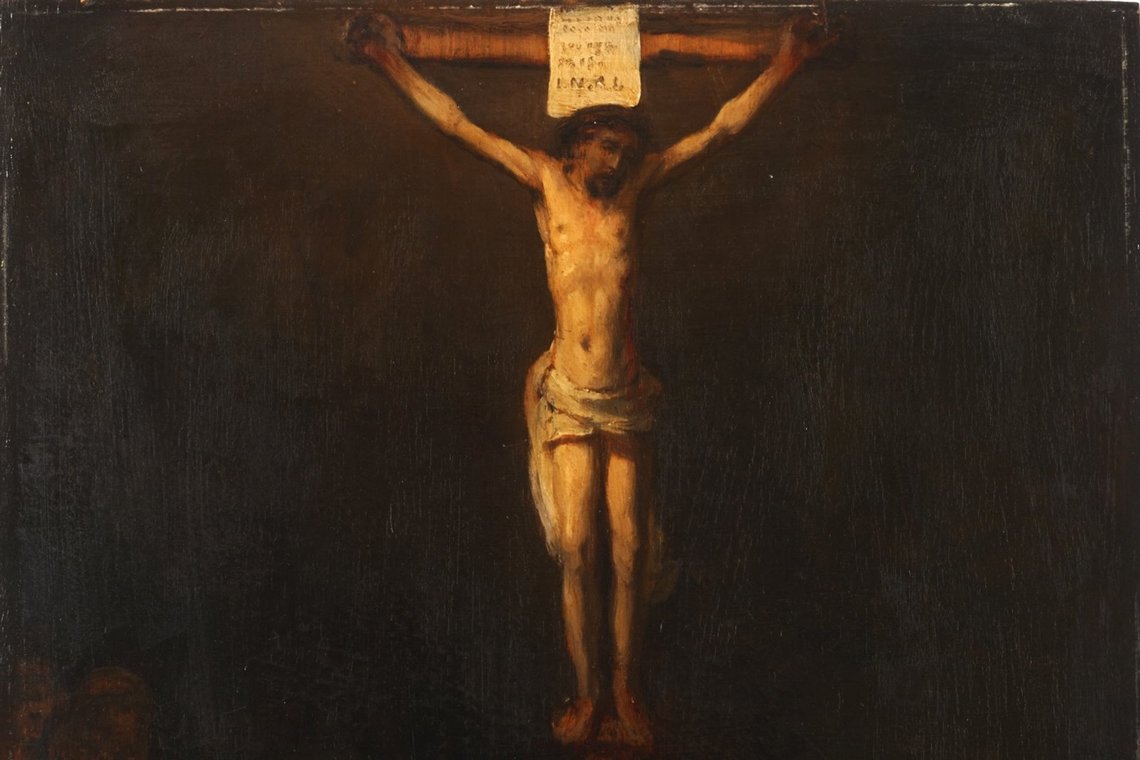
The section head himself believes that they are quite courageous when they purchase art. They dare to challenge, as he puts it. But there are certain limitations, he adds, and highlights two specific examples: Firstly, works with explicitly sexualised content are problematic, because they can provoke reactions among people from other cultures. The second problem is Christian symbolism, in particular the crucified Jesus.
It is no longer permitted to place religious motifs in, for example, a ceremonial room in a nursing home, because these rooms are now to be ‘value-neutral’, we are told. Works associated with Christianity are no longer purchased. The municipality is now collecting this art and attempting to have it transferred to other collections. Instead, lyrical-abstract compositions of a meditative character are hung.
There is a remarkable principle behind the municipality’s stated aim of creating good and relevant art experiences for the city’s population: It is not the viewer who is exposed to the art, but the other way round. The art must be adapted to the sensitivities of the person looking at the work. Oslo Municipality has in practice become the therapist who solves the problem of diversity with a new method of treatment.
The art is a visitor, and so it must be ‘relevant’. The two journalists in the studio content themselves with saying yes and aha to this, as though it were the most natural thing in the world to remove Christian symbolism from the capital’s public art.
The strange thing is that the change appears so undramatic. No one has decided that Christianity is to be removed from the capital’s cultural life. Christian symbols are not forbidden. It somehow does not matter that the same symbols that are now disappearing represent a central part of our own history and identity. Nor does anyone wonder about the examples – pornography and Christian symbolism – as though they were somehow two equivalent problems within the same complex of issues.
The perverse and the Christian, two intolerable elements in the new public sphere, although the former has found a place in the public sphere nevertheless. So which public sphere is actually being protected?
In his autobiography, Zweig writes that it was also like this for the young before the First World War. They were so preoccupied with culture, art and literature, the author relates, that they scarcely registered the great political changes around them: We lived in a world that seemed unchangeable, but the signs that it was already in the process of disappearing were all around us.
Perhaps this is how our own ‘World of Yesterday’ disappears. Not through one great decision, but through the many small changes to that which tells us who we are and upon what foundation of values our society is built.
One can still read about it in Article 2 of the Constitution, as well as catch sight of it in those museums that tolerate Christian works of art. If we examine more closely, we are eventually forced to admit that something is missing.


