

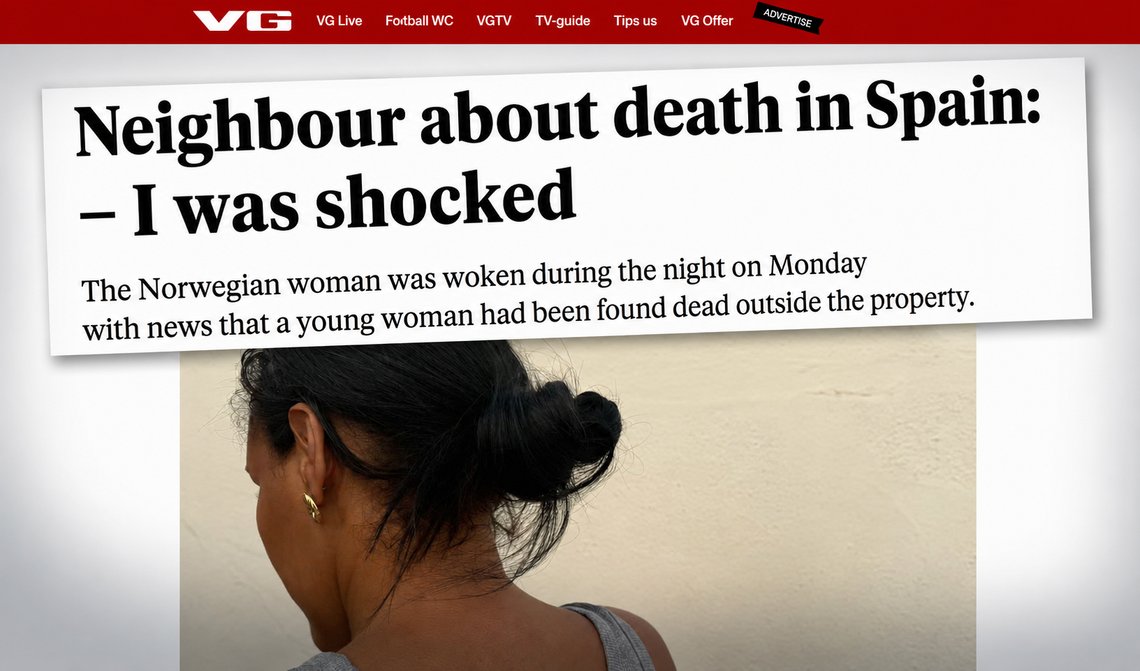


Norway’s largest newspaper VG’s anonymous source, who is said to be Norwegian and the owner of a holiday home beside the motorway where Nikoline Piwoni Høie was found after being struck by a vehicle, claims there is an opening in the central reservation where people often cross. But no such opening exists anywhere nearby.
For those familiar with the area, several aspects of VG’s interview from Mijas in Spain, published on 9 July, raise questions.
The woman’s friend had been out for the evening and woke her to say that there was “a dead woman lying in the street outside”.
She says she got up and went outside with her friend. Just outside the property, a person was lying on the ground, covered with a white sheet.
But the “street”, supposedly “just outside the property”, is, at best, on the opposite side of a four-lane motorway with a central reservation and a safety barrier.
Dangerous and prohibited to cross on foot
The article states that the woman’s holiday home is located on the beach side of the motorway. The deceased 17-year-old was found in the carriageway furthest from the beach.
The interviewee shows the VG journalists a video on her mobile phone. She claims that taxis often drop passengers off on the wrong side of the motorway when they are heading home:
“This is typically where you’re dropped off if you take a taxi home,” she says.
The video shows a car park on the inland side of the four-lane motorway. The opposing carriageways are largely separated by a physical barrier.
But this never happens. Junctions are closely spaced on both sides of the motorway. No taxis drop passengers off on the wrong side of this stretch. It is dangerous and prohibited to attempt to cross the road.
“But you can cross here,” she says, pointing to an opening in the barrier.
No such opening exists. There is an uninterrupted central reservation with a safety barrier for more than 1.3 kilometres along this stretch.
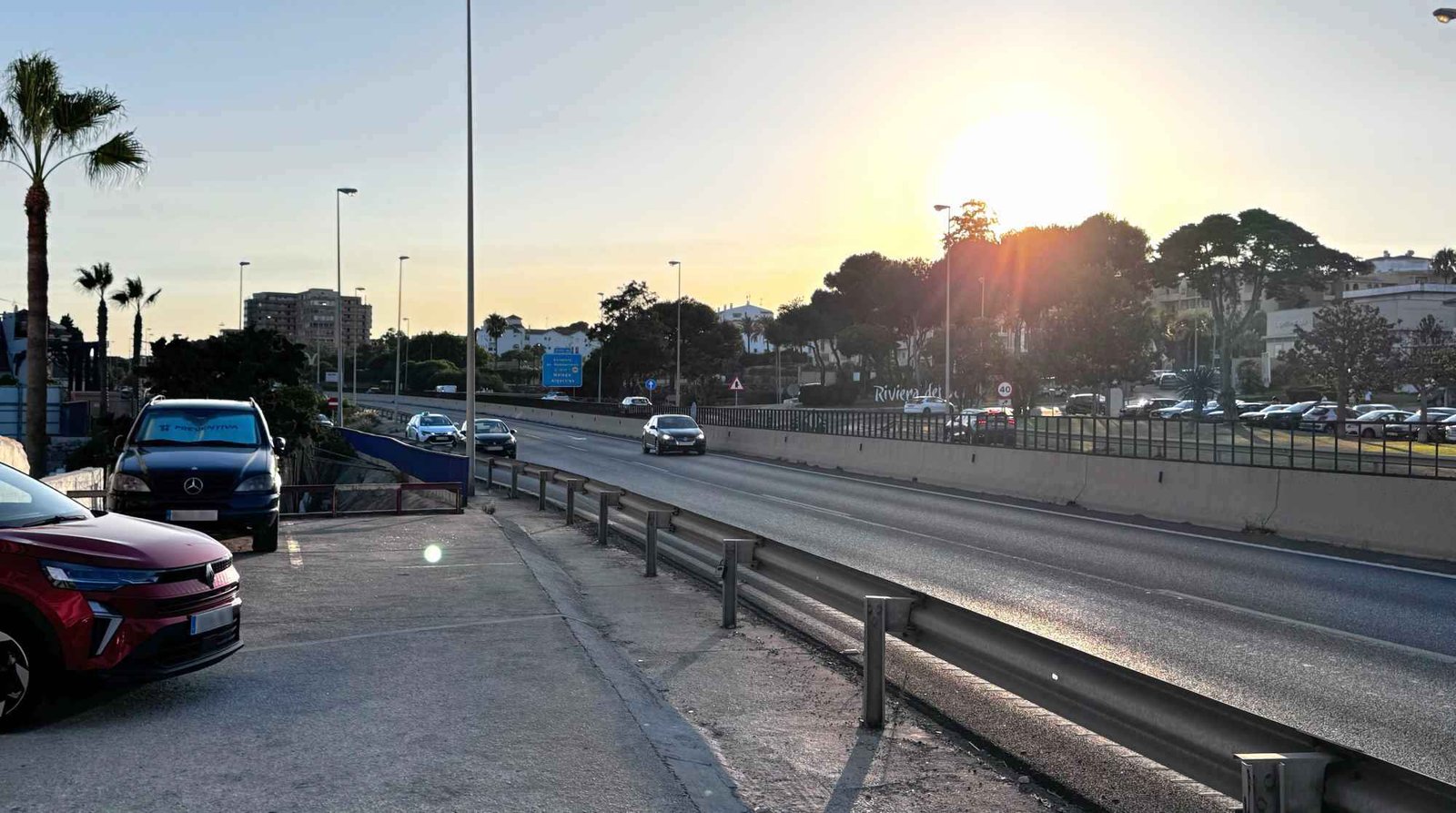 There is an uninterrupted central reservation with a safety barrier along a lengthy stretch of the A-7 near the Riviera del Sol exit. The photograph was taken from the beachfront property Aguamarina, looking towards the location where Nikoline Høie was found in the opposite carriageway. (Photo: Document)
A pedestrian bridge is located 700 metres from the accident site. Approximately at the location where the accident occurred there is an underpass for both vehicles and pedestrians.
In its response, VG rejects the claim that the interview is fictitious.
“VG interviewed the woman referred to in the article, and the account is based on an actual interview and our own journalistic investigations at the scene,” writes VG’s acting breaking news editor, Espen Bolstad.
Document’s questions and Bolstad’s full response can be found at the end of the article.
The footage was filmed from an easterly position along the A-7 at Riviera del Sol and zooms in on the location where Nikoline Høie is said to have been found, near a westbound bus lay-by in the carriageway leading back towards Marbella and Puerto Banús.
According to the Spanish press, the collision occurred in the opposite carriageway and was so severe that the teenager was thrown over the central reservation.
Difficult to see anything at all
We base our assessment on the location shown by VG in its own photograph, near a bus lay-by just west of the underpass and the Riviera del Sol exit.
At its widest point, there are the equivalent of six or seven traffic lanes between the “street” where the Norwegian 17-year-old was found and the street level where the eyewitness must have been standing. An exit road descends towards the beach, and the painted central reservation is approximately one lane wide.
The video above shows the view from the car park of the property closest to the scene, Urbanización Lubina del Sol.
The car park is lower than the carriageway. Even a very tall woman could not possibly see a person lying on the far side of the central reservation and steel barrier.
Nor can Google Maps’ Street View camera, mounted on a rig atop a passenger car, see a person lying at the scene from the opposite carriageway at Lubina del Sol.
The place where Nikoline was found is, at best, 65 metres from the women’s possible position. From the building furthest away, the distance is approximately 130 metres.
It was also dark when the collision occurred and while the emergency response was under way. The sun did not rise until an hour and a half after the fatal accident.
If, contrary to expectations, VG’s interviewee lives in one of the tower blocks east of the accident site, the distance to the location where the victim was found is even greater, around 200 metres. It is at least as difficult to see a person lying in the opposite carriageway from that position.
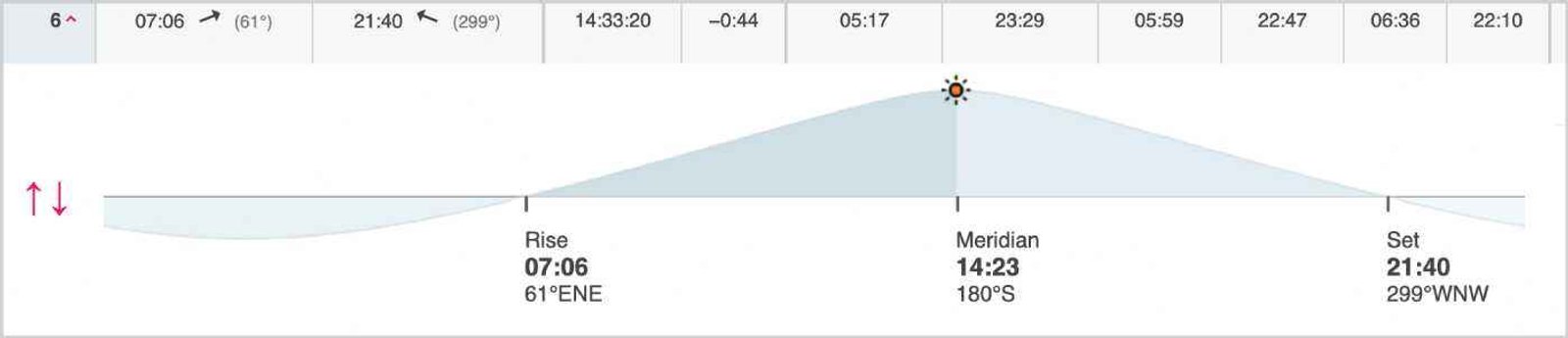 It was dark at the scene when the collision occurred, before 05:20. The sun did not rise until after 07:00 on 6 July this year. (Graphic: timeanddate.com)
The woman visits her holiday home in Málaga every year.
A holiday home suggests a detached house. There is only one house on the beach side of the motorway along the relevant stretch. But it is situated even lower in the terrain. From there, the central reservation, several crash barriers, a metal fence, numerous traffic signs and an overgrown roadside with dense vegetation all lie between the observer and the accident scene.
The house is also unoccupied. It contains a restaurant that closed long ago.
 VG journalist Fathia Mahmoud Farah visited the accident scene in Spain together with Joakim Midtbø Viland. (Photo: Private)
“Since Monday, I’ve just been looking forward to going home. I don’t think it’s pleasant here any more. It doesn’t feel safe.”
Traffic accidents occur every day on Spanish motorways. Is it really a typical reaction for someone holidaying in Spain to want to return to Norway because of a traffic accident in which she was not involved?
“It’s difficult to know what is true. But I’ve almost been hit by a car at the same place several times,” she tells VG.
There is just one problem with this account:
There is nowhere along this stretch of motorway where it is possible to cross without climbing over the safety fence, which is approximately 170 centimetres high.
The central reservation and the fence are uninterrupted for a distance of 1,350 metres.
It would take a great deal to “almost get hit several times” here. There is no reason to wander into the carriageway. There are no shops or anything else nearby that would cause someone to stray into the traffic by accident.
According to the woman, it is common for people living in the area to cross the motorway to get home, even though there is no pedestrian crossing.
“This is typically where you’re dropped off if you take a taxi home,” she says.
Highly atypical.
The norm is that taxis and ride-hailing services take you directly to your door, regardless of whether it is on the right or left side of a motorway.
“If you cross at the wrong place, you cannot get to the other side.”
As already noted, there are no openings whatsoever in the central reservation or the steel safety barrier.
VG journalist Fathia Mahmoud Farah holds a Master’s degree in education with a specialisation in Norwegian, grew up in Ål in Hallingdal, and has family roots in Djibouti.
As a diversity scholarship recipient in the FleRe programme, she began an internship at NRK in 2023 and later secured a permanent position. She joined VG as a journalist in April 2026.
One of the last things she did for NRK was publish an interview with a senior member of Hezbollah in Lebanon.
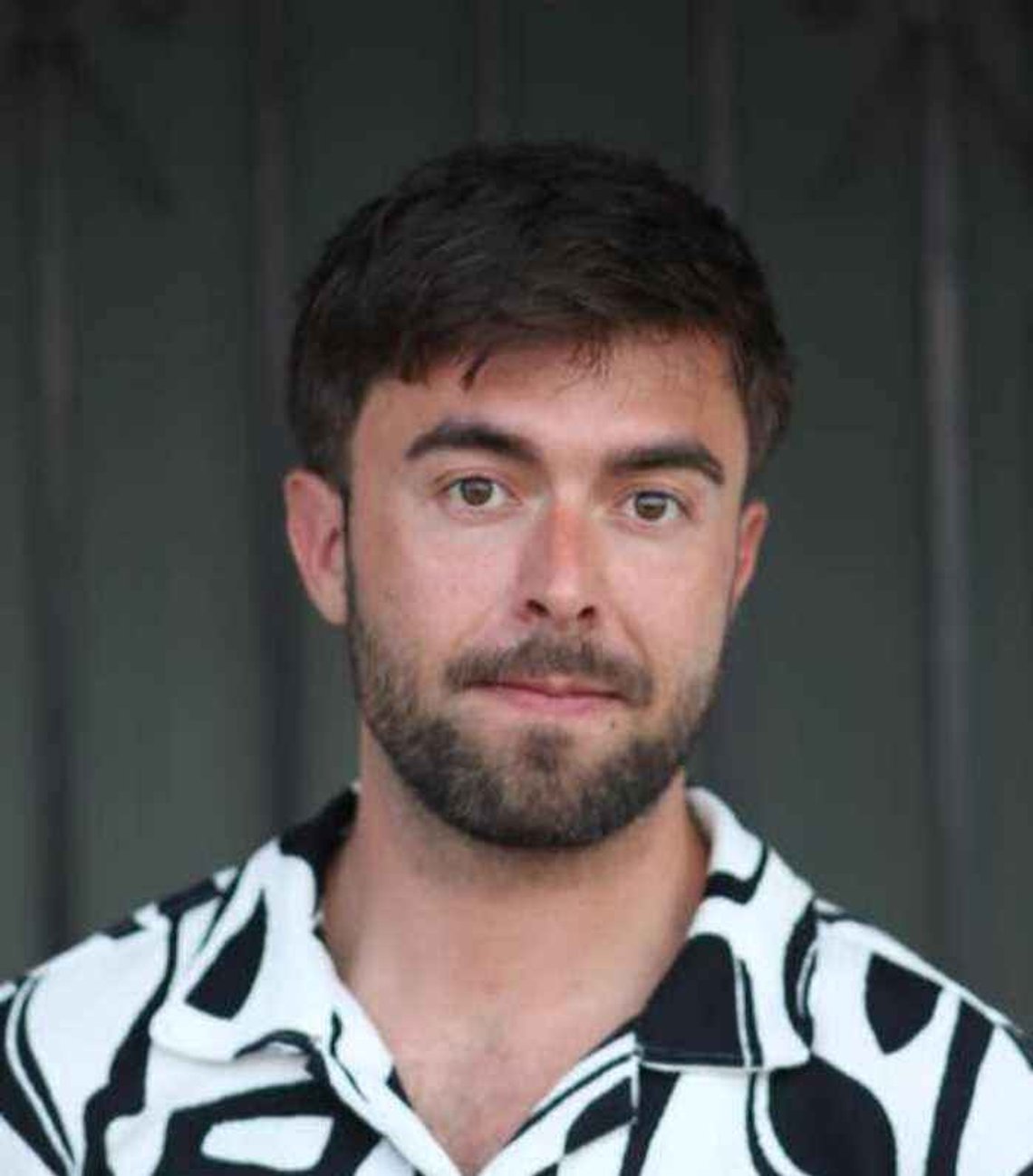 VG journalist Joakim Midtbø Viland. (Photo: Private)
Joakim Midtbø Viland joined VG six months ago. He studied journalism at the University of Stavanger and has worked for Aftenposten and Drammens Tidende.
He served as researcher and fixer for the British miniseries about the “eunuch-maker”, the Norwegian Marius Gustafson, who in 2024 was sentenced to life imprisonment in the United Kingdom for the paid mutilation of people’s genitals.
Dagbladet’s version with the same eyewitness
The day before VG’s article was published, Dagbladet published an interview with “a Norwegian holiday homeowner” near the accident site. Everything indicates that this is the same woman whom VG interviewed the following morning.
Dagbladet’s journalists, Oda Sophie Usterud and Nicolai Alcaniz, also present the situation as though the deceased teenager had been lying just outside the interviewee’s house. They do not reveal whether the interviewee is a man or a woman.
“It isn’t normal to see someone lying dead outside your own house. It’s truly tragic […].”
There are discrepancies between VG’s and Dagbladet’s accounts:
Dagbladet places the accident scene closer to the buildings on the inland side of the road, where some residents may have had an unobstructed view of the location. In comments to Dagbladet, the interviewee claims to have seen the accident scene from the window of her house. In VG’s version, she went out into the street with a friend to look.
From the window they could see the flashing blue lights of the emergency services working at the scene.
Dagbladet’s version contains no mention of a person lying beneath a white sheet. The source also says the exact opposite of what VG writes regarding the possibility of crossing the road:
“It is impossible to cross the road there,” the person tells Dagbladet.
Document’s questions to VG
After presenting the article, Document put the following questions to VG’s journalists:
- My question is whether VG actually interviewed this woman, or whether the interview is fictional.
- Can you state the address or the name of the residential complex outside which the source was standing when she observed the accident scene?
- Did VG itself visit this location, and if so, were you able to see the carriageway (the right-hand lane towards Marbella) where the victim was found?
- You write that the woman was woken by her friend at around 5 a.m. According to the police, the collision was not reported to the 061/112 emergency centre until 05:20. Does “around 5 a.m.” accurately reflect when the source’s friend saw the accident scene and woke VG’s source?
VG rejects Document’s allegations
VG’s response comes from acting breaking news editor Espen Bolstad:
“Let us categorically reject the allegation that VG’s article is based on a fictitious interview. That is simply not true. VG interviewed the woman referred to in the article, and the account is based on an actual interview and our own journalistic investigations at the scene.
“You have asked for details about the source. We do not comment on the identity of anonymous sources or provide information that could contribute to identifying them. For the same reason, we will not elaborate further on our assessment of sources or our methodology.”
Read also:
https://www.document.news/news/2026/07/nikoline-piwoni-hoie-17-from-arendal-found-dead-in-spain
https://www.document.news/editorials/2026/07/spoke-to-nikoline-before-she-disappeared-i-tried-to-warn-them


