

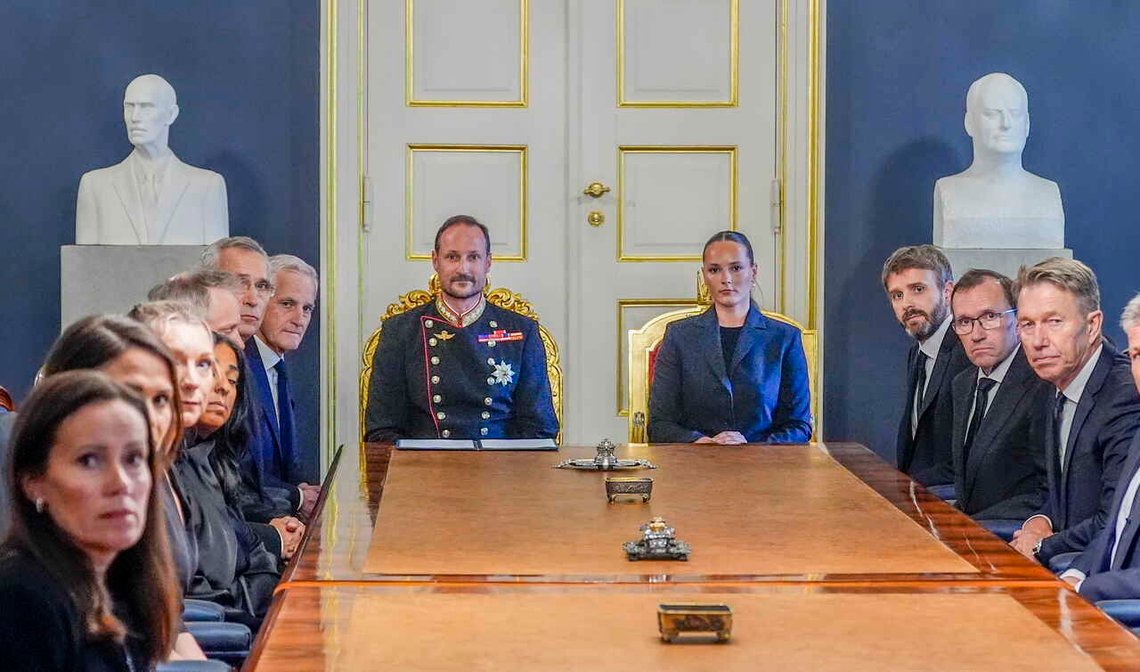


Nettavisen understands that Haakon VIII’s taking of the oath as King of Norway will take place in the Storting on Tuesday.
The oath, which is prescribed by Article 9 of the Constitution, reads as follows:
“I promise and swear that I will govern the Kingdom of Norway in accordance with its Constitution and laws, so help me God, the Almighty and Omniscient!”
In Norwegian, “constitution” means the Constitution (Grunnloven), or more generally the constitutional order – but regardless of how one understands the word, it is clear that the Constitution is the most important constitutive document.
The forthcoming taking of the oath raises questions that are relevant quite independently of King Harald’s death, but which nevertheless acquire renewed relevance with the change of monarch: What status does the Constitution have today? How much substance remains in it?
One does not have to read very far into the document before one is tempted to answer: “Not very much.”
For how much remains of it when Article 1 of the Constitution, in which Norway is defined as independent, is left as an empty shell? Listen to this:
The Kingdom of Norway is a free, independent, indivisible and inalienable realm.
If we dwell for a moment on the word “independent”, authoritative sources will give “sovereign” as a constitutionally relevant explanation.
But Norway is no longer sovereign when all laws relating to the EU’s internal market – and there are an enormous number of them – are inexorably incorporated into Norwegian law through the EEA Agreement.
Norway’s most important legislative assembly is no longer the Storting, but the European Parliament. And since in practice it is almost exclusively the unelected European Commission that has the power to propose new legislation in the Union, it is therefore a small clique of administrators from other European countries who in practice determine the future of our country.
We have now lived with the EEA Agreement for more than thirty years, a period that roughly coincided with King Harald’s time on the throne. We did not notice all that much difference at first, but as new laws and directives have piled up over this period, Norway’s own legislative power has been cut away piece by piece by the salami-slicing method. Soon there will be little more than a dry end-piece left of the poor salami.
For the most Brussels-obsessed power brokers in Norway, this is a pretext for our country to take the decisive step into the EU. Janne Haaland Matlary has already argued that this should happen without a referendum.
The issue may very well arise quite quickly during King Haakon’s time on the throne.
What is the King to do if the government wants to lead the country into a political union not only without the consent of the people, but even against the will of the majority?
King Haakon’s great-grandfather became King of Norway because in 1905 the Norwegians no longer wanted to be part of the relatively benign union with Sweden, which was light years away from imposing on us directives as detailed as those imposed by the European Soviet Union today.
Haakon VII himself showed such strength of purpose that in 1940 he personally told the Nazis to go to hell when they demanded that he abdicate and appoint Quisling as prime minister.
We live in rather turbulent times, in which our country could quickly become the scene of great political drama. Will Haakon VIII be equal to a situation in which what little remains of genuine Norwegian sovereignty is seriously threatened?


