

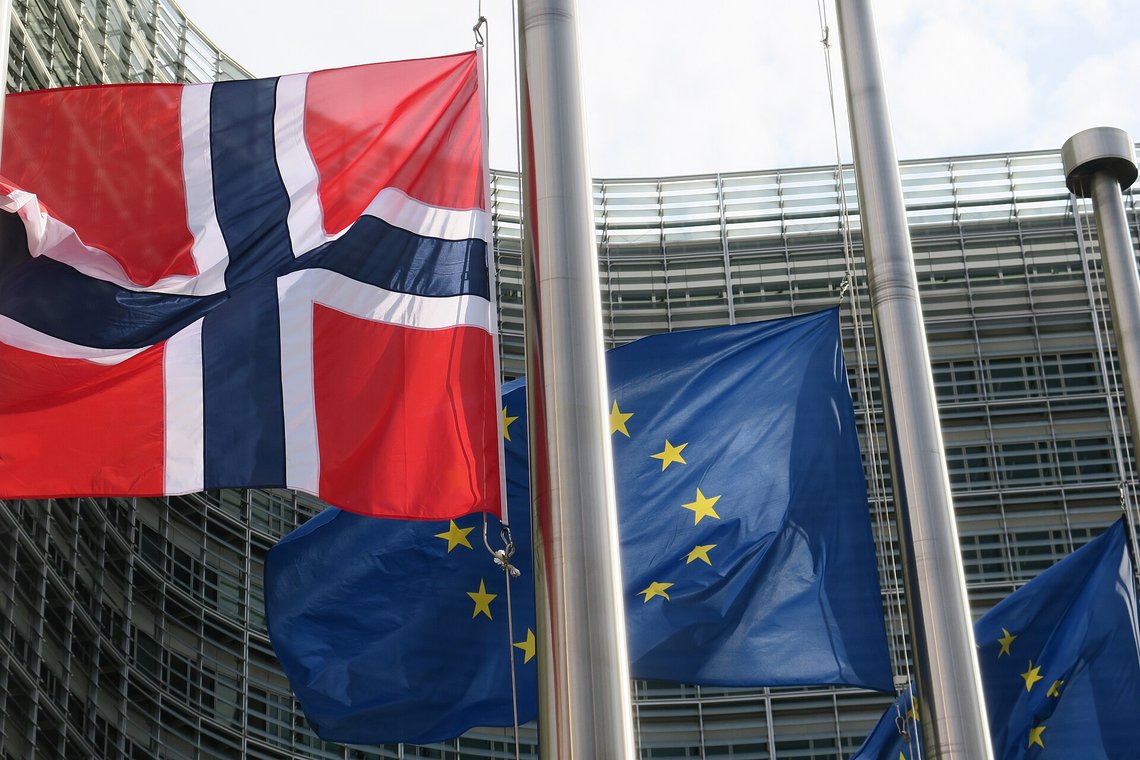


The EU has issued clear warnings to Norway that the pace of implementing EU directives must be increased. Too many directives are being left pending. Norway’s Ministry of Foreign Affairs (UD) appears to be taking the EU’s side. Espen Barth Eide sees the matter from the EU’s point of view, as though we in Norway have nothing to say. Norway supplies 30 per cent of all EU-imported gas and 12–14 per cent of all oil.
Yet Norway is portrayed as though it should stand there cap in hand.
NTB’s Isabel Bech uses anonymous sources who are spared any responsibility for the blackening of the picture:
– I am quite concerned. What we are now hearing from all official meetings, in various contexts, is that the EU has tightened its stance regarding the backlog. It is the first item at every meeting all the time, regardless of what they are discussing, says one of the sources.
It seems the Norwegian sources wish to put pressure on Norway.
In his EU/EEA policy statement last week, Foreign Minister Espen Barth Eide (Labour Party, Ap) partially confirmed the picture. Among other things, he maintained that the EEA Agreement is becoming increasingly inadequate.
– It is becoming steadily more expensive for us if we do not reduce the backlog, Eide afterwards told NTB.
On Tuesday, the Storting is to debate the statement.
The authorities/government appear to have laid out a course whereby Norwegian EU membership is presented as inevitable.
One of the reasons why the EU is increasing the pressure is that all three EU institutions – the Commission, the Council and Parliament – at the end of April agreed on a historic roadmap and timeline for a wide range of legislative proposals.
More than 40 legislative packages and initiatives are to be fully negotiated and adopted by the end of 2027.
It is said never before to have happened that the EU institutions agreed on fixed deadlines – and this before the Commission had even tabled the proposals.
In other words, the EU has increased the pressure on itself.
And this is now spilling over onto the EEA countries, the sources in Brussels say.
Reference is made to countries such as Norway being slow in implementing directives, but nothing is said about how many directives EU countries sabotage without any consequences following.
Through the EEA Agreement, Norway and the other EEA countries, Iceland and Liechtenstein, are obliged to incorporate new EU rules continuously in order to ensure equal competition within the internal market. The agreement states in clear terms that relevant legal acts are to be introduced “as closely as possible in time” after they are adopted in the EU.
But there the EEA countries are failing. Many legal acts have remained pending for years, and the famous backlog now stands at 565 legal acts, according to the Ministry of Foreign Affairs, well above the “magical” threshold of 500 legal acts.
It is the EEA Committee that formally incorporates new EU laws. At the committee’s latest meeting on 30 April, the EU is said to have delivered an unusually clear message:
They will no longer tolerate the EEA countries’ sluggishness when it comes to introducing relevant EU regulations.
At no point in the article does Isabel Bech choose to mention that Norway has something to bring to the table: exports of both oil, gas and electricity.
The EU’s irritation over the backlog is well known. But recently things have tightened, the sources in Brussels say.
– The EU has become harsher. In the area of trade, matters are becoming even more difficult because of the backlog, says one of them.
Another points out that Norway could end up outside when the EU introduces its “Made in Europe” regime.
– The European Commission increasingly regards Norway as a third country, the person says.
– This could become ugly, says a third source, who believes there may be more cases like the much-discussed ferrosilicon case, where Norway ended up outside the EU’s tariff wall.
Has Jonas Gahr Støre ever stood up for Norway and demanded better terms? Something of that kind seems unthinkable.
NTB has clearly spoken with sources in the Norwegian delegation who are engaged in outright advocacy for Norwegian membership. They are irritated by Norwegian opposition to the EU.
Among the legislative packages waiting in line are a number of important directives and regulations, including five energy directives, as well as the laws for the Net-Zero Industry Act (NZIA), Critical Raw Materials Act (CRMA) and the EU’s Digital Services Act (DSA).
The fact that Norway has not implemented NZIA and CRMA also prevents access to important support schemes.
– What is often forgotten is that it is good for Norway and Norwegian competitiveness that we have the same regulations as our European partners, points out the head of NHO’s Brussels office, Anne-Line Kaxrud, to NTB.
The sluggishness is already exacting a penalty, according to the sources:
– When Norway wants more cooperation in new areas, the EU simply says no, they say.
But scaremongering is rarely a good tactic. The EU is dependent on Norwegian energy. We expect a little gratitude in return, but our relationship appears to be a one-way street. That confirms the worst premonitions Norwegians have had about the EU ever since the 1970s. As long as the Ministry of Foreign Affairs chooses to take the EU’s side, opposition to the EU will continue to remain strong.
The EU does not understand how to speak with the periphery of Europe, but demands obedience.


