

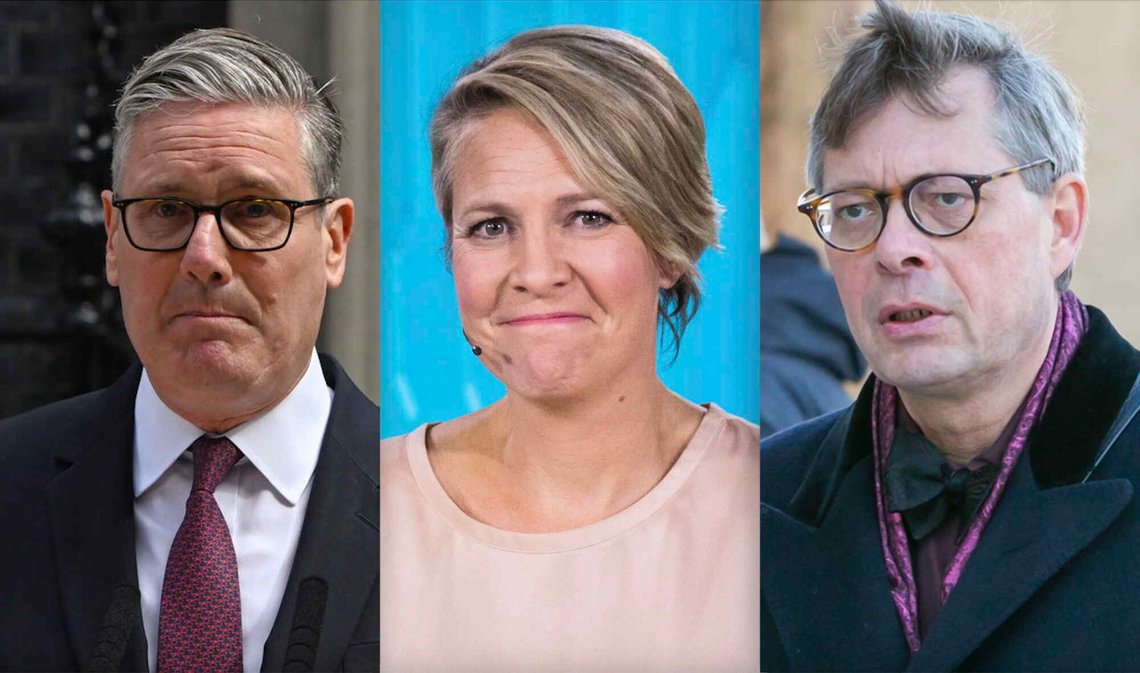
Keir Starmer’s resignation as British Prime Minister is explained away by Norway’s state broadcaster NRK and newspapers like Dagens Næringsliv. They conclude that the discontent which ultimately led Starmer to resign was caused by a weakened economy as a consequence of Brexit.
In doing so, they avoid mentioning the real causes of the widespread discontent, a phenomenon that is by no means confined to the United Kingdom.
When Britain’s Prime Minister Keir Starmer announced his resignation, the Norwegian state-owned media oligopoly NRK was quick to explain why.
NRK correspondent Gry Blekastad Almås was assisted by Dagens Næringsliv commentator Kjetil Wiedswang. The discontent that led to Starmer’s resignation, and which has triggered a palace revolt within the British Labour Party, has nothing to do with Starmer himself, if these two are to be believed. Rather, they argue that the British economy has weakened as a consequence of Brexit, and that Starmer has undeservedly been forced to bear the consequences of this unfortunate situation. This message was delivered during prime-time broadcasting.
Dysfunctional immigration policy and climate policy
What they failed to mention was the massive migration, which has spiralled completely out of control and has triggered widespread protests throughout the United Kingdom. Nor did they mention climate policy, where the objective of achieving a net-zero society invariably takes precedence over energy security, causing prices—not only for energy—to soar.
Nor did they, of course, mention the large demonstrations under slogans such as “Stop the Boats” or the riots following serious violent incidents such as the knife attack in Belfast or the fatal stabbing of Henry Nowak in Southampton, where the young man bled to death while in police custody. These incidents are not isolated, but form part of a pattern that has prompted otherwise placid Britons to take to the streets, where they are branded “far-right extremists” by, among others, correspondent Blekastad Almås.
They did not mention that an increasing number of Britons speak of a two-tier system of justice in which the majority population is discriminated against. Nor did they mention that the United Kingdom is the Western country in which the greatest number of people have been imprisoned or fined for statements made on social media.
The abuse scandals
Nor did they discuss Starmer’s and Labour’s indifference towards the nationwide abuse scandals, in which Pakistani men abused young British girls from typical working-class areas on a scale unparalleled in history.
Hundreds of thousands of girls in their early teens are said to have been exploited, abused, raped and even murdered over a period of 20 to 30 years. These organised abuses have taken place in typical Labour constituencies where the party has held power. The indifference has been driven by electoral considerations and fear of being branded racist.
But above all, they failed to mention that declining trust in the authorities is not confined to the United Kingdom but is a Western European phenomenon. Similar discontent is also discernible in Norway, for the same reasons as in Britain and elsewhere, where the key issues are dysfunctional immigration policy and equally dysfunctional climate policy. An increasing number of people believe that Western Europe has been on the wrong course ever since the fall of the Berlin Wall.
Overwhelming distrust of Western European governments
The following table shows Statista’s overview of various heads of government ranked by popularity and public dissatisfaction.
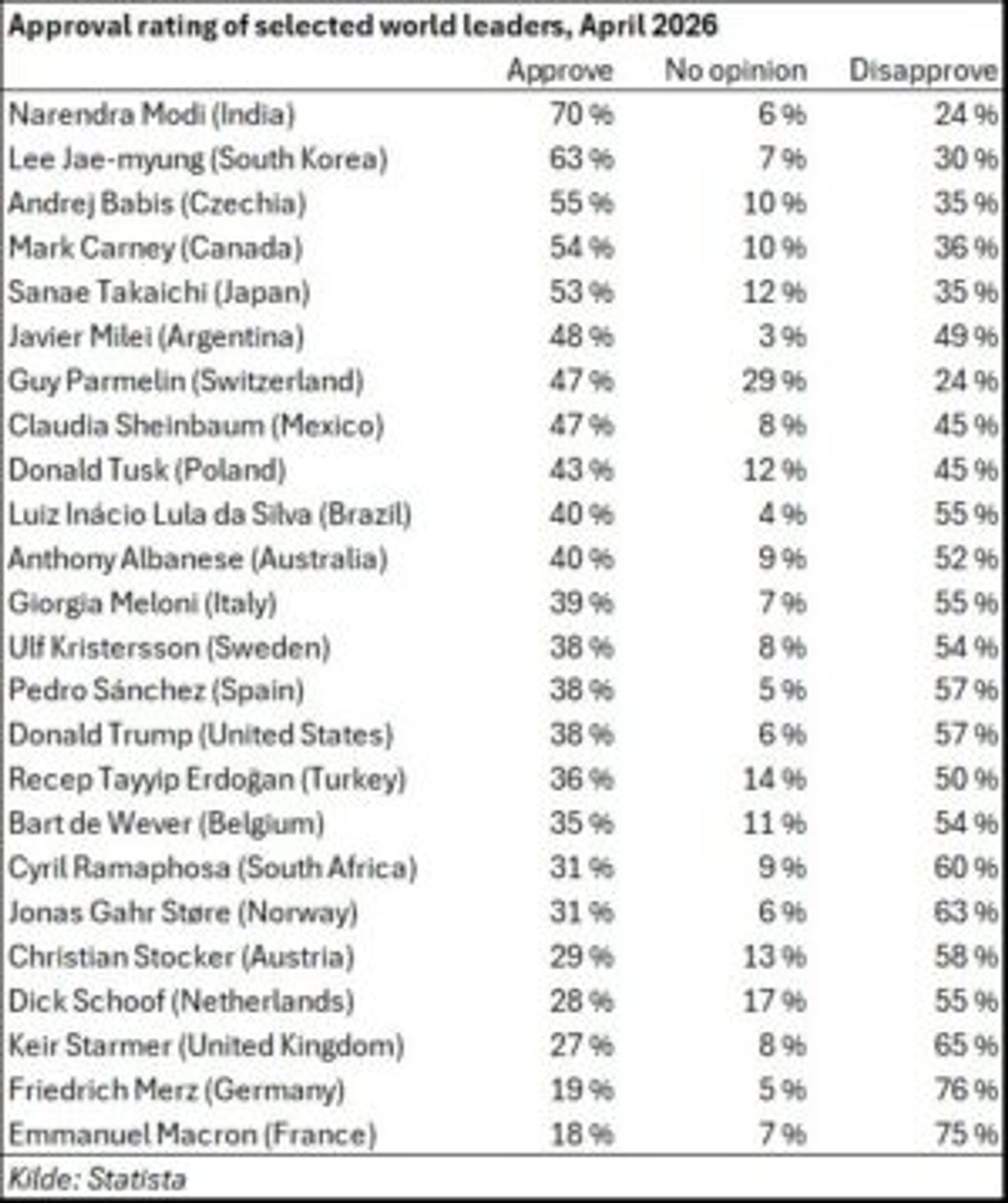
The table includes political leaders in countries where official opinion polling is permitted and practicable. China, Russia and Iran are naturally absent from the overview. Nevertheless, it provides an indication of where the problems lie.
The press’s omissions
One clear conclusion from the statistics is that every Western European leader, with the exception of Guy Parmelin in Switzerland, is unpopular in his respective home country. With the exception of Swedish Prime Minister Ulf Kristersson and Spanish Prime Minister Pedro Sánchez—the latter as unpopular as President Trump—all Western European heads of government are substantially more unpopular than Trump. Yet the press remains silent about this.
At the very bottom we find French President Emmanuel Macron, who has reached a historic low in the opinion polls with only 18 per cent support, while 75 per cent of the French want him gone, which will presumably happen after next year’s presidential election. Prime Minister Jonas Gahr Støre, who himself performs poorly in Statista’s rankings, recently entered into a strategic defence alliance with Macron. Only Støre and Macron know what it actually entails.
While the Norwegian press constantly tells us how unpopular President Donald Trump is, Statista shows that he is more than twice as popular among Americans as Macron and Chancellor Friedrich Merz are in their respective home countries.
The survey, which summarises the April polling, shows that fully 65 per cent of Britons were dissatisfied with Keir Starmer. Dissatisfaction has probably increased, since some time elapsed between the initial calls for him to resign and his eventual resignation.
Moving towards the upper part of the table, it emerges that Argentine President Javier Milei, who is implementing profound and painful reforms after a century of misgovernment, receives 48 per cent support compared with 49 per cent dissatisfaction, which is an exceptionally good result compared with the standing of several of his Western European counterparts. Document has searched for favourable coverage of Milei in the Norwegian press. The result is precisely zero.
A wise man once said that fake news does not necessarily consist of directly false representations of facts, but more often of omissions.


