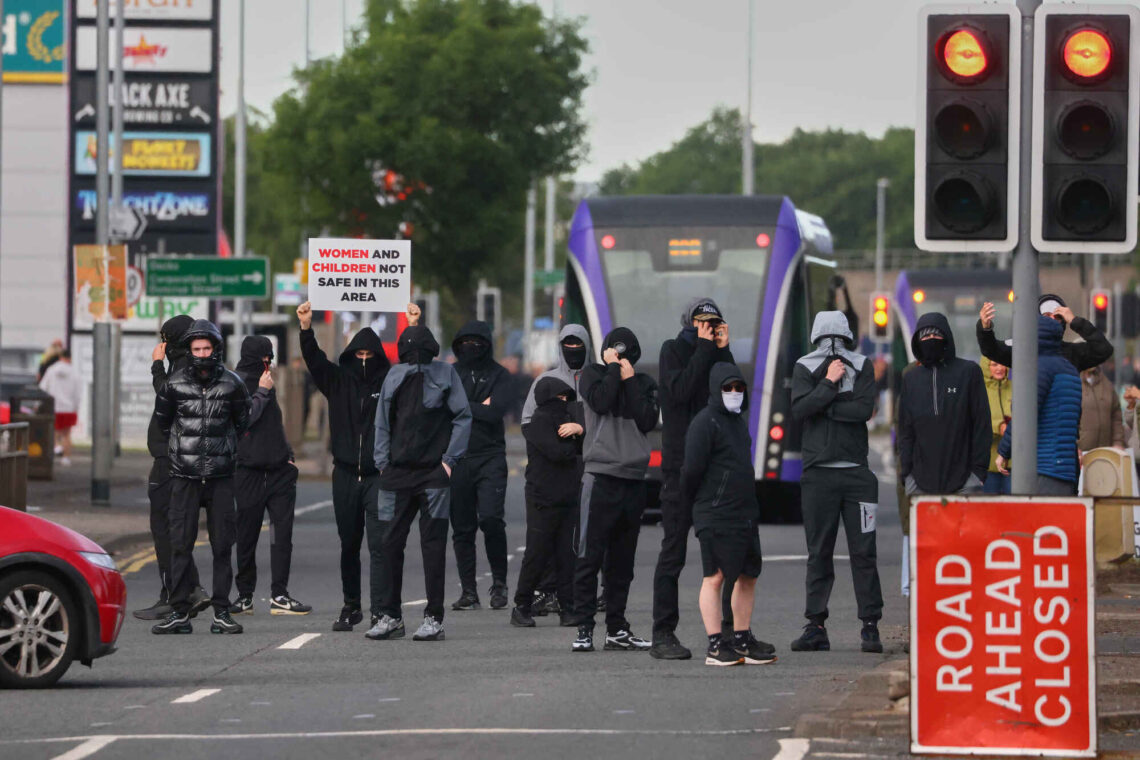
In recent years, the United Kingdom has been shaken by a series of gruesome violent crimes in which the perpetrators have had immigrant backgrounds, but with the slaughter of Stephen Ogilvy in Belfast only days after the circumstances surrounding the murder of Henry Nowak in Southampton became known, an anger among Britons who are normally silent has once again erupted – less than two years after the murders of three young girls in Southport.
One senses a change in mood this time. For when British politicians, authorities and other public hyper-moralists once again condemn the admittedly rather ugly manifestations of the anger of ordinary working-class Britons more than the incomprehensible brutality of immigrants, hardly anyone gives a damn about what they say.
It is a clear expression of this change in mood that The Times, in a leader late on Wednesday evening, states that the cause of the riots in Northern Ireland is uncontrolled immigration.
For this is not just any newspaper; it is the one that has retained its rank as the most weighty and influential in the island kingdom for a very, very long time. It is the newspaper that everyone in the power elite reads and takes seriously. It is so close to power that it is not unreasonable to suspect that it from time to time also functions as an instrument of power. Sometimes it seems as though it has remarkably good sources in 10 Downing Street.
It is therefore all the more remarkable when Prime Minister Keir Starmer, in The Times’ view, sounds as though he has a scratched record when he once again indulges in ritual condemnations of the people’s rage.
Sir Keir Starmer says he is sickened. He says he has “absolutely no tolerance” for abhorrent scenes of violence in Britain’s streets. He sounds like a scratched record.
The Times also, naturally, distances itself from the violence, which it calls
a sign of a new ugly mood: masked men prowling the streets shouting “foreigners out”, smashing windows in a house where an African family had lived for 20 years, and arson attacks on homes.
But the leader writer goes a long way towards assigning responsibility for the violence to Starmer himself by stating in the headline that “the simmering anger in Belfast is fuelled by inaction on immigration”, and by writing at the outset that the Prime Minister “must realise that weak immigration policy threatens the stability of the country”.
Given the British penchant for understatement, this is in reality a veritable demolition of Starmer that bears witness to a marked turn at The Times, which in practice takes the side of ordinary people against a power elite of which the newspaper itself is really a part.
The stylistic device is unmistakable: first one mentions what is least important. The newspaper admittedly does not like the unrest:
Too often of late, stabbings, assaults and rapes involving migrants and asylum seekers have triggered street violence, a storm of anger on social media and finger-pointing by politicians trying to deflect blame.
But then comes the verbal coup de grâce against the greatest villain, namely the incompetent government:
And as ever, the Prime Minister has offered cliché-ridden condemnations, his ministers have urged calm, and a bewildered and drifting government has done nothing to tackle the cause.
Distance is dutifully taken from Trump, Elon Musk and angry people on the internet, but the principal cause is rubbed in:
The cause – as social media, self-promoting provocateurs and interference from across the Atlantic insist – is uncontrolled immigration.
And soon people will no longer allow themselves to be controlled either:
The general perception is that legal and illegal immigration is out of control, that Britain is too permissive and that millions of pounds are being spent housing asylum seekers in comfortable hotels. It is a message that is being thundered out in increasingly coarse language, and which sometimes amounts to an ugly incitement to violence against anyone who is not white, whether they arrived last week or are third-generation Britons.
By then it is too late to complain.
A faltering Starmer invites contempt, and his empty words are merely further provocation. This is genuinely a national security risk.
We repeat that point, just to be on the safe side: it is the government that threatens the security of the realm – that is as true in Norway as it is in the United Kingdom.