

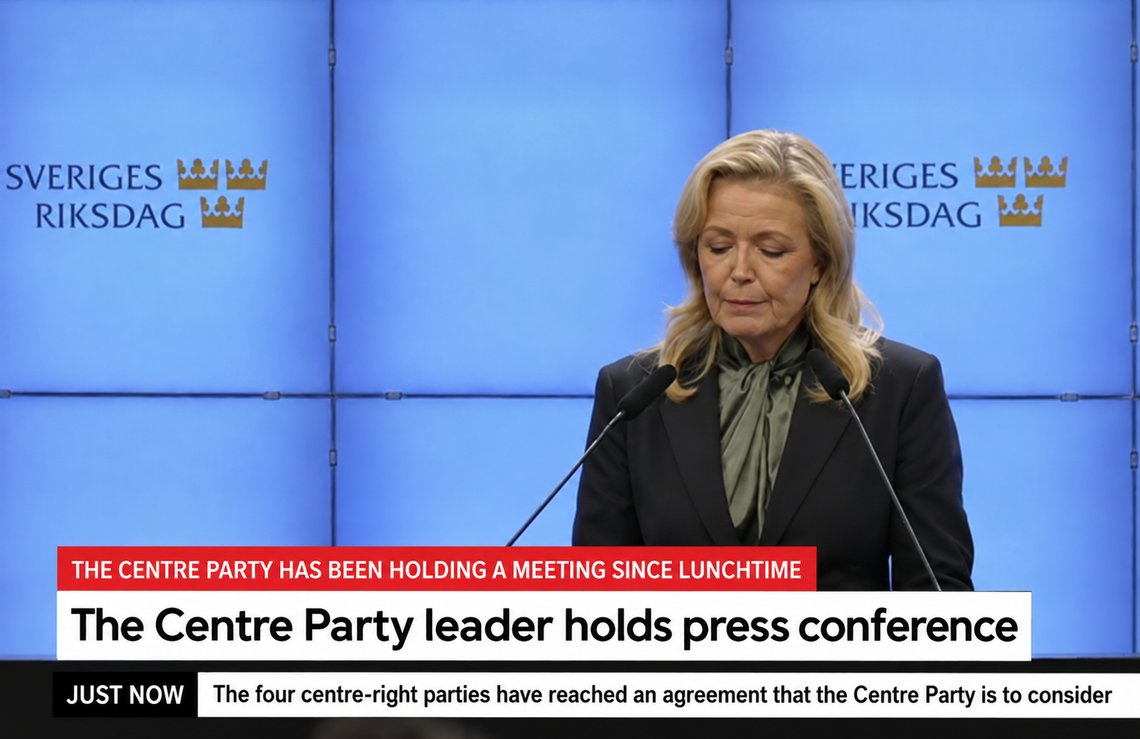


The Centre Party leadership wants the party to vote in favour of Ulf Kristersson (Moderates) as prime minister of Sweden and join a four-party centre-right government alongside the Moderates, Christian Democrats and Liberals. The announcement follows a meeting lasting several hours between the party board and parliamentary group. However, the decision was not unanimous and must now be approved by the party’s Council of Confidence.
At a press conference in the Riksdag on Thursday afternoon, Centre Party leader Elisabeth Thand Ringqvist announced that the party leadership recommends that the Council of Confidence endorse a new political direction.
– We recommend that the Council of Confidence support the Centre Party voting yes in Monday’s prime ministerial vote and joining the four-party government that the Speaker of the Riksdag has put forward, she said.
At the same time, she emphasised that there was no unanimity within the party.
– The decision was supported by a majority, but I also want to make it clear that it was not unanimous.
According to Thand Ringqvist, the Centre Party has explored several different government alternatives and held talks with all the parties. The party leadership now believes that the limit has been reached as to how long Sweden can go without a new government.
– Sweden needs a government that can take responsibility for the country. We have tried several different alternatives and held talks with all the parties, she said.
Wants to pursue centre-right policies
The Centre Party has negotiated what is known as a policy framework agreement with the Moderates, Christian Democrats and Liberals. Thand Ringqvist describes it as a new political direction for Sweden, focusing on growth, climate action, rural areas and greater trust between people.
She stressed that the agreement contains several important elements of the Centre Party’s policies and emphasised that it should not be seen as a continuation of the policies pursued during the previous parliamentary term.
The party’s change of course therefore means that the Centre Party leadership is prepared to join a government led by Ulf Kristersson, despite having previously opposed such an arrangement.
Insists that its position on the Sweden Democrats remains unchanged
Thand Ringqvist was careful to emphasise that the decision does not represent any change in the party’s position on the Sweden Democrats.
– Our willingness to move forward with Ulf Kristersson’s policy framework agreement does not mean that we are changing our view of the Sweden Democrats, she said.
She stressed that there is no agreement on structured cooperation with the Sweden Democrats, no promises have been made to the party, and the Sweden Democrats will not be part of the government.
At the same time, she acknowledged that the proposed four-party government will need to seek support from other parties in order to get its policies through the Riksdag.
– When it comes to legislation and the budget, support in the Riksdag is of course required. The government will now need to start sounding out support in the Riksdag at an early stage and hold discussions with various parties in the committees and ahead of parliamentary votes, she said.
According to Thand Ringqvist, a government can implement parts of its programme within the scope of its own mandate, for example through the direction of government agencies, appropriation directions, assignments and instructions. However, when it comes to legislation and the budget, it depends on support in the Riksdag.
She did not rule out the possibility that securing sufficient support could prove difficult.
– I am not going to be naive. If all the parties choose to vote against the government’s proposals, the bills will fail. And there will be occasions when it is difficult to secure support. There will be friction, she said.
If the Sweden Democrats, on the other hand, choose to vote in favour of proposals that the Centre Party also supports, she does not regard that as a problem in itself.
– That is how parliamentary democracy works, Thand Ringqvist said.
Divisions within the Centre Party
The announcement follows a meeting described as crucial to the Centre Party’s future direction. Before the meeting, MP Birgitta Ohlsson, a vocal opponent of the Sweden Democrats, described the decision as momentous.
The fact that the party leadership’s proposal did not receive unanimous support shows that there are internal divisions over the new direction. Thand Ringqvist nevertheless assured that the party would be able to overcome its disagreements.
– As a party, we have survived many challenging periods, and we will get through this together, she said.
Today’s decision would not have been possible without the Sweden Democrats’ earlier announcement that they would not take part in a new Tidö Agreement. Instead, the Sweden Democrats intend to move into full opposition when the next government is formed.
The final decision now rests with the Centre Party’s Council of Confidence, which consists of the party leader and delegates elected by the party’s district organisations, as well as representatives of the party’s affiliated organisations and the party board.
If the Council of Confidence endorses the recommendation, the Centre Party can vote in favour of Ulf Kristersson as prime minister on Monday and join the four-party centre-right government. Such a government would, however, lack a majority of its own and depend on support from other parties in the Riksdag – including the Sweden Democrats, even though the agreement does not include any formalised cooperation with the party.


