

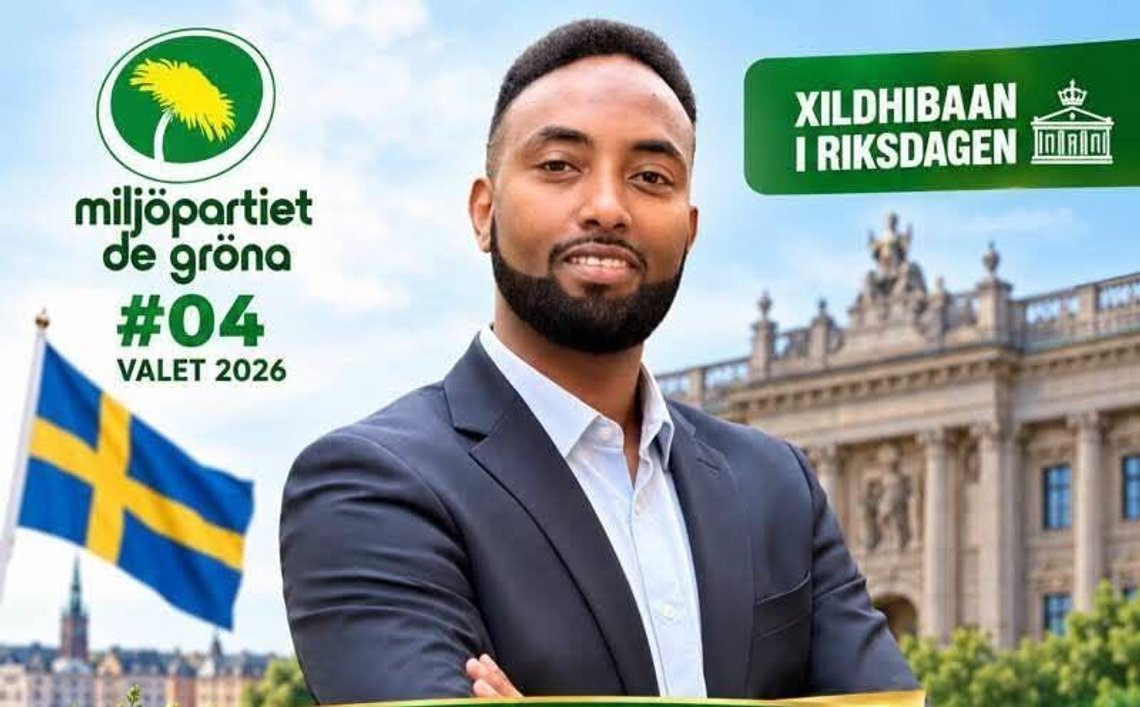
What happens when a small but strongly mobilized voter base can turn the parties’ own candidate lists upside down? After this year’s election, two established left-wing politicians have lost their seats in the Riksdag to candidates of Somali background – placed far down the lists. Ethnic networks are now influencing Swedish democracy.
Two established politicians on the left will have to leave their seats in the Riksdag following this year’s election. In both cases, Somali candidates who stood further down on their parties’ lists have been able to overtake them through preference votes – candidates who before the election were unknown to the general public and, according to local party representatives, also within their own parties.
But they had something their Swedish party colleagues lacked: massive support from their own clans.
Spokesperson loses seat – to unknown Somali with debt restructuring
Within the Left Party, the party’s climate policy spokesperson Kajsa Fredholm has lost her seat in the Riksdag to Somali Mohamed Abdukardir Ali. Fredholm was first on the Left Party’s list in Dalarna and Ali was ninth, but Abdukardir Ali received 648 preference votes and thereby took the party’s seat in the constituency.
When the election result was announced, a number of questions arose. It turned out that Abdukardir Ali had only been a member of the Left Party for one year, and that as recently as 2024 he had been denied Swedish citizenship based on lack of good moral character. At that time, Abdukardir Ali had 163,000 SEK (16,600 USD) in debt in the form of unpaid taxes, student loans and private loans.
In addition, he had no income.
The Swedish Migration Agency justified its decision as follows:
“On September 13, 2022, you received a decision on debt restructuring from the Swedish Enforcement Authority. The Swedish Migration Agency considers that you have not had acceptable reasons for failing to pay your debts previously.
Therefore, a certain qualifying period is generally required – at least two years – during which you demonstrate that you intend to continue fulfilling your obligations in the future before you can become a Swedish citizen.
You therefore cannot be granted Swedish citizenship at this time.”
Swedish Migration Agency broke its own rules
Abdukardir Ali was subsequently granted debt restructuring, which means that his debts will be paid by Swedish taxpayers. In February this year, the Swedish Migration Agency broke its own rules and granted the Somali man Swedish citizenship – and now he is taking his seat in the Swedish Riksdag.
The Left Party’s group leader in Borlänge, Matts Hammarqvist, has admitted to Expressen that he “doesn’t really” know who Ali is, but the party’s district chair in Dalarna, Amanda Dalmans, says that she looks forward to working with Abdukardir Ali “to change Dalarna,” and the Left Party’s chair in Borlänge, Erik Buller, writes in an email:
“Mohamed Abdukardir Ali has not previously held any positions within the party, but he has participated in the election campaign for us, and I have no reason to believe that he will not become an excellent representative for us in the Riksdag.”
Money and pre-filled ballot papers
But it has now emerged that the police have conducted a surveillance operation targeting Abdukardir Ali’s election campaign, after a report of suspected electoral fraud was submitted to the National Unit for Corruption Crimes.
The investigation is being led by prosecutor Oskar Edvardsson, who does not want to disclose what the suspected criminal activity consists of, but according to Aftonbladet, the police conducted a surveillance operation targeting a car that transported voters in disadvantaged areas to and from polling stations.
A person is also alleged to have withdrawn cash from an ATM on several occasions and then distributed money and ballot papers – with Abdukardir Ali’s name already checked – to voters.
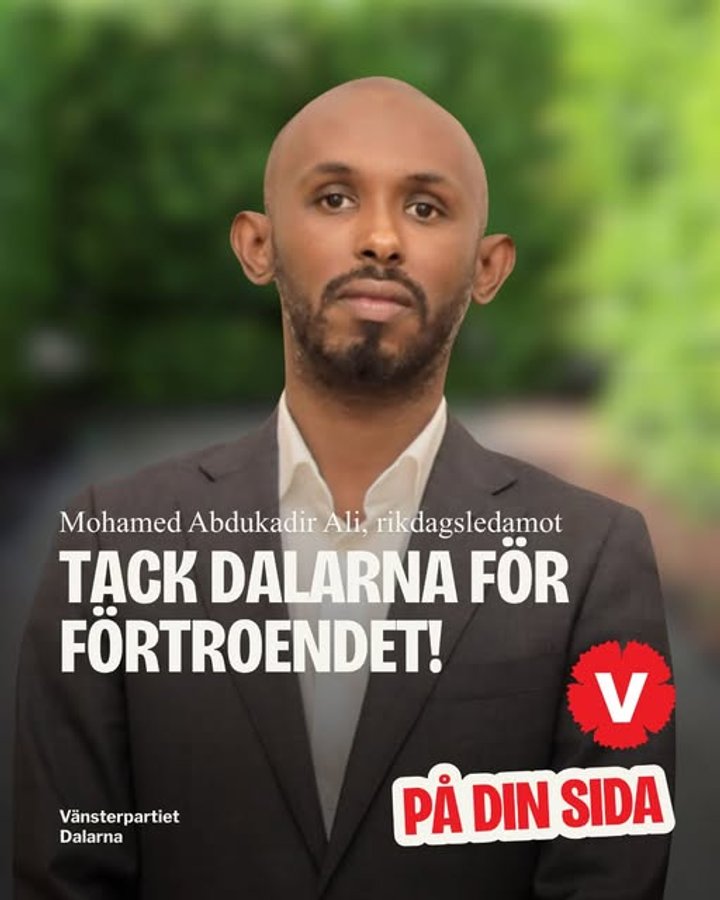
Two years after he was denied citizenship due to a lack of good conduct, he takes his seat in the Riksdag. Photo: Facebook screenshot
Green Party launches persuasion campaign?
The Green Party has also been affected by Somali clan voting. Mohamed Abdukani, who was fourth on the party’s list in Södermanland County, received 484 preference votes – compared with 446 for the party’s energy policy spokesperson, Linus Lakso, who was first on the list.
Abdukani therefore overtook Lakso and took the seat that would otherwise have gone to Lakso. The difference was only 38 preference votes.
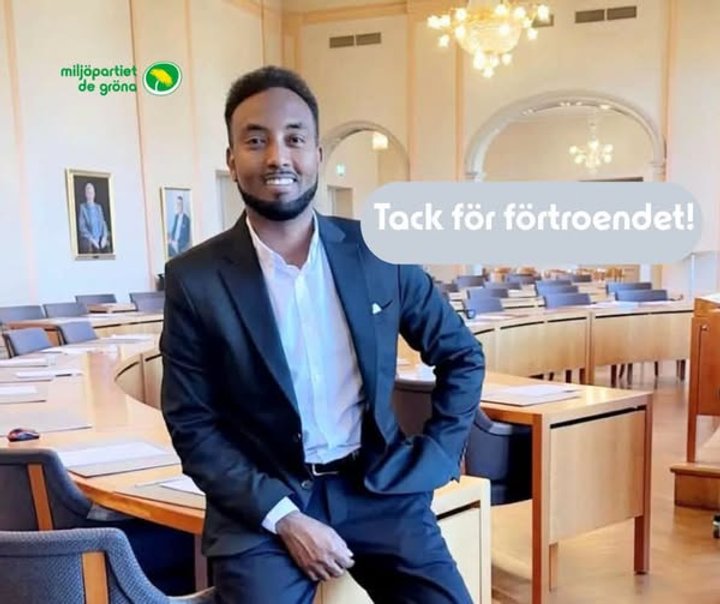
Muhamed Abdukani thanks voters for their confidence – but the party is reportedly not equally pleased… Photo: Facebook screenshot
The result is said to have prompted a reaction from the Green Party.
According to sources cited by Ekuriren, the party, which in other contexts has claimed that it is racist to question the strongly left-leaning election results in Sweden’s disadvantaged areas, is now trying to persuade Abdulkani to relinquish his seat in the Riksdag in favor of Lakso.
– I think Mohamed will come under considerable pressure from the party to give up his seat to Lakso, a source told the newspaper.
Clan voting changes party lists
In the parliamentary election, eight candidates succeeded in taking advantage of the Swedish preference-voting system’s possibility of overtaking candidates who were ahead of them on the lists. Among them are three Left Party candidates and one Green Party candidate.
The issue of ethnic or group-based voting is not new. Already after the 2018 election, Green Party candidate Leila Ali Elmi attracted attention when she entered the Riksdag from 21st place on the list following a strong campaign directed at the Somali community in Gothenburg.
The results once again raise a broader question: what significance do concentrated networks and preference voting have in an electoral system where a relatively small number of votes can change which candidates actually receive a seat in the Riksdag?
This year’s election results show that the combination of preference voting and clan voting has had concrete consequences for the parties: established candidates have been overtaken by people who stood far down on the lists, sometimes by very small margins. The winner is the person who succeeds in mobilizing strong support among voters who primarily vote according to group affiliation.
“I see democracy in change”
But the fact that Sweden’s future is now being determined by people who primarily represent ethnic and religious groups is seen by many as a success. Ali Alabdallah writes on Facebook:
“Hope for the future in the Riksdag 2026. Following the 2026 election, for the first time five Swedes of Somali origin will take their seats in Sweden’s Riksdag: Leila Ali Elmi (MP), Mursal Isa (MP), Mohamed Mohamed (MP), Ilyas Hassan (V), Mohamed Abdukardir Ali (V). When I look at this picture, I see more than five politicians. I see hope. I see the future. I see democracy in change. [—]
Five names. Five stories. A new picture of Sweden. Dream big. Work for your dream. And believe that you have a place in the future.”
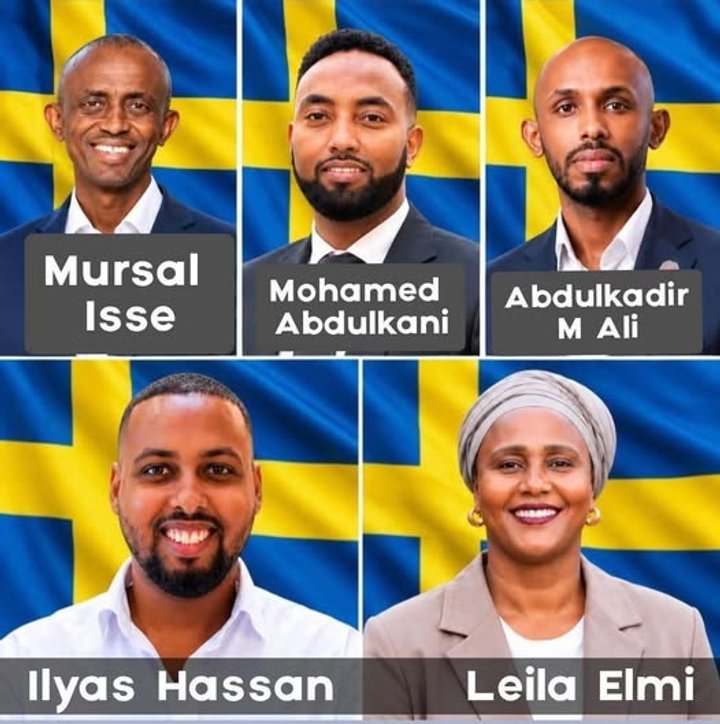
Hope for the future in the Riksdag 2026? Photo: Facebook screenshot/Ali Alabdallah


