

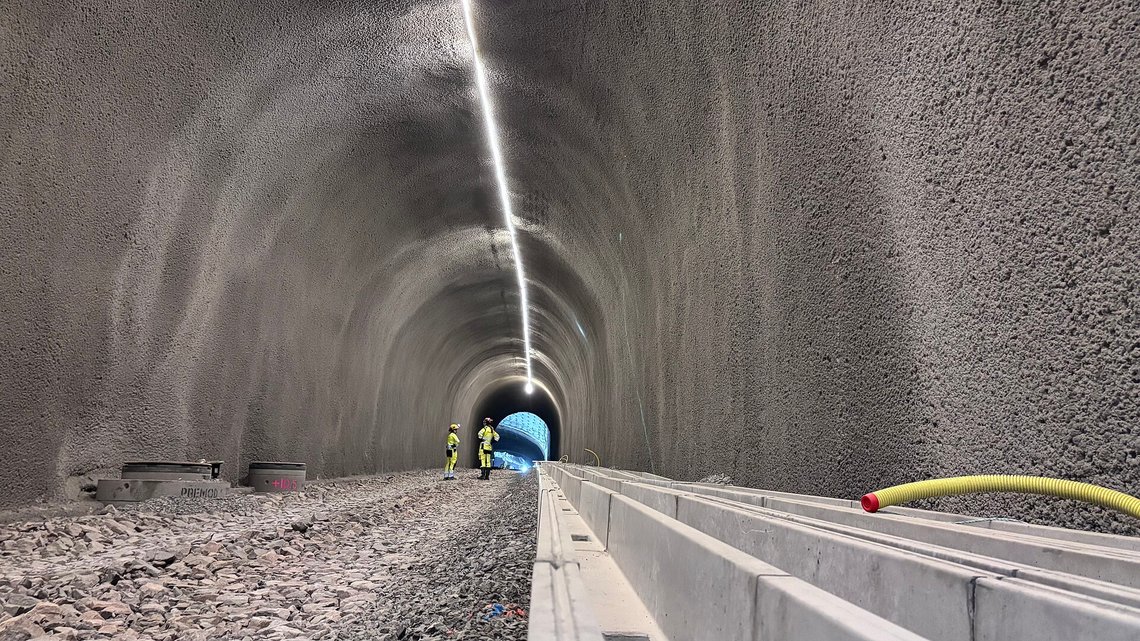


The Fornebu Line, which is set to connect leafy Snarøya and Fornebu to the metro network at the Central Oslo districts at Majorstuen via a tunnel beneath Frogner Park, has become a financial quagmire for everyone involved. The latest budget estimate stands at almost 35 billion kroner. If the project were to be funded by ticket revenue, each journey would cost more than a ticket to the opera.
The Fornebu Line was launched 13 years ago with a budget of 4.5 billion kroner. The current cost estimate stands at 31.2 billion kroner, but consultancy firm Metiers’ latest estimate is 34.8 billion kroner.
The project will never turn a profit from operations. Consequently, there will be a negative return on capital. And any prospect of paying off the project can simply be forgotten. If the project were to be financed by ticket revenue, a single journey from Snarøya to Majorstuen would have to cost between 1,100 and 1,200 kroner.
By way of comparison, the best tickets for the sold-out performance of The Nutcracker at the Opera House cost 995 kroner each. But the Fornebu Line is set to be a tougher nut to crack than The Nutcracker has ever been.
Huge operating losses
The following assumptions have been made:
- Ruter’s estimate of operating and maintenance costs at 343 million kroner from 2029.
- Departures every ten minutes for 20 hours a day, using double train sets comprising a total of 6 carriages and 276 seats per departure.
Opening hours, departures and the size of the train sets are standard for the Oslo Metro. Consequently, there will be 87,600 departures and 24,177,600 seats per year.
Operating and maintenance costs alone amount to 14.2 kroner per seat per departure. With fewer departures or smaller train sets, this figure increases considerably. With simple three-carriage train sets, for example, the cost per seat per journey would be 28 kroner.
A single ticket in Zone 1 currently costs 46 kroner. Cheaper journeys are available with season tickets. Ruter’s own figures for 2025 show an average revenue per passenger on the Metro of 9 kroner. However, this calculation assumes a 10 per cent occupancy rate. Although one might assume full trains during rush hour, many trains run half-empty or empty outside rush hour.
Based on these figures, each seat will, on average, incur an operating loss of 13.3 kroner per journey. Fewer departures, fewer hours per day, or single-carriage trains result in higher losses per journey. On an annual basis, this amounts to an operating loss of 321 million kroner, based on the ticket prices applicable for 2025.
Ruter recently reduced the price of the 30-day ticket from 655 to 495 kroner, effective from 1 November. Until May this year, the 30-day ticket cost 805 kroner. Consequently, the loss at current ticket prices will be significantly higher than NOK 321 million per year.
A huge financial shortfall
If the Fornebu Line is to break even on its operations while carrying a similar number of passengers per train to other lines on the Oslo Metro network, including the well-used journeys between Majorstuen and Helsfyr, it would require revenue per journey of 142 kroner for the Fornebu Line alone. However, a passenger travelling from Snarøya will, as a rule, be travelling further than to Majorstuen, where the Fornebu Line is to be connected to the rest of the metro network. So the fare would have had to be higher for the metro network’s operations to break even overall.
But it doesn’t stop there. The capital invested in the project requires a return. The money could have been spent differently – for example, on more frequent bus services, a shuttle bus or a city tram at Fornebu/Snarøya, combined with upgrading Lysaker station and the line into Oslo S, with more frequent services, and possibly combined with express ferries from Fornebu to Aker Brygge and Bjørvika.
The following assumptions form the basis for the calculation of capital costs:
- Metier’s latest estimate of investment costs at NOK 34.8 billion, NOK 3.6 billion above the currently approved cost framework of NOK 31.2 billion.
- Cost of capital at 4, 5 and 6 per cent
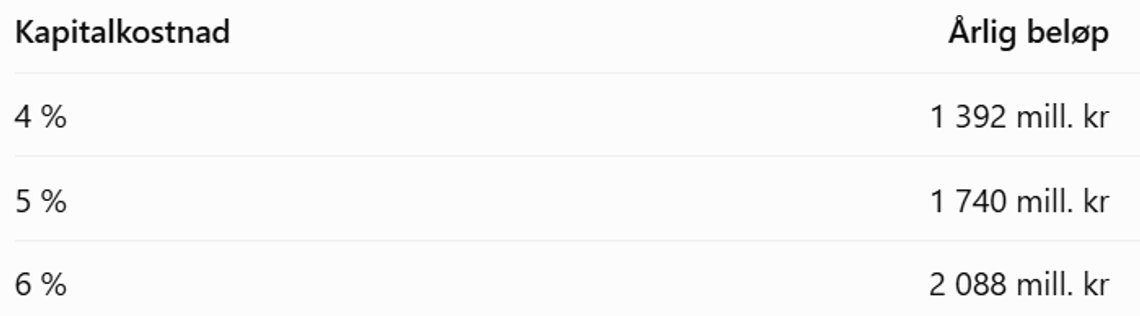
The cost of capital, converted into annual amounts, is as follows:
Before depreciation and project repayments, the cost per seat per departure is as follows:
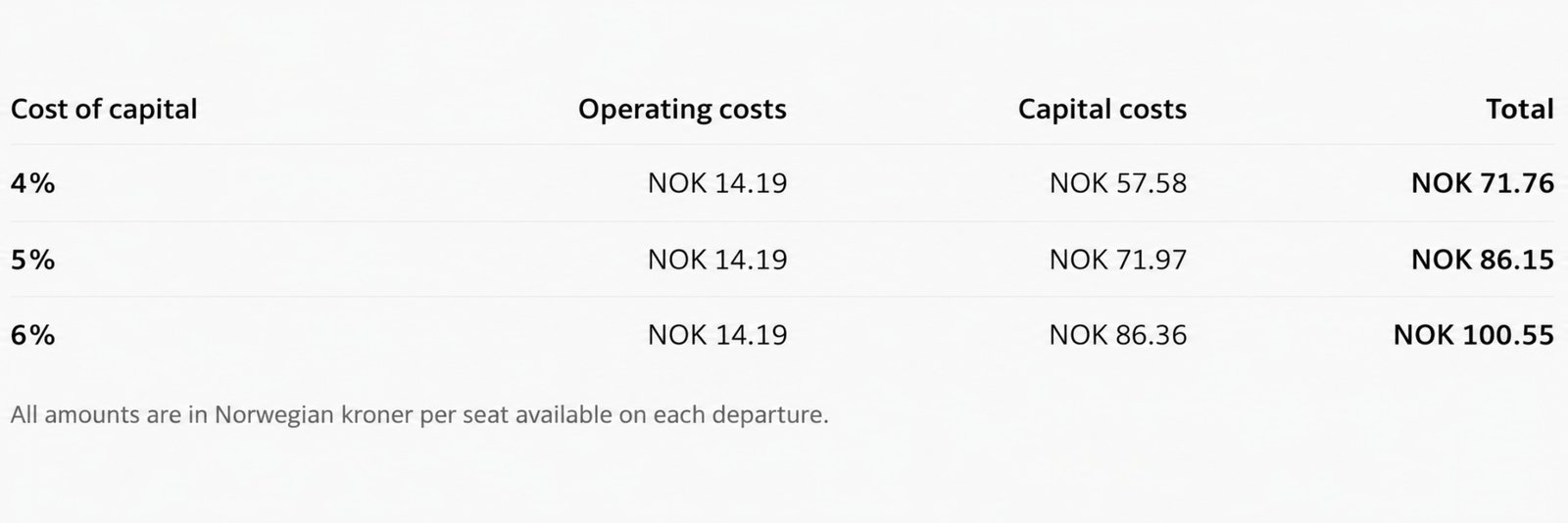
All calculations have been carried out using ChatGPT.
Based on the passenger load factor and revenue per passenger used by Ruter, revenue of 90 øre can be deducted from these costs. Again, fewer seats in operation increase the cost per seat.
If we assume a capital cost of 5 per cent, the annual loss amounts to 2.06 billion kroner. This consists of at least 321 million kroner in operating losses – cash outflow that must be recouped. This loss is significantly higher at current prices for 30-day tickets, as shown above. In addition, there is NOK 1.74 billion in lost return on invested capital. This represents funds that could have been used elsewhere, as mentioned above. For example, how many more services on the No. 31 bus from Snarøya could we have had for that amount, as an alternative to the Fornebu Line?
To cover the cost with a cost of capital of 5 per cent using ticket revenue, a ticket price of more than 860 kroner per journey would be required.
More expensive than the Nutcracker
But there is one more thing to consider. All projects must be paid off. Someone has to foot the bill.
To ensure that the cost of a project is not passed on ‘to someone else’ – i.e. subsidised through tax revenue or tolls – the project must generate a surplus from operations. Furthermore, the operating profit must be sufficient to generate a return on the capital invested in the project. This is important for comparing different alternative projects against one another. And finally, the capital invested must be repaid.
A repayment period of 40 years requires an additional 36 kroner per seat. Assuming a repayment period of 60 years, 24 kroner is required.
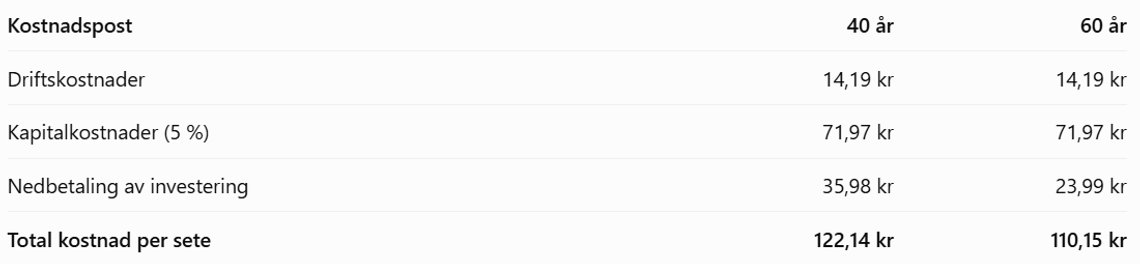
Based on Ruter’s estimate of a 10 per cent occupancy rate on the metro over a 20-hour operating period, the fare would be 1,221 and 1,105 kroner respectively. By way of comparison, a ticket to the main stage at the Norwegian Opera costs 995 kroner.
This means that if the Fornebu Line were to be financed by ticket revenue, a journey from Snarøya to Majorstuen would have cost more than an orchestra seat for The Nutcracker, which is sold out.


