



The failure of the climate summit provided the backdrop to Equinor’s autumn conference, at which the government pledged its full commitment to oil and gas for the foreseeable future. There are no longer any reservations. Extraction must go ahead in order to finance the green transition.
On behalf of the government, Støre made a promise to the energy sector that Norway will in no way halt oil and gas development on the Norwegian continental shelf.
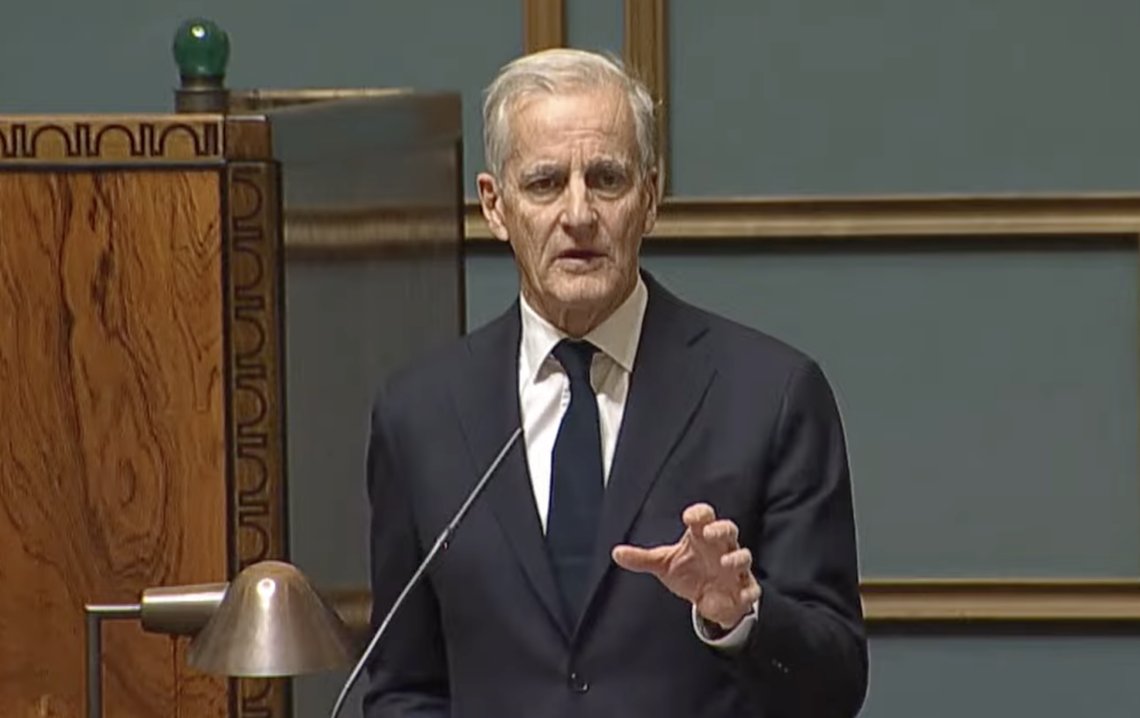
“In a turbulent world, I believe that reliability in itself has become a value. That is why my policy in this government is to develop – not phase out – the Norwegian continental shelf,” said Støre from the podium.
He described Norway as a reliable supplier to its allies in Europe, stating that Norway will continue to explore and develop new discoveries on the Norwegian continental shelf.
– We need increased production from existing fields – and that is happening. We need investment in new developments,” said Støre.
Such statements would have been met with an outcry just a few years ago.
– So carry on exploring, carry on improving recovery rates – it is remarkable what we can now extract compared with a few years ago. And keep reducing costs and emissions, was the call.
CEO Anders Opedal responded to Støre’s call by referring to Equinor’s investment plans for the coming years.
– At Equinor, we have set clear ambitions for the Norwegian continental shelf. We aim to maintain the same level of production in 2035 as in 2021. We have invested around 60 billion kroner every year for the past four to five years, and we will continue to do so right up until 2035,” said Opedal.
80 new fields
Environmental organisations appear to have lost the battle over fossil fuels.
Opedal began by showcasing the company’s latest gas field, Irpa, in the Norwegian Sea, which is due to come on stream in a few weeks’ time. The gas field is equipped with a subsea installation at a depth of 1,350 metres, which is set to extract 20 billion cubic metres of natural gas in the years to come.
However, the CEO emphasised that declining reserves and depleted wells mean the oil and gas industry requires stable regulatory conditions, and, not least, access to new extraction areas.
– As we now deliver on our 2035 ambition, we will develop 80 new fields, projects and discoveries that we have in our portfolio. However, as we step up the pace of field developments, we will deplete that portfolio more quickly. We believe there may be more oil and gas in the North Sea, the Norwegian Sea and the Barents Sea,” said Opedal. (NTB)


