


Norway accounts for less than one per mille of global CO2 emissions. Even cutting emissions to zero by 2050 would result in a temperature reduction of less than two ten-thousandths of a degree, according to the IPCC’s models.
The global impact of Norway’s measures is negligible, whilst the annual cost amounts to 1–2 per cent of gross domestic product (GDP) and is comparable to what the government spends on roads and railways.
What does Norway’s climate policy cost? There is no comprehensive overview of this. These costs must be gathered from various sources, which is a formidable task. We have sought help from Microsoft’s Copilot. It responds quickly and provides estimates in the blink of an eye, but its reliability can occasionally be called into question, as will become apparent below. It is nevertheless interesting to report on the experiment. We now have an estimate, and anyone who may question individual items can use this as a starting point to investigate further and obtain a more accurate result. We have archived Copilot’s responses, but they are slightly too extensive to be published in full in a short report. Anyone interested in this may contact us.
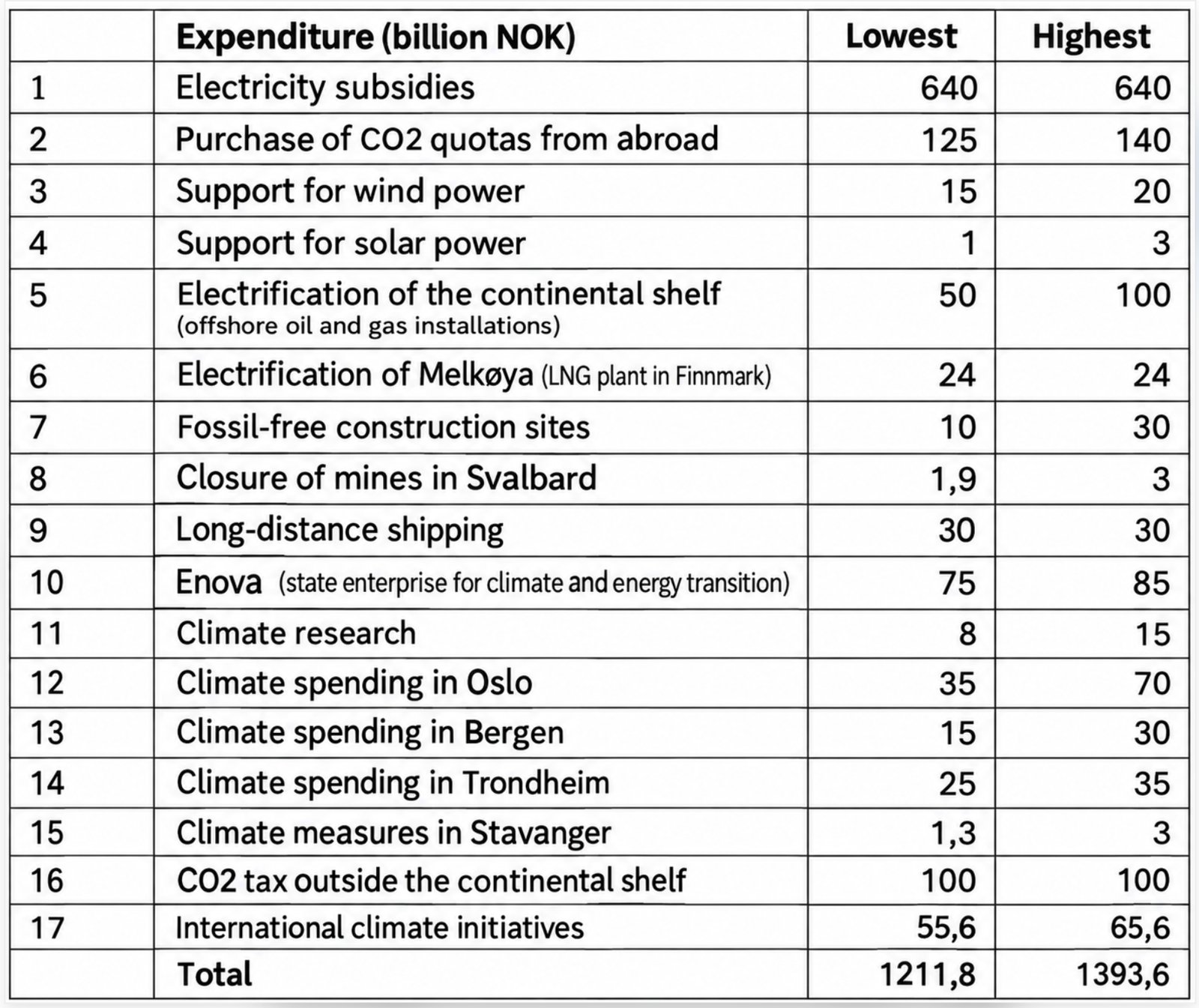
The costs of Norway’s climate policy since 1990
We first asked about costs from 1990. The results are shown in Table 1. The total cost amounts to just over one thousand billion (1211–1394). The largest single item is electric car subsidies, estimated at 640 billion. This represents a financial loss for the state, but is due to the fact that electric cars are far more expensive than equivalent petrol and diesel cars. This is why consumers must be enticed to buy these cars through tax relief. The purchase of expensive cars, where people do not base their choice on the actual costs, results in a socio-economic loss. The tax relief for electric cars is an estimate of this loss.
Another surprisingly high figure is the climate expenditure in the City of Oslo. It is claimed to fall within a broad range of 35–70 billion and is far higher than in other major cities. Stavanger’s expenditure is far lower than that of other major cities. There is reason to believe that Oslo’s expenditure is overestimated, and there may also be some degree of double-counting. For example, Oslo City Council has paid part of the cost of the Langskip (CO2 treatment plants at Klemetsrud and in Brevik), which are reported separately.
The penultimate expenditure category in Table 1 is CO2 taxes outside the continental shelf. These cover only the years 2016–2024. These taxes are relatively new and have risen sharply over time. Why include these? CO2 taxes on petrol and diesel make the running costs of petrol and diesel-powered vehicles more expensive for ordinary consumers and are clearly a cost to them. Businesses must, of course, recoup these taxes to balance their books. This leads to price mark-ups and makes all facilities that require petrol- or diesel-powered machinery more expensive, including residential properties. The tax on the continental shelf affects oil companies. For them, this is largely to be regarded as a tax that is completely overshadowed by other, heavier taxes. However, the CO2 tax on the continental shelf may have the unfortunate effect of causing oil or gas fields to be shut down prematurely in order to avoid the CO2 tax. It should therefore be abolished. Any oil and gas production that we may miss out on due to the premature closure of oil and gas fields is a cost that the CO2 tax imposes on society, but this is not included in our overview, as we have no examples to date of oil or gas fields being shut down due to the CO2 tax.
The final expenditure item in Table 1 is international climate initiatives. The majority of this relates to the so-called forestry cooperation with developing countries in tropical regions, which aims to reduce deforestation or plant trees. This is intended to sequester carbon dioxide in forests compared with what would otherwise have been the case, and can subsequently be recorded as reduced emissions in the rich countries participating in the forestry cooperation, including Norway. It is noteworthy that a lengthy and comprehensive report to the UN from the Norwegian Climate and Environment Agency (Status report as of December 2022, resubmitted in March 2023: Norway’s Eighth National Communication under the Framework Convention on Climate Change) does not mention a single word about where the emission allowances that caused Norway’s climate accounts under the Kyoto Protocol to rise came from, or at what price they were purchased.
It is also worth noting that these forest cooperation partner countries are among the most corrupt in the world. In the Environment Agency’s budget proposal for the 2025–26 national budget, this forestry cooperation and climate cooperation with certain other developing countries is described as ‘challenging’. It is then left to the reader’s imagination to picture what this means. For once, both climate activists and climate realists have a shared interest in obtaining more accurate reporting on these matters; climate realists to find out what they cost, and climate activists to find out whether they result in a genuine reduction in emissions.
A few other smaller amounts are included in this final item in Table 1. One of these is the so-called Green Climate Fund, established to support developing countries’ transition to green energy. Between 2015 and 2019, Norway contributed NOK 400 million annually to this fund, and from 2020 onwards, NOK 800 million annually. Furthermore, there is a Norwegian Climate Investment Fund managed by Norfund on behalf of the Ministry of Foreign Affairs. Allocations to this fund totalled NOK 4 billion in the years 2022–25, plus a matching amount from Norfund.
Climate costs in the context of other expenditure
A figure of just over one billion is high, but it does not really mean much unless it is related to something with which it can be compared. An obvious starting point is to compare this with gross domestic product (GDP), the total value of goods and services produced in Norway. This must be done either on an annual basis or over a reasonable time interval. We have chosen the period 2016–2025, as climate expenditure has increased over time, and we therefore asked Copilot to provide the individual expenditure categories from 2016 onwards. The results are shown in Table 2. These figures are significantly lower than the figures for the entire period since 1990 and are in the region of 600–800 billion (606–765), or between 1 and 2 per cent of total GDP (1.37–1.73) for the period 2016–2025.
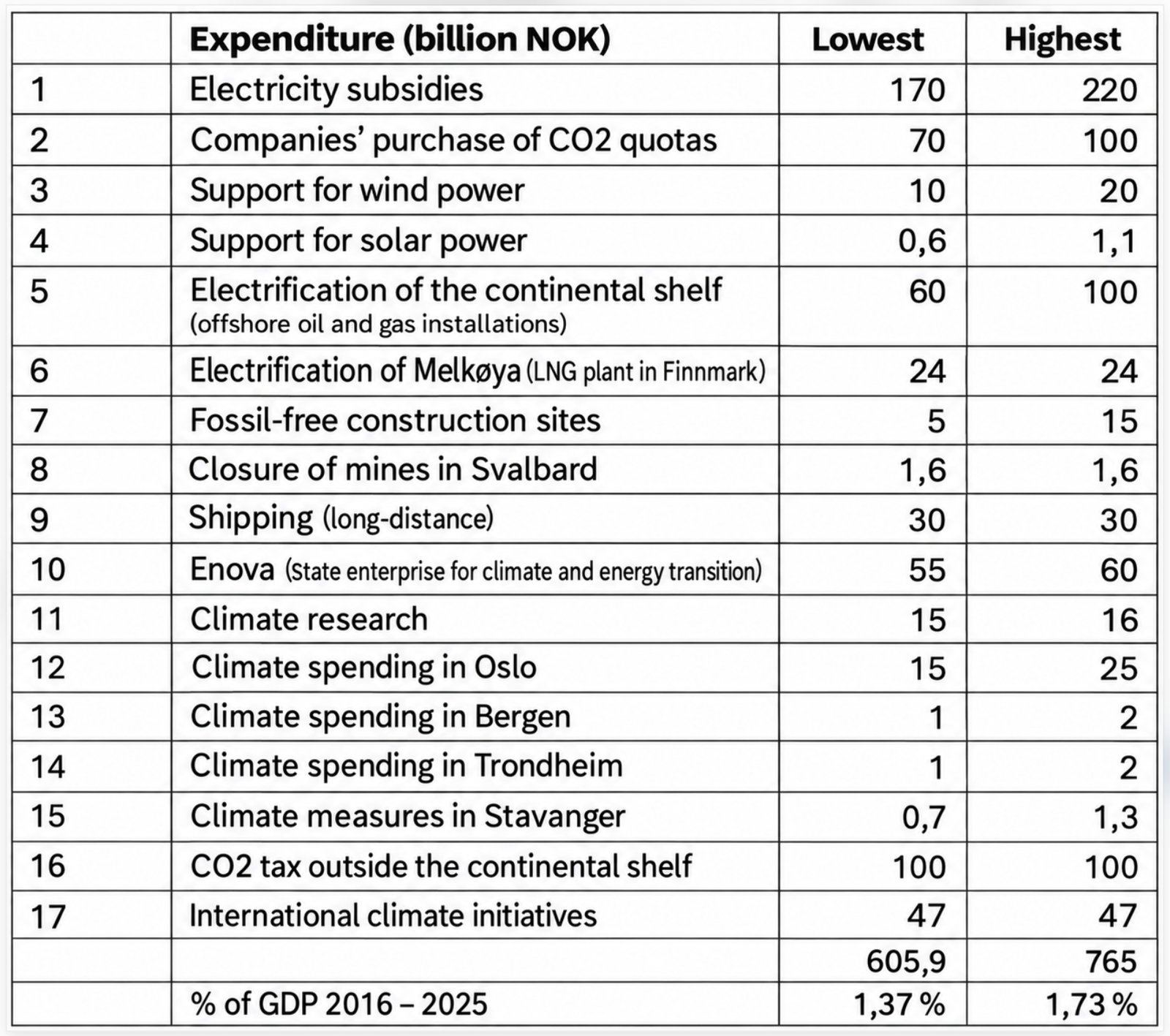
The costs of Norway’s climate policy 2016–2025
There are two categories of expenditure that show surprisingly low figures for 2016–2025 compared with the figures for the entire period since 1990. One of these is the electric car subsidy. This is reported to have totalled 640 mrd. since 1990, whilst the figure for 2016–2025 is 170–220. Copilot cites NRK as the source for the 640 mrd. and states that this covers the period 2007–2024. It is said to cover exemptions from the one-off registration tax, exemptions from VAT, and ‘other reductions in vehicle taxes that favoured electric cars’. The latter includes tolls and the one-off registration tax. When asked about the years 2016–2025, Copilot reports 170–220 billion, which is said to cover VAT exemptions, exemptions from the one-off tax and other electric car benefits. It is difficult to believe that support for electric cars would have amounted to 420 billion or more for the years 2007–2015, but only 170–220 billion for 2016–2025. Either the first figure is too high, or the second is too low.
The second category in which disproportionately high figures are reported for the entire period after 1990 is the major cities’ climate expenditure. For Oslo, Copilot puts the figure at 35–70 billion for the 25 years after 2000, but only 15–25 billion for the ten-year period 2016–2025. For Bergen, 15–30 billion is reported for the years after 2000, but only 1–2 billion for 2016–2025. Some of this may be due to the Bergen light rail system, which was built before 2016. The figures reported for 2016–2025 are more comparable for the three cities of Bergen, Trondheim and Stavanger than the figures for 2000–2025.
One category in which Copilot reports zero expenditure is the government’s purchase of carbon credits. It is pointed out that the government makes a substantial profit from the sale of carbon credits, but these are credits over which the government has control under the climate cooperation with the EU (the ETS scheme). This has its counterpart in companies’ purchases of carbon allowances, as reported in the tables above. This is, of course, a cost for the companies. The government operates a scheme whereby some companies exposed to competition receive compensation for the allowances they have purchased, but this is, of course, merely a shift of the burden from the companies’ accounts to the state.
What is 1–2 per cent of GDP comparable to? GDP in 2025 was 5,500 billion, so 1–2 per cent of this is 55–110 billion. Here are some items of expenditure from the government budget in this order of magnitude (billion NOK):
The government’s budget for roads and railways in 2025: 78.6
Ministry of Defence budget for 2025: 125.1
Ministry of Health budget for emergency preparedness in 2025: 130.0
Ministry of Education and Research’s budget for higher education and research: 59.9
In other words, climate expenditure is far from insignificant. They are of the same order of magnitude as government spending on roads and railways or expenditure on higher education and research. They are slightly lower than defence expenditure prior to the increase in the 2026 budget, as well as the Ministry of Health’s budget for emergency preparedness. It is also worth noting that removing climate expenditure would reduce the funding shortfall in the national budget.
It is worth pointing out that many climate policy regulations impose various kinds of inconvenience on the Norwegian public which are not included in this overview, and which are difficult to quantify in monetary terms. In this context, one might mention the ban on heating buildings with oil, which has rendered oil-fired boilers and paraffin stoves obsolete. Furthermore, one might mention the crackdown on private car use, which has eliminated parking spaces and made parking unnecessarily expensive in towns and cities, thereby hindering the public’s mobility.
The impact on the global climate
Norway accounts for less than one per mille of the world’s man-made carbon dioxide emissions, and the effect on the climate of a reduction in Norwegian emissions is correspondingly negligible. If we in Norway were to gradually phase out emissions year on year, reaching zero by 2050, this would reduce the global temperature by less than two ten-thousandths of a degree, according to models used by the UN Intergovernmental Panel on Climate Change itself. If it were the case that all the world’s countries were joining forces to solve the global climate crisis, one could certainly argue that Norway, despite its insignificance in this context, ought to have taken part in this ‘collective effort’. But no such initiative is currently underway; carbon dioxide emissions are rising relentlessly year after year, with the exception of exceptional years such as the 2008 financial crisis and the Covid-19 in 2020. The annual increase in China’s emissions is six times as large as Norway’s total annual emissions. Emissions are rising in developing countries that prioritise their economic development, which in turn requires increased energy production and carbon dioxide. There is nothing to suggest that this process will be reversed in the near future, other than through a global economic crisis – something most people would probably prefer to avoid. The annual increase in China’s emissions alone is six times greater than Norway’s total annual emissions. It is therefore an indisputable fact that Norwegian measures to cut CO2 have no global impact.
It is not difficult to see what lies behind this lack of collective effort to resolve what must surely be a shared global problem requiring joint solutions – and, in particular, contributions from the major emitting nations. It simply stems from the fact that the so-called developing countries are preoccupied with matters entirely different from solving so-called climate problems. They are focused on growing out of poverty and creating a standard of living for their populations that is comparable to what we in the wealthy part of the world take for granted. To achieve this, they need more energy, and this still comes mainly from fossil fuels, just as it did in most rich countries when they went through the same stage of development. Table 3 helps to illustrate this problem. It shows the increase in CO2 from energy sources since 2015 in the 11 countries where the increase was greatest. Most of these countries are poor or moderately wealthy and have a long way to go to catch up with the wealthy part of the world. It is also worth noting that almost half (48 per cent) of the world’s population lives in these countries. It is in these populous countries that the issue of CO2 emissions will be decided, not in a tiny country like Norway, or even in the whole of Western Europe, which is responsible for only around 10 per cent of global emissions.
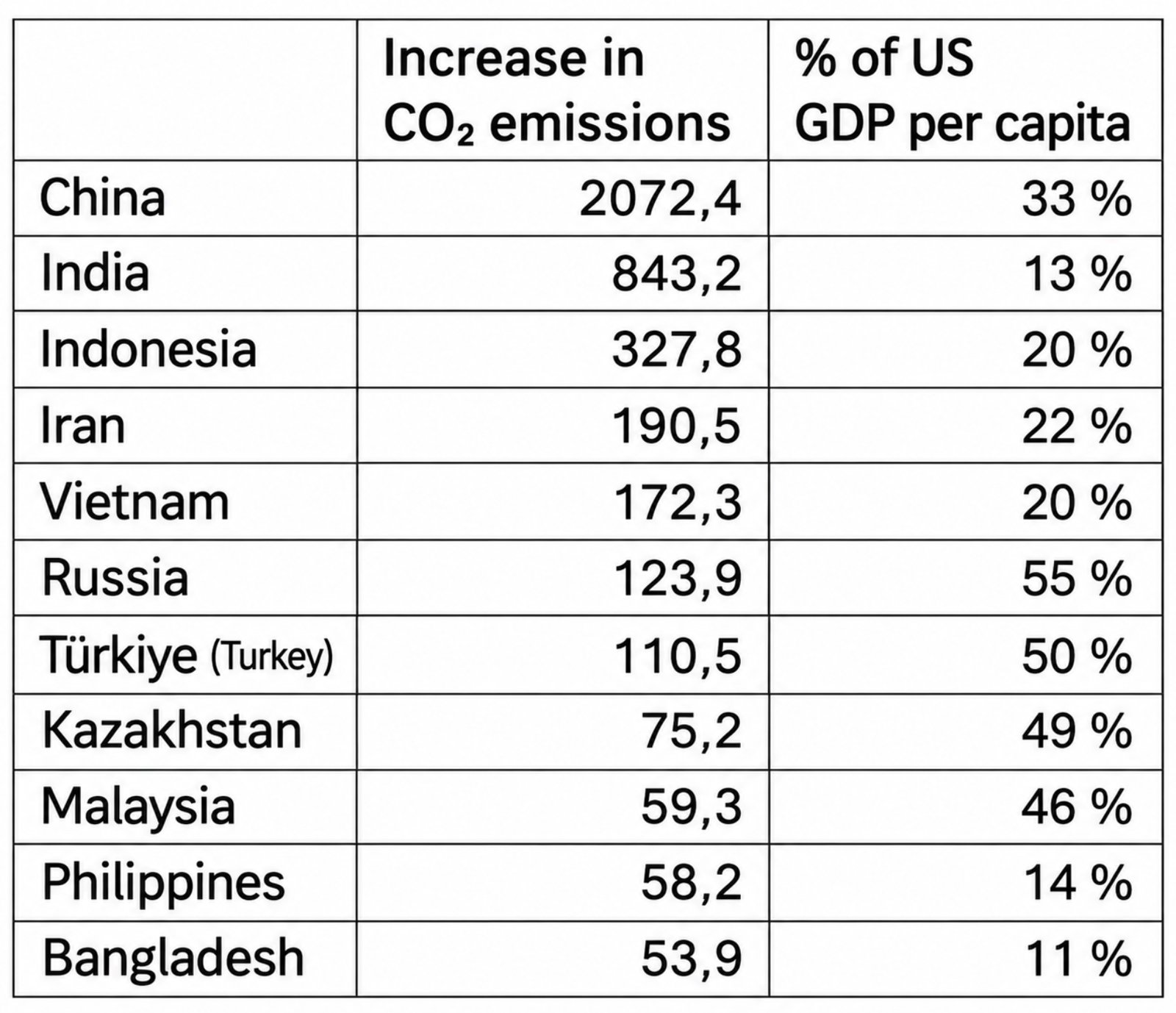
Increase in energy-related CO₂ emissions (million tonnes), 2015–2025, in the 11 countries where they increased the most, together with GDP per capita as a percentage of that of the US, measured at purchasing power parity (PPP).
Then there is the question of whether carbon dioxide emissions pose any threat at all to the global climate. This is highly uncertain, and although uncertainty in itself is an argument for insuring against adverse outcomes, it is highly doubtful whether the elimination of all man-made carbon dioxide emissions and the consequent dismantling of our industrial civilisation is a reasonable insurance premium to pay. We refer to an article by the climate economist Richard Tol, who a few years ago summarised a number of studies on the costs and benefits of achieving the goal of net-zero carbon dioxide emissions globally by 2050 (Costs and benefits of the Paris climate targets. Climate Change Economics 14(4), special issue on net zero 2050). His conclusion is that the costs are high and relatively certain, whilst the benefits are highly variable and, in some cases, even negative.
‘Clean development’
A relevant issue in connection with the purchase of emission allowances from developing countries is the extent to which this contributes to economic development in these countries. These carbon credits were introduced under the Kyoto Protocol, and the intention – at least the stated one – was that the purchase of carbon credits from developing countries should contribute to ‘clean’ economic development in these countries. The question is to what extent Norway’s and other rich countries’ initiatives to reduce deforestation or replant trees have actually achieved this. It is not uncommon for economic development to have consisted of the cultivation of soya beans or oilpalm oil or cattle farming. What all these have in common is that forests must be felled in order to plant something new that can yield greater economic returns. This is, of course, something that wealthy countries have done in the past. They have cut down their forests to make way for towns, motorways and agriculture. The world’s developing countries are no different in this respect, except that they are at a much later stage in their development. Unfortunately, there is no serious discussion in public publications in Norway regarding these issues – namely, the extent to which forestry cooperation or other climate policy measures funded in developing countries contribute to economic development in those countries or to keeping them trapped in poverty. There is considerable room for improvement in the reports regularly produced on Norwegian climate policy in developing countries, not least in the ‘Green Book’, which is appended to the national budget.
This report from the board of Klimarealistene was published on 24 September 2026. The lead author is Rögnvaldur Hannesson, Professor Emeritus at the Norwegian School of Economics (NHH). The other members of the board are Olav Martin Kvalheim (chair), Ove Huus, Agnar Mikalsen and Dag Hallvard Østtveit.


