



Since Wednesday morning, 3 November, songs of jubilation have been rising to the heavens from the Danish media in joyful ecstasy at the fact that the evil President Trump has now been ousted by the American people. All year long, the press has been basking in the joy of anticipation at the thought that Trump would end his second term as a ‘lame duck’, who, with Parliament against him, cannot continue his illegal war against Iran, the creeping annexation of Greenland and his rapprochement with President Putin.
On 3 November, the desired result finally arrived. The Republicans lost their majority in both houses of Congress as the Democratic electoral wave swept across the country.
When the election result was announced, share prices on the US stock exchanges rose sharply, as if the financial world, too, were celebrating the tyrant’s downfall. However, the euphoria lasted only a day before investors came to their senses and sent share prices plummeting in a historic crash. The Danish media, however, had an explanation ready straight away.
The decline is, of course, down to Trump, who had staked everything on the rapid development and roll-out of AI (artificial intelligence) using energy-intensive data centres – something the Democrats are not keen on, as they prefer to focus on a green transition to solar and wind power. That explanation does not hold water, however. It is true, admittedly, that AI companies took the biggest hits on the stock markets when the brief rally was followed by a free fall to rock bottom. The stock market crash was not limited to so-called technology shares, but affected the entire US stock market across all three indices: the Dow, Standard & Poor’s and the Nasdaq.
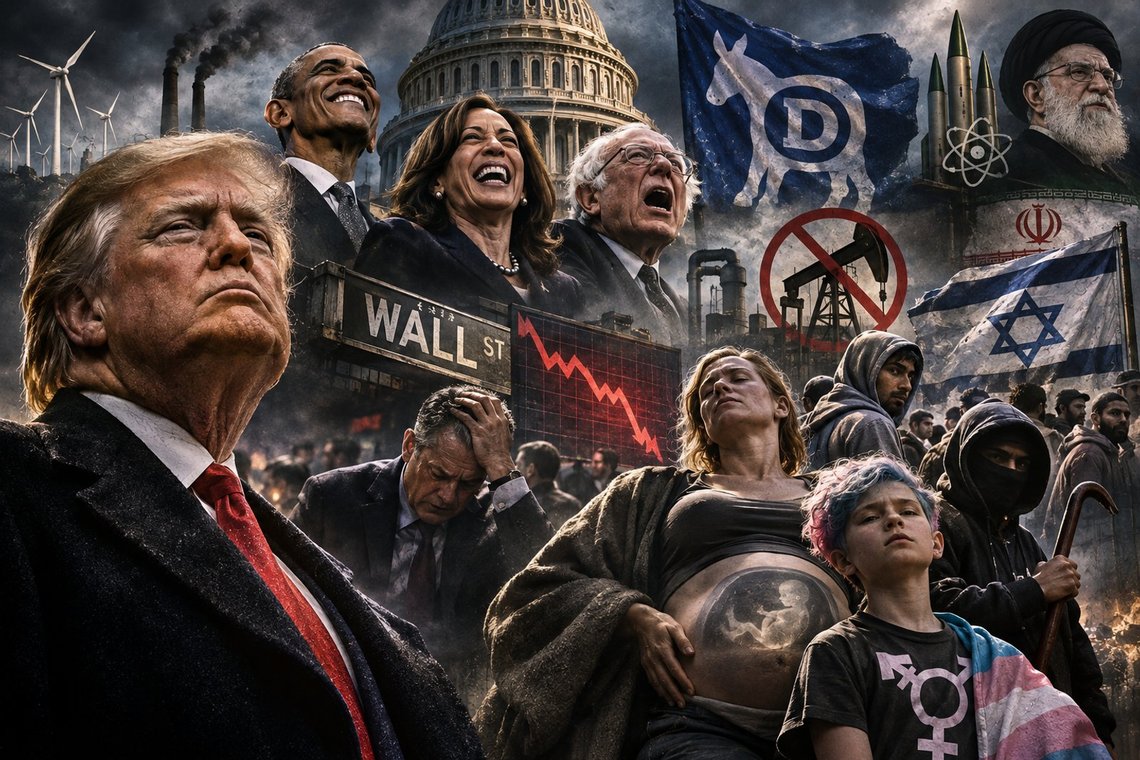
Americans usually have their pension savings invested in shares, and when the stock market crashes, wage earners can lose a large proportion of their savings. Here, the downturn affected virtually all listed shares in the manufacturing, retail and service sectors, from Coca-Cola to Amazon and Walmart. This happened, of course, because the market had to realise that the mid-term elections had let the Obama-Biden genie out of the bottle, and that the future of the US would be governed by a Democratic Party lacking in leadership or reform plans to improve living conditions for the working class. The US is now returning to a society characterised by anti-Semitism, nuclear weapons for Iran, and a cold shoulder towards Israel and Sunni Muslim communities. We are seeing the legalisation of abortion right up until the moment of birth, the phasing out of oil and gas production, sex reassignment surgery on children and the legalisation of illegal immigration. Property crime goes unpunished and is not regarded as a crime, but as a social construct, a result of discrimination, oppression and a lack of inclusion. The stock market crash was thus attributable neither to Trump nor to the IA, but solely to the fact that the stock market had realised what lies in store when the new Congress convenes after the New Year.
Trump as a ‘lame duck’ was triumphantly proclaimed from the rooftops in the Danish media once the Democrats’ landslide victory was a fact. When President Obama suffered a similar landslide defeat in the 2014 mid-term elections, in which the Democrats ended up in a minority in both houses of Congress, not a single word was heard in the Danish press about Obama being a ‘lame duck’. People are different, after all. In Denmark, Barack Obama was hailed as the closest thing we have to the Second Coming of Jesus Christ. A Messiah cannot, of course, be a ‘lame duck’, and in the Danish media Obama was able to continue as a presidential ‘Lykkeper’, above criticism and doubt, worshipped by the entire nation.
We are not going to see President Trump as a ‘lame duck’, any more than Obama was in his last two years as president. ‘As long as I have a phone and a pen, I’m the one who calls the shots,’ said Obama, and he was quite right about that. Admittedly, the Democrat-dominated Congress can make life more difficult for Trump, not least when it comes to appropriations and budgets in the federal economy, but the President has the power to veto legislation across a broad political spectrum, whilst also having the power to issue executive orders bypassing Congress. This therefore applies to foreign policy and defence.
There is no doubt that, over the next two years, Trump will use his remaining powers on projects that will secure his place in history as one of America’s great presidents, in the same league as Roosevelt and Reagan.
He can still achieve this, but it requires him to tackle three major challenges: Trump must combat the Koranic dictatorship in Iran and bring about regime change. This would be a military and political masterpiece that would secure lasting peace and cooperation in the Middle East. Trump must complete the work in Gaza, where the Palestinians are to be guaranteed a safe and peaceful life with a disarmed Hamas and under security guarantees from Israel. Finally, Trump can secure his place in the presidential hall of fame if he succeeds in bringing peace to the war in Ukraine in a way that both Russia and Ukraine can live with.
It will be a tough battle. The victorious Democrats are obsessed with revenge and will make life as difficult as possible for President Trump. They have a long list of legal cases in the pipeline against Trump, his family and several ministers. “Lawyer up!” is the threat from Robert Garcia, the incoming chair of the House Oversight Committee.
It is uncertain whether Trump will succeed in tackling his three fateful tasks over the next two years. One can say a lot about Trump, but however much the Danes may view him as a lame duck, in the time ahead we will see the President as a battle-ready fighter who will fight to the last drop of blood so that future generations will remember him as one of America’s greatest Presidents.


