

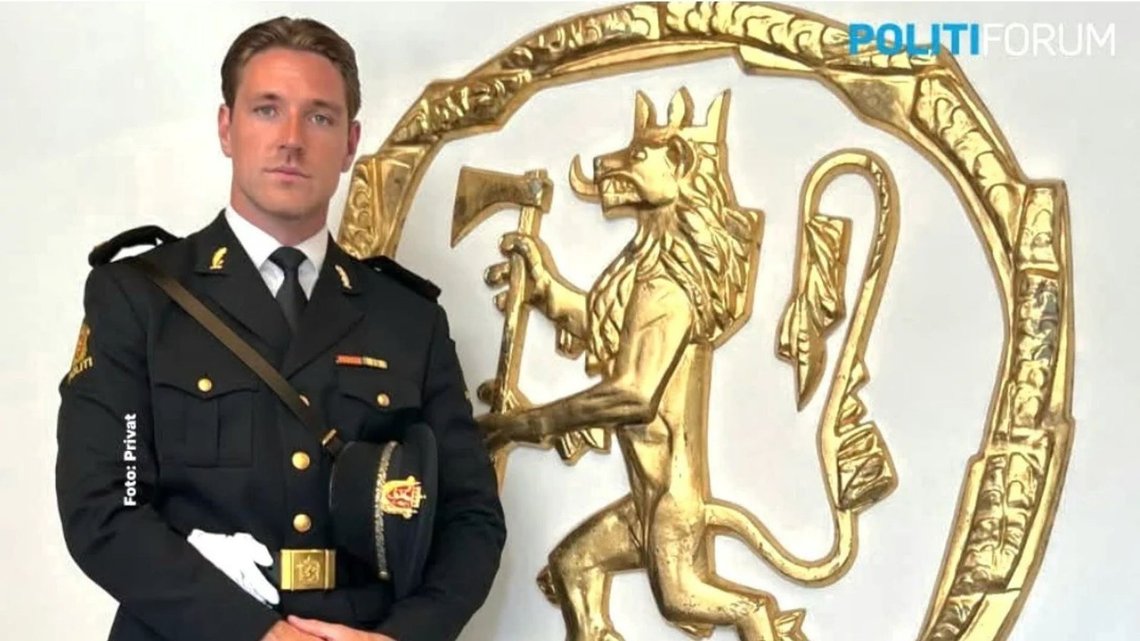


“The issue of the hijab as part of the police uniform has been settled three times. Now they’re trying again, using a cross on a crown as a lever,» writes Daniel Osen in response to criticism from Hamza El Mekki Gartit regarding the cross as a symbol on the police uniform. Gartit, a Muslim, is a police officer and leader of the Sarpsborg Labour Party. Osen works in the Armed Forces.
Hamza El Mekki Gartit raises a pertinent question in his column: How neutral is the police uniform, really? Gartit has spotted a cross at the top of the crown in the emblem and concludes that the uniform ‘is not free of religious symbols’.
Norway is not neutral
That is correct, writes Osen in an opinion piece in Politiforum, pointing out that Norway is not neutral. It is a country built on over a thousand years of Christian history.
Gartit asks rhetorically: ‘If visible Christian symbols in themselves undermine trust, do we not already have a problem?’ The answer is no. We do not have a problem; we have a country. Look at the flag. The cross on the Norwegian flag is inherited from the Dannebrog, which, according to legend, fell from the sky during King Valdemar’s crusade at Lyndanisse in 1219.
When Frederik Meltzer, a native of Bergen, designed our own flag in 1821, his stipulation was that it should consist of a cross in red, white and blue. The state requires all government agencies to fly this cross flag on Liberation Day, 8 May, and on Constitution Day, 17 May. No one is suggesting cutting the cross out of the flag to make 17 May more inclusive. No one is suggesting moving the Christmas and Easter holidays to neutral dates. No one is suggesting tearing down the churches that stand in every single village.
Police and the Armed Forces
Daniel Osen graduated from the Police Academy in 2023. He has served in the Armed Forces for ten years, as a squad leader, second-in-command, acting platoon commander, and has worked in high-performance teams. In addition, he has been deployed abroad on both NATO and UN operations.
He still works in the Armed Forces, but is also a mental coach, and helps elite athletes, coaches and people in demanding roles to strengthen their psychological resilience and performance, according to his own website. Osen is the county leader for the Generations Party, he has written a book on motivation and perseverance, he is a public speaker and is currently working on a PhD in sports psychology at the UK’s Health Sciences University.
The national coat of arms on the uniform
And he has, in fact, taken the time to familiarise himself with a thousand years of Norwegian history and Norwegian values. He links this to the symbols on the Norwegian police uniform:
Let’s look at what the emblem actually depicts. The police badge bears the national coat of arms: a crowned lion holding an axe. According to the government’s own account, it was King Eirik Magnusson who, ‘in 1280 or shortly thereafter’, equipped the lion ‘with the martyr’s axe of St Olav’. The crown above the shield is, according to the royal resolution of 1937, to be ‘a royal crown with the royal orb and cross’. The *Store norske leksikon* explains why: the King wished to be seen as the heir and successor to Olav, ‘Norway’s eternal king’.
The police uniform and Norway’s eternal king
Every single police officer in Norway thus bears on their shoulder a direct reference to the man who fell at Stiklestad in 1030. Gartit sees this as a problem. Personally, I see it as one of the finest aspects of the uniform. It does not say ‘I am a Christian’. It says ‘this is the Norwegian police, and Norway has a history stretching back a thousand years’, writes Osen.
Hamza El Mekki Gartit does not appear to be particularly concerned with Norway’s Christian history and values. He is a Muslim and clearly adopts a Muslim perspective in an opinion piece in Politiforum. There he is referred to as a police officer, but he is also the leader of Sarpsborg Labour Party. Gartit does not reveal much about his background, either in interviews or on social media, but both the name Gartit and El Mekki are most commonly used in Morocco. We do not know whether his roots lie there.
New debate on the hijab in the police force
In the opinion piece, Gartit says he “does not wish to conclude whether the hijab, turban or kippah should be permitted with the police uniform”, but rather to challenge the arguments put forward. “Just how religiously neutral is the Norwegian police uniform, really?” he asks.
“Look at the emblem we wear on our caps and sleeves. At the top of the crown is a cross. Furthermore, the police describe the force’s emblem as Norway’s coat of arms on a shield ‘adorned with Greek crosses’”
writes Gartit in a reply to a post by Terje Bjøranger, an author and former police lawyer at Kripos, who has worked extensively on so-called honour-based violence. Bjøranger concluded that those who consider the hijab more important than their job are excluding themselves. “The hijab in the police force? May that never happen», wrote Bjøranger in her post in response to a post by Imama Akram, Mona Lajili and Mads Andenæs, who believed it was time for the hijab to be introduced in the Norwegian police force.
This is probably also implied in the post by Hamza El Mekki Gartit. Although he insists he is not taking a stance, the examples and premises he uses perhaps suggest the opposite.
Daniel Osen, at any rate, believes that his opinion piece was based on a premise that does not hold water.
A Christian country, according to the Constitution
Gartit writes that ‘Norway is, in principle, a secular state’. That is not true. Article 2 of the Constitution states that ‘Our values are rooted in our Christian and humanist heritage’, and Article 16 states that the Church of Norway ‘remains Norway’s national church and is supported as such by the state’. This was adopted by a broad majority in the Storting as recently as 2012, when the state and the Church were separated. The Storting thus chose, with full knowledge of the facts, to retain the Christian heritage as the foundation of the state’s values. Anyone who wants a neutral Norway must first amend the Constitution. Until then, the cross in the police emblem is not an oversight, but a faithful representation of what this state is.
Premises and standpoints appear to differ, depending on one’s own perspective and the values on which one bases one’s views.
Difficult to identify with Norwegians?
“But what about trust in the other direction? Can’t a police force that visibly reflects the diversity of the population also strengthen trust? For some, surely it means encountering a police officer they can relate to?” asks Gartit.
As if certain immigrants cannot be expected to identify with Norwegians?
Whilst Daniel Osen warns against losing what makes Norway Norway:
«In contrast to today’s technology, which is advancing at breakneck speed, we should hold fast to our history so that we do not become history-less,» says Daniel Osen.
He also addresses some myths surrounding the introduction of Christianity in Norway.
The Viking Age and Christianity are not opposites
It is often claimed that the Viking Age and Christianity are opposites, and that the cross was something forced upon free Norwegians. Research suggests the opposite. In the standard work *Christianisation and the Rise of Christian Monarchy*, Sverre Bagge and Sæbjørg Walaker Nordeide describe the Christianisation of Norway as a gradual process from around 930 to 1030, completed between 1050 and 1100.
In *The Viking Age as a Period of Religious Transformation*, Nordeide traces the transition from Norse to Christian rituals throughout the Viking Age, burial mound by burial mound. And the Yale historian Anders Winroth demonstrates in his award-winning *The Conversion of Scandinavia* that the Scandinavians were not conquered into Christianity. The chieftains chose it themselves, because it served their political, economic and cultural interests. The Vikings were not victims of the cross; they adopted it, writes Osen.
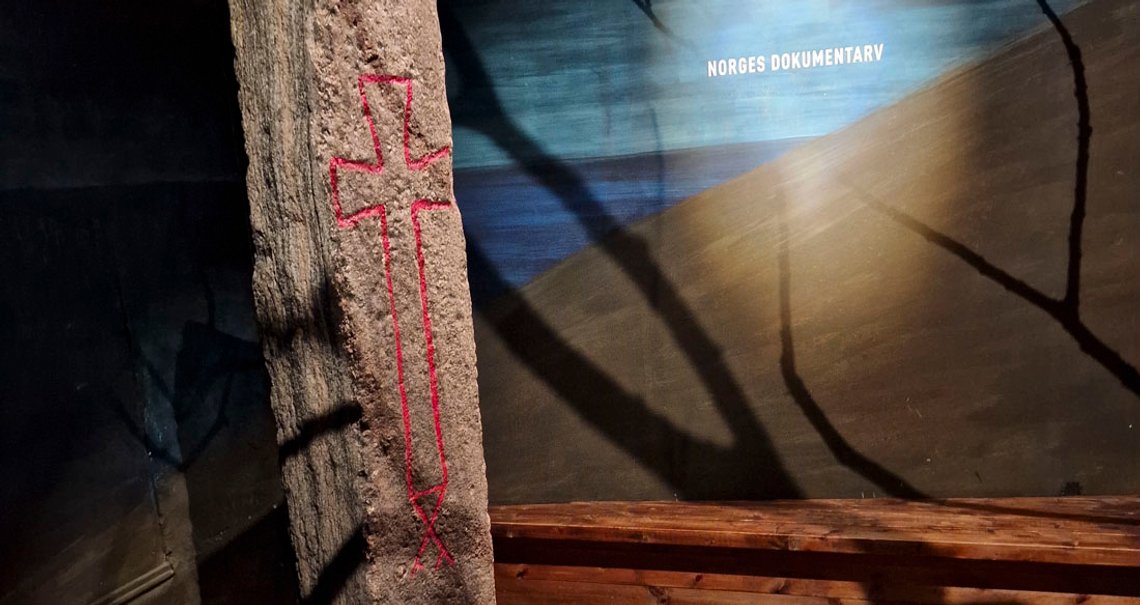
The runic inscription on Kulisteinen, which dates from the early 11th century, is referred to as Norway’s ‘baptismal certificate’, as this is the first known instance of the name ‘Norway’ being used on Norwegian soil. Kulisteinen was erected on the island of Kuløy, between Edøy and Smøla, in the archipelago off Kristiansund in Nordmøre. It is a 1.90 m tall, slender, four-sided runestone with a carved cross on one side and a runic inscription in two vertical lines on one of its narrow sides. Each line begins with a small cross. Tore and Halvard erected this stone after ***… after ***…
For twelve winters, Christianity had improved matters in Norway… The stone came to the DKNVS Antiquities Collection (NTNU Science Museum) in 1913 and was placed in the garden. It was not until 1956 that the runes were discovered. The original Kulistein could be seen in the museum’s medieval exhibition, but the exhibition has since been taken down. A replica has been erected on Smøla. Photo: Bente Haarstad.
A Viking lion and a cross carved from the same piece of wood
The clearest evidence stands on Smøla. The Kulisteinen stone, erected by two Viking-era men, bears a cross and the inscription stating that ‘Christianity had been in Norway for twelve winters’. This is the first known reference to the name ‘Norway’, and in 2012 the stone was included on UNESCO’s Norwegian Documentary Heritage List. Our country was, quite literally, named in the same sentence as Christianity.
Osen points out that Viking-era animal ornamentation was not thrown onto the bonfire when Kvitekrist arrived. It was carved into the church walls.
Not least at Urnes Stave Church, which is a UNESCO World Heritage Site.


