

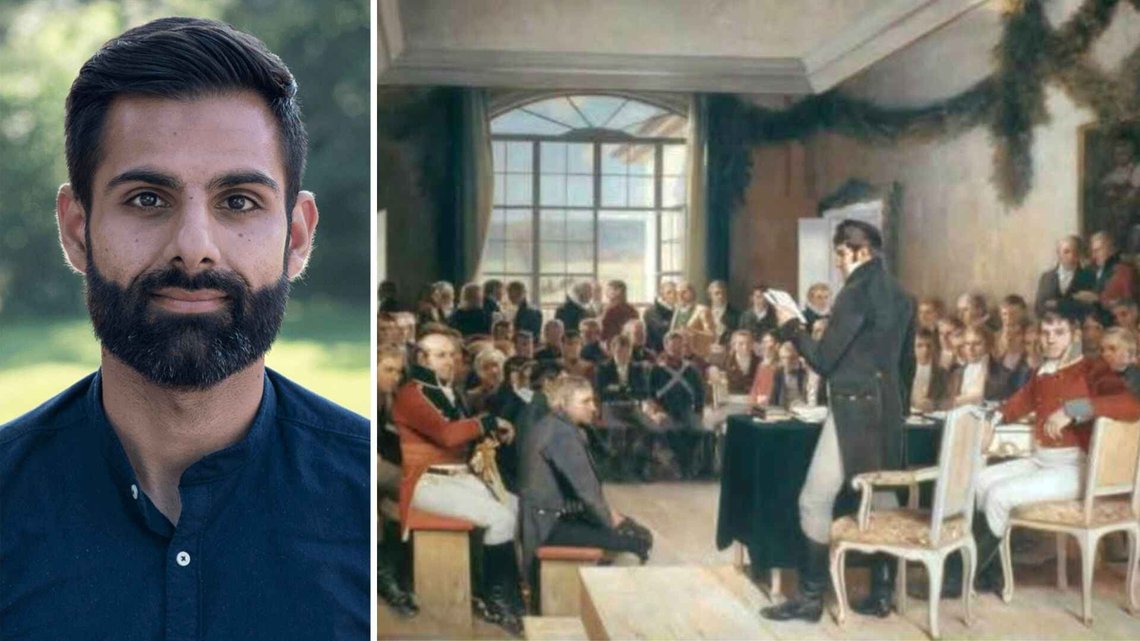
Zamran Ahmad Butt from the mosque Islamic Cultural Centre is to speak at Christian Magnus Falsen’s grave on 17 May in Oslo. Falsen is regarded as the father of the Constitution at Eidsvoll in 1814. Butt, for his part, has claimed that “every third Norwegian shares Breivik’s Islamophobic body of thought”. He was also recently the keynote speaker at an event against Islamophobia, in collaboration with Islamic Relief, which is banned in several countries. Asle Toje was cancelled by the same 17 May committee.
Researcher, author and deputy chair of the Nobel Committee, Asle Toje, was cancelled as a 17 May speaker in Oslo, because he is allegedly too preoccupied with the Norwegian nation. So in come as many as several speakers on Norway’s National Day who seem more preoccupied with other nations and cultures than the Norwegian one. For example Rabia Musavi, with a background in Pakistan and Afghanistan. She is to speak at the grave of the resistance men Viggo Hansteen and Rolf Wickstrøm. Nasrin Naimy from Afghanistan is to speak at Gina Krog’s grave. President of the Storting Masud Gharahkhani from Iran is to have two wreath-laying ceremonies. First at the National Monument for the Victims of the War 1940–45 at Akershus Fortress, and then at King Haakon VII’s statue in 7 June Square. He often keeps to a Norwegian focus. Zamran Ahmad Butt, with roots from Pakistan and active in the mosque milieu, is to lay a wreath and give a speech at Christian Magnus Falsen’s grave at Gamlebyen Gravlund in Oslo. To mention some of the programme.
Falsen is regarded as the father of the Constitution
Christian Magnus Falsen was a jurist and the leading representative at the Riksforsamlingen (Constituent Assembly) at Eidsvoll in April and May 1814. He chaired the Riksforsamlingen’s constitution committee and later received the honorary designation “the father of the Constitution”. Together with Johan Adler, Falsen drafted a constitutional proposal which eventually became the Norwegian Constitution adopted on 17 May 1814. Falsen was so important in this process that it is he whom we see as the main figure in the well-known painting hanging in the Storting chamber, that is, “Eidsvold 1814”.
Active in the mosques
The honour of paying tribute to this father of the Constitution on National Day in 2026 thus goes to Zamran Ahmad Butt. He sits on the board of the mosque Islamic Cultural Centre Norway (ICC), is a deputy member of the board of the mosques’ umbrella organisation Muslimsk Dialognettverk, and a board member of Alkhidmat Europe, the Norwegian branch of a Pakistani aid organisation that assists Muslims both here and there in the world. Not least, he is very preoccupied with “Islamophobia”, a term which, among others, the researcher Gilles Kepel links to the Muslim Brotherhood, an Islamist organisation that seeks to create a caliphate governed by Islamic law (sharia), where the term “Islamophobia” is regarded as a means of limiting or stopping all criticism of Islam.
Preoccupied with Islamophobia
That, at any rate, was what Vebjørn Selbekk concluded when in 2017 he responded to a call to create a Norwegian action plan against Islamophobia, launched precisely by Zamran Ahmad Butt, who was then leader of the youth organisation of the ICC mosque.
“Attacks on Muslims and vandalism against mosques in Europe and the USA have escalated violently since 2010. According to research, this has affected Muslims’ mental health, and many are generally concerned for their safety”, Butt wrote in VG.
Selbekk was, of course, agreed that hatred and violence must be combated, but believed that this is not done by pathologising the critics of a powerful world religion:
“The numerous terrorist attacks that have been carried out in the first half of this year alone have shown that no target is too soft and no method too cruel when jihad is to be waged for the caliphate, the Koran and the prophet’s honour. The low point was probably reached in Manchester at the end of May, when the suicide terrorist Salman Abdi selected a concert venue full of children and young people in order to spread death and destruction in Allah’s name. The increasing scepticism towards Islam in Europe therefore has nothing to do with phobia. It is a highly understandable reaction to the atrocities committed in the name of that religion”, Selbekk wrote in his reply to Butt.
A few months later that same year, Butt had his claim that “every third Norwegian shares Breivik’s Islamophobic body of thought” printed in Aftenposten. We do not know whether he thinks the same about Norwegians now.
Butt had his Islamophobia wish fulfilled
Nine years later, Zamran Ahmad Butt has had his wish fulfilled. The Labour Party has given Butt and religious Muslims an action plan against Islamophobia, that is: They call it an action plan against hostility towards Muslims, and it applies until the millennial anniversary of the Christianisation of Norway in 2030.
He otherwise participates in meetings on Islamophobia and also right-wing extremism, for example arranged by Islamsk Råd Norge, and he recently marked the UN’s day against Islamophobia, together with the highly controversial Islamic Relief. Document has recently discussed the organisation, including in articles about the imam from Islam Net who is employed at the Norwegian School of Theology, Religion and Society, and who collaborates with Islamic Relief.
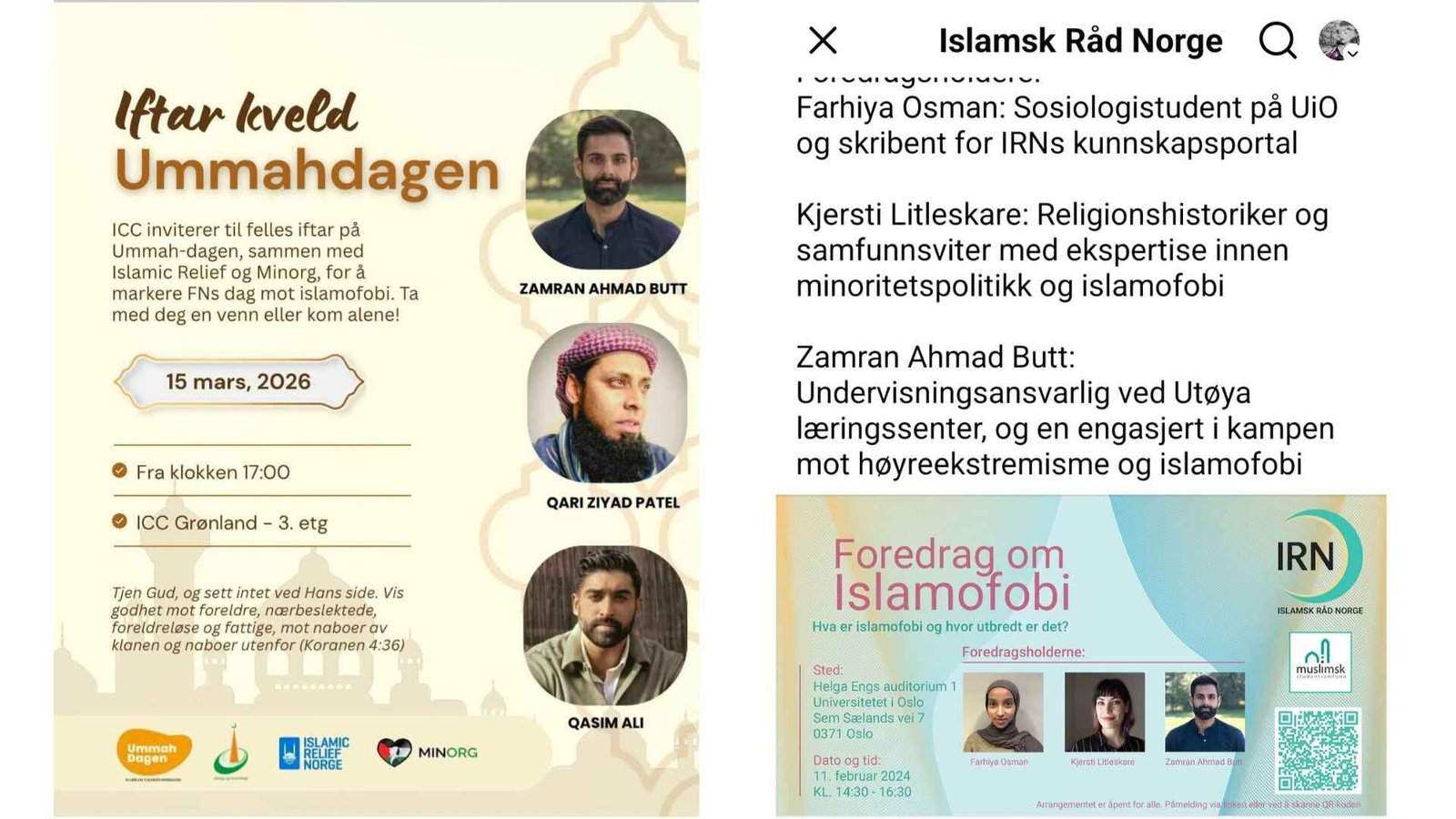 17 May speaker Zamran Ahmad Butt participates in an event organised by, among others, the controversial Islamic Relief, and he is hunting for both Islamophobia and right-wing extremism. Photo: Social media.
Zamran Ahmad Butt is otherwise acting head of Demokrativerkstedet at Utøya, where he trains Norwegian youth in democracy. Certainly with great emphasis on Islamophobia there as well.
The programme for 17 May in Oslo says nothing about what music is performed. In Butt’s case, it is Oslo Janitsjar that plays in connection with the speech and wreath-laying, and orchestral music is perhaps just as well as the national anthem?
Christian constitution and Christian history
Norway’s Constitution was adopted unanimously by the Riksforsamlingen at Eidsvoll on 16 May 1814. The next day, 17 May, the Constitution was dated and signed by the presidency. The men of the Constitution at Eidsvoll were, of course, Christian. They were appointed by the congregations around the country, and they gathered for divine service several times during the period in which they worked on Norway’s Constitution. There it states in § 1 that “The Kingdom of Norway is a free, independent, indivisible and inalienable realm.” And in § 2, the second most important paragraph: “The values remain our Christian and humanist heritage.”
This Christian heritage through a thousand years is also reflected in the Norwegian flag, with its cross, and in our two national anthems. “Gud signe vårt dyre fedreland” (“God bless our dear fatherland”) is one. There we sing, among other things:
Let the People live together as Brothers,
As befits Christians!
And in “Ja, vi elsker”:
Norwegian man in house and cabin,
thank your great God!
The country he wished to protect,
though it looked dark.
All that the fathers have fought,
the mothers have wept,
the Lord has quietly eased
so that we won our right.
There is nothing about Islam, Pakistan or Afghanistan in Norwegian hymns, or in Norwegian history.
All those referred to are welcome to comment if this is relevant.
Karim Tahir from Iraq and Syria is, by the way, as last year, selected by the Labour Party as one of the 17 May speakers in Trondheim, even though he considers Syrian blood to be sacred.
Syrisk taler i Trondheim 17. mai: Syrisk blod er hellig. Hva med norsk?


